
Phil Castle, The Business Times
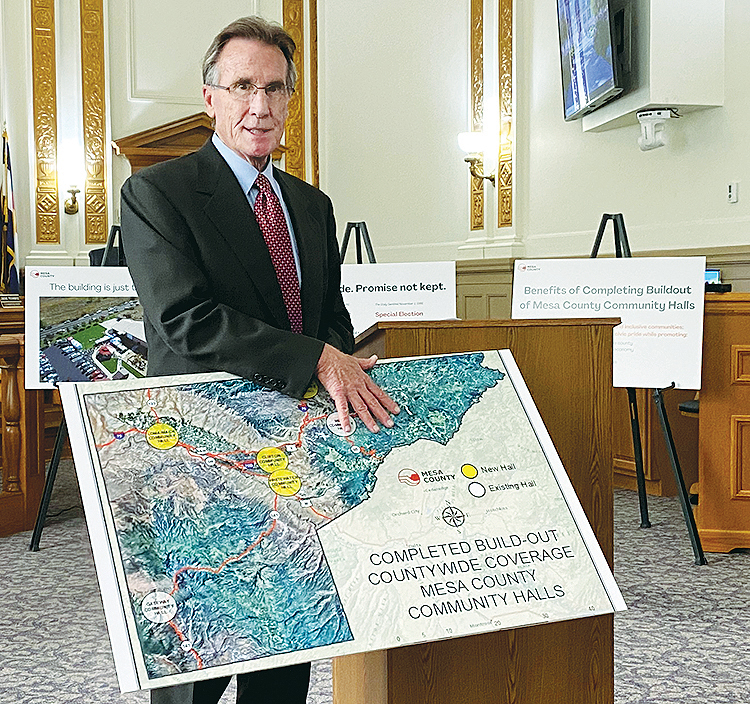
Construction is expected to begin next year on community halls in Clifton and De Beque, the first of four such facilities planned in Mesa County.
The community halls will not only offer venues for classes, meetings and other events, but also fulfill a nearly 40-year-old promise to voters who approved a measure to impose a county sales and use tax.
Mesa County Commissioner Scott McInnis announced the project at a news conference. He said the opening of the new halls will serve as triggering events that lead to additional improvements in Clifton and De Beque as well as in Whitewater and the Loma and Mack area.
The estimated cost for all four halls, including land acquisition, totals $8 million.
Commissioners Cody Davis and Janet Rowland also praised the effort.
“We’re more than happy to support the project,” Davis said.
“It is exciting,” Rowland said “I think it’s exciting for all those communities.”
Mesa County Administrator Pete Baier said the county is in the process of locating and purchasing land and securing utilities and access in Clifton and De Beque. Construction should begin early next year. The same process will follow in Whitewater and the Loma and Mack area.
That process also will include working with residents in those communities to determine what they want to include in community halls.
Nothing is yet decided, but the Mesa Community Center offers a model, McInnis said. That facility includes a gymnasium, industrial kitchen and meeting rooms.
A community center also operates in Gateway.
The new community halls won’t be recreation centers or house permanent events, he said.
The community halls will offer venues for a variety of uses, he said, including fitness and computer classes, health clinics, public meetings and weddings and other special events.
The halls also will help in promoting civic pride and building stronger communities, he said, while serving the portion of the Mesa County population that lives outside more urban areas.
The new halls have been a long time coming, McInnis said.
They were promised prior to an election in 1981 in which voters approved a measure imposing a 2 percent county sales and use tax, half of which is earmarked for capital improvements.
The oil shale bust followed, as did other economic downturns that made it difficult for the county to fulfill that promise. “We weren’t able to do that mission.”
A legal issue involving ownership of the existing Clifton community hall — a situation McInnis dubbed the “Clifton stall” — took years to resolve.
Baier said increased tax collections and other resources are now available that enable Mesa County to do more. “This is an exciting time to be in local governance.”

Build the halls: Project under way to open Mesa County venues added by Phil Castle on
View all posts by Phil Castle →