
Phil Castle, The Business Times
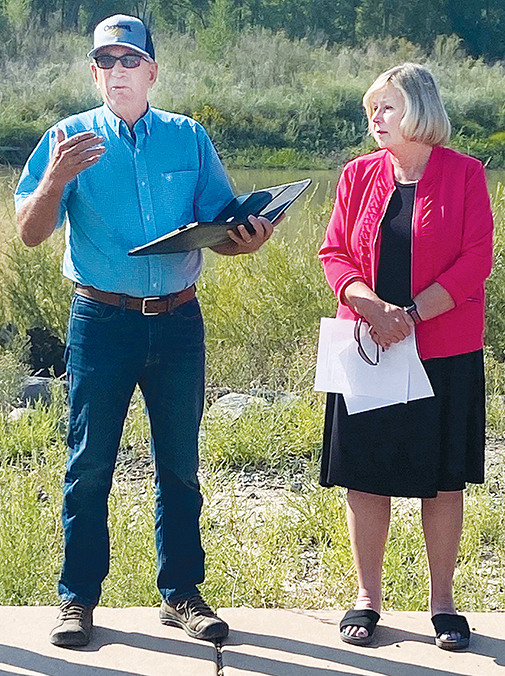
A group of water providers, governments and business organizations have appealed a proposed water quality rule for the Grand Valley they contend is based on insufficient information and neglects longstanding improvement efforts.
“It’s an unfair way to ask the Grand Valley to deal with the problem,” said Mark Harris, general manager of the Grand Valley Water Users Association.
Harris was among the participants at a news conference conducted along the Colorado River to announce the appeal of a water quality rule proposed by the Colorado Department of Public Health and Environment (CDPHE)
The rule would implement what are termed total maximum daily loads for what are considered pollutants to maintain water quality standards. Those pollutants include selenium, recoverable iron and E. coli bacteria. The ruling would apply to washes and other waterways north of the Colorado River in the Grand Valley.
Harris said the appeal was filed with the CDPHE and will prevent the agency from moving forward until the matter is resolved.
Under the best circumstances, the CDPHE will change the ruling and continue to work with what Harris said are willing partners to address water quality issues in the Grand Valley.
Under the worst-case scenario, the ruling would stand and affect the Grand Valley in potentially costly ways, he said.
Diane Schwenke, president and chief executive officer of the Grand Junction Area Chamber of Commerce, agreed. “We see the economic impacts.”
“It’s a bad rule, and we’re going to end up paying for it,” Schwenke said.
Harris said the CDPHE sets minimums for what it deems are pollutants under the federal Clean Water Act.
He said he was disappointed the state agency didn’t accept offers to continue to collaborate with local water users and collect better information on which to base total maximum daily loads.
The proposed rule doesn’t take into account the amount of selenium found naturally in Grand Valley soils that are washed into watersheds when it rains, he said. “This was a total misunderstanding of the plumbing of the Grand Valley.”
Moreover, the rule doesn’t take into account efforts that have occurred in the Grand Valley over decades to reduce naturally occurring salinity and selenium as well as other pollutants in water, Harris said. That includes lining irrigation canals and converting what were open ditches into pressured pipe systems. “Those things have made a difference.”
The Grand Valley Water Users Association continues to line the canals it operates and has converted nearly all of its laterals to piped systems, he said.
Improvements to irrigation infrastructure in the Grand Valley also have helped to reduce the amount of water diverted from the Colorado, he said. That leaves more water in the river to dilute pollutants — an important effort at a time when climate change could reduce water flows.
Rather than fight the rule once it’s implemented, Harris said it was decided to appeal it instead.
In addition to the Grand Valley Water Users Association and Grand Junction Area Chamber of Commerce, organizations joining in the appeal included the Orchard Mesa and Palisade irrigation districts, cities of Grand Junction and Fruita, town of Palisade, Mesa County, Mesa County School District 51, Mack Airport, Housing and Building Association of Colorado, Western Colorado Contractors Association and Associated Members for Growth and Development.
Mesa County Commissioner Cody Davis said the proposed rule is based on poor and missing information. “This lacks basic science.”
Shawna Grieger, executive director of the Western Colorado Contractors Association, said she’s concerned about the potential costs of implementing the rule. Those costs would not only affect contractors, but also would be passed along to businesses and individuals, Grieger said. “This is a very big and important issue.”
Harris said he’s uncertain if it’s even possible to meet the requirements of the proposed rule.
If the rule is implemented, though, it could potentially affect the Grand Valley in varied and profound ways, he said, including everything from farming to urban development.

Groups join in appeal of water quality rule added by Phil Castle on
View all posts by Phil Castle →