
Brandon Leuallen, The Business Times
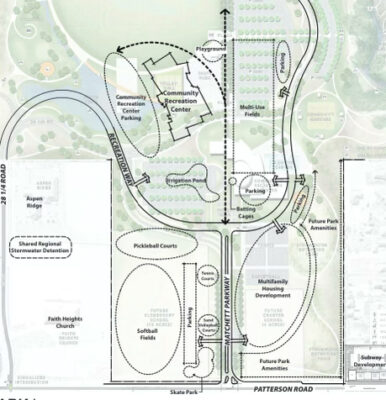
A proposal to develop housing on part of a 14-acre parcel at the front of Matchett Park, directly off Patterson Road, has sparked a range of reactions from local residents, reflecting differing views on affordable housing and whether housing is the proper use for land originally donated for recreation and schools.
The 14 acres originally was donated to School District 51, and the district had identified it as a spot for a future charter school and elementary school.
In 2014, the city developed a master plan for Matchett Park, which included the district’s parcel and two schools. However, in 2016, the district decided not to use the property and sold it to the city, leaving the parcel in limbo. Now, with construction of the new community rec center under way, the city is considering using the land for housing in partnership with the Grand Junction Housing Authority.
Community Perspectives
Community members have voiced support and opposition to the proposed housing units on social media.
Supporters generally praise the idea of increasing subsidized housing for lower-income residents. Opponents, however, argue the city’s involvement in providing housing is outside the government’s role. Others, while supportive of more housing in the city, believe the project conflicts with the intended use of the property and goes against the wishes of the Matchett family, who donated the larger portion of the land to the city for parks and recreation rather than housing.
City’s Objectives
During a Feb. 24 workshop, Parks and Recreation Director Ken Sherbenou, Housing Manager Ashley Chambers and Jody Kole, the CEO of the Grand Junction Housing Authority, presented background on the proposed project. Their recommendation described the initiative as a strategic move to address the city’s affordable-housing shortage while also enhancing park security. It highlighted issues of vandalism and after-hours trespassing at Canyon View Park and argued that adding housing at Matchett Park could provide “eyes on the street,” helping deter illegal activities and safeguard community investments.
The background reads, “In February 2024, a memorandum was submitted to the City Council and later presented at the April 1, 2024, City Council Workshop; staff provided an inventory of City-owned and School District 51-owned land identified for potential affordable and mixed-income housing development to help reduce costs and facilitate affordable housing efforts. Matchett Park was among the sites identified. Following City Council’s direction, the City initiated discussions with the Grand Junction Housing Authority regarding a potential partnership for the site’s development.”
Furthermore, the background says, “In the City’s refreshed and adopted 2024 Housing Strategy, the City continues to look for opportunities to “Leverage City-owned land for affordable and mixed-income housing.” Part of the strategy includes maintaining partnerships with local and regulation affordable housing developers that work to construct and deliver affordable units within the City. Ballot Measure 2b that passed by a vote of the people now allows the city to lease for up to 99 years, lands for affordable and workforce housing.”
Incentives and Costs
The passing of Proposition 123 in Colorado has further influenced the city’s goal to expedite subsidized and restricted units through the planning process. To encourage development in this sector the city has a voucher program that reimburses impact fees for qualifying units. The program requires long-term commitment.
“To qualify for fee waivers, affordable housing units must have an affordability term of 30 years. This term must be enforced through a mechanism such as a recapture agreement, land use restriction, deed restriction, use covenant, or another comparable document commonly used in affordable housing models,” according to the city website.
Developing affordable housing has historically been more expensive than market-rate housing due to stringent regulations and requirements. According to the city’s proposed-linkage-fee presentation from Nov. 19, 2024, the rounded weighted cost per unit from affordable housing the city has already participated in is $388,000 per apartment.
Response from City
The Business Times reached out to the City of Grand Junction about the proposal, and Sherbenou responded: “The City now owning these 14 acres, they are available to meet needs beyond what was planned in the 2014 Matchett Master Plan. This includes allowing for the relocation of amenities that shifted with the final location of the Community Recreation Center (pickleball courts, tennis courts, sand volleyball courts and a skate park).
“Additionally, there is now room for two more full sized multi-use fields (for soccer, lacrosse and football) as well as softball fields, neither of which were envisioned in the 2014 Master Plan.
“The sum total is well beyond what was planned for parks and recreation in the 2014 Matchett Master Plan. Lastly, four acres is contemplated for the affordable housing on the east side of Matchett Parkway. These four acres are too small and not conducive to diamond or rectangular fields, which makes this the best location to meet this need.
“It’s far too early to determine the options of rent, lease, or own. While GJHA has primarily focused on rental housing for households under 60 percent area median income (AMI), new funding sources that are being explored could allow for mixed-income rental opportunities—so AMIs haven’t been set and won’t for some time. Everything depends on funding and site-specific details.”
Sherbenou concluded with: “Before any of the above can be explored, the City first needs to determine if the site is even viable, which starts with a lease or Letter of Intent for a lease allowing the housing authority to conduct environmental reviews, soil studies, and other information. Then, develop design plans based on findings while also determining demographics (those who will be served and AMIs) – then identification of funding sources to fund the project, which also could change the AMIs and demographics again.”

Proposed housing at Matchett Park sparks community discussion added by The Business Times Staff on
View all posts by The Business Times Staff →