
Brandon Leuallen, The Business Times

Homeownership in Mesa County is becoming increasingly out of reach for first-time buyers due to rising material costs, stricter regulations, higher local fees and an inventory struggling to keep up with the area’s growth, largely fueled by an influx of retirees, according to census data.
While no single solution can fix the crisis, the question remains: Are there market-based options on the horizon to make homeownership more attainable? Can new ideas emerge to build homes priced at 100 percent of the area’s median income, often referred to as the “missing middle” housing market?
Emilee Powell, executive director of Housing Resources of Western Colorado, says a home priced around $300,000 is considered affordable for those at 100 percent of the area median income (AMI). However, homes at or below that price point are limited in Mesa County.
According to developer Kevin Bray, building homes above this price point increases supply and creates a “ladder effect” in which buyers move up “the ladder” to higher-priced homes and free up some lower-priced homes for others to enter the market. However, the lack of new homes being built in the “missing middle” leaves first-time homebuyers competing for an increasingly smaller pool overall of available homes in their price range.
Cottage Courts: A Potential Solution
One potential way to address the “missing middle” is through cottage court developments, which consist of small homes typically ranging from 800 to 1,200 square feet, facing each other across a shared sidewalk, without the need for standard-sized lots. A cottage court can be built in pockets of subdivisions or planned communities.
The City of Grand Junction has a Use-Specific Standard (USP) for cottage courts, requiring a minimum project size of half an acre and a maximum of five acres. The maximum footprint per cottage is 1,200 square feet.
While no developers have attempted cottage court-style developments in Grand Junction, Laurel Cole, executive director of Habitat for Humanity, is interested in pursuing this model.
“We have been inundated with calls from people wanting to own a home, asking if we could just build them a small home to purchase,” Cole said.
If Habitat were to pursue a cottage court, the homes would be evaluated and priced at market rate, potentially serving as a benchmark for other developments.
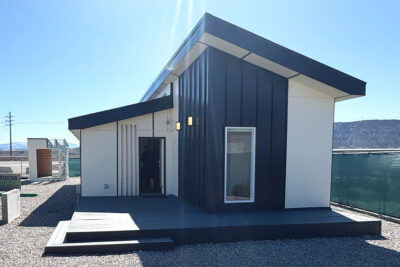
Modular and Tiny Homes
Modular homes have long been considered an affordable housing option. While Grand Junction has a Clayton Homes dealership, there are no modular manufacturers in Mesa County, and no new mobile home parks are planned at this time.
At this year’s Home Builders Association Housing Summit, local builders discussed incorporating modular homes into developments but noted high delivery costs from out of town make them more expensive than traditional stick-built homes.
Mosaic Housing, a large modular manufacturer, purchased land south of Community Hospital to build a factory. Despite plans to begin construction in 2022, Mosaic has yet to break ground. The company focuses on modular multifamily housing rather than single-family homes.
In Mesa County, there are multiple companies that build tiny homes, often purchased as accessory dwelling units (ADUs) for rental purposes. However, no planned tiny-home communities for sale to buyers currently exist in the county.
Eco Dwelling: Affordable, Eco-Friendly Homes
One company pushing the envelope on the Western Slope is Eco Dwelling, based in Rifle. Eco Dwelling is building eco-friendly, two-bedroom homes in Rifle and Parachute, with lots included, priced around $300,000. The homes are framed with recycled metal studs, making them lightweight during construction while ensuring durability.
Site manager Seth Myers says two crew members can have a house ready for electrical and plumbing in less than two days. With pre-cut, labeled holes for plumbing and electrical systems, the process is efficient for workers. The goal is to complete a home in about five weeks.
“A lot of people talk about building affordable homes, but nobody is doing it,” said John Kuersten, longtime Rifle developer and Eco Dwelling investor. “If we don’t do something, our kids and grandkids will never own a home and miss out on building personal wealth through homeownership.”
Eco Dwelling homes are energy-efficient, come with appliances and feature solar hookups for easy installation of solar panels.
Kuersten said Ecodwelling has had challenges with the city of Rifle trying to get the developments up and running, lamenting that although the city of Rifle is making efforts to build subsidized housing, the city has been less responsive to Eco Dwellings efforts to build more attainable market rate for sale homes in the community. He said planning meetings over the projects drew a considerable amount of local residents who supported a development.
Despite these challenges Eco Dwelling is poised to roll out its first homes in Rifle’s Marketplace development on Railroad Avenue, across from City Market, in less than a month.
Homebuyers in Mesa County can set these homes up as primary residences on their own lots as well, even doing some of the work themselves and completing them in a much shorter amount of time.
Eco Dwelling homes are sold as kits, with pre-labeled parts and instructions, enabling quick assembly on site without heavy equipment. Two-bedroom kits can be purchased for about $94,000.
Education, Sweat Equity Can Help First-Time Homebuyers
For first-time homebuyers, education, creativity and planning are essential in today’s market.
Emilee Powell, executive director of Housing Resources of Western Colorado, emphasizes the importance of early education and counseling. She said some buyers come to them after trying to move toward home ownership on their own and having a lack of success.
“We encourage people to come to us early so they are more informed consumers,” she said. “We can put them on the right path and save them a lot of time.”
Housing Resources offers an eight-hour class, available both in person and online, that covers the home-buying process. The in-person class is free, while the online version has a fee. The course covers topics such as homeownership, loan types and the buying process.
In addition, the organization provides free, one-on-one, pre-purchase counseling. This service helps potential buyers assess their credit, budget and income to improve their chances of qualifying for a mortgage.
“Improving their credit score can help them get a better rate,” Powell said.
Clients can attend multiple sessions over time to work on their credit and financial plans.
Housing Resources also assists with understanding credit reports and disputing errors. Powell stressed the importance of reporting rent payments to boost credit scores, a practice that is increasingly recognized by credit bureaus.
In addition to education, sweat equity can help reduce costs for first-time buyers. Some loan products, such as the Freddie Mac HomePossible program, allow buyers to contribute labor for part of their down payment when purchasing homes that need repairs.
When asked about sweat equity, Jack O’Neal of Guild Mortgage said, “Sweat equity can help with concessions and help someone get into a home.”
In the current market buying a smaller home and/or an older home that needs TLC may be the only option for first-time homebuyers who wish to get started in home ownership.
For new construction, builders such as Ron Abelo of Chaparral West work with buyers willing to do some of the labor and have a range of finish options to reduce costs.

Market alternatives for attainable housing added by The Business Times Staff on
View all posts by The Business Times Staff →