

Tim Harty, The Business Times
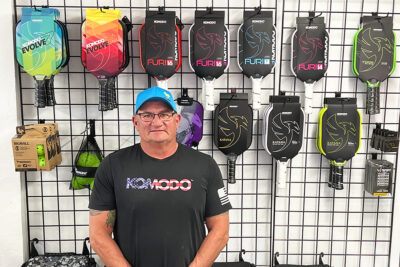
Dave Milo was working out in his home gym one morning about a year and a half ago when the powerfully built owner of Grand Junction-based Komodo Pickleball was overcome with despair.
Komodo Pickleball, a designer, maker and retailer of pickleball paddles and accessories, was about to go bankrupt, and Milo said, “I was down to my last little bit of money, and, I mean, I have everything invested in this.”
A man of Christian faith, Milo said he dropped to the floor and just started crying.
“And I asked the Lord to help me,” he said. “I said, ‘Lord, I’m giving this to you. I cannot do this anymore. I’m mentally, physically, financially, I’m gonna lose everything that I have, and I don’t know what to do.’”
As of that day, Milo figured he had 15 days left of income, 15 days for something to happen, or he would file bankruptcy. Thirteen days passed, then a friend from California, during an event in Denver, introduced Milo to another man of faith, a winner of eight men’s tennis Grand Slam championships: Andre Agassi.
And a new day dawned for Komodo Pickleball.
“On Day 14, I met Andre Agassi, and Andre Agassi came on board and helped lift me to a next level,” Milo said. “And you can look that up, it’s online, Komodo Pickleball, Andre Agassi was a part owner of our company.”
In his office at 1077 22 Road, Milo pointed to a photo of Agassi with Milo and his wife, Jessica, and he said, “He lifted us up to the next level and brought us out of a hole.”
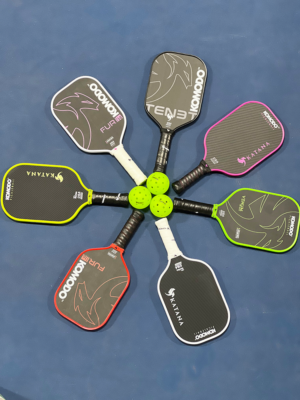
Komodo Pickleball went from the brink of bankruptcy to a burgeoning international pickleball company.
Milo said Agassi moved on to a different pickleball company, Joola, a few months ago.
“He is with the number one paddle company in the world right now, because they’re paying him big bucks,” Milo said.
Milo added they’re still good friends, mentioning during an April 30 interview he had called Agassi the day before to wish him a happy birthday.
There is nothing to be upset about, he said. Milo remains grateful for Agassi and sees their friendship as a gift from God when he needed it most.
“Things in life like that, and in business, it’s truly amazing what can transpire when you release it and give it to God,” Milo said. “And that’s what I did. I mean, I completely said, ‘Take it. ‘”
GROWING INTO GLOBAL COMPANY
Proof that Komodo Pickleball is now thriving comes in numerous forms, such as:
- This week’s Komodo Open, a second-year pickleball tournament that starts May 7 and runs to May 11.
It drew more than 250 participants a year ago, and Milo expects at least as many this year. There will be plenty of players with a Komodo Pickleball paddle in hand on the Lincoln Park pickleball courts.
- As of Jan. 1, according to Milo, Komodo Pickleball made the top 20 of paddle companies – “and there’s about 80 of them,” he said – based on pro-shop sales throughout the tennis and pickleball world.
“The tennis world right now is where a lot of the pro shops are picking up pickleball,” he said. “There’s not a lot of dedicated, just pickleball stores. It’s a lot of racket sports, too, so tennis is the big one. So, in the tennis world right now, out of pro shops, tennis pro shops, we’re ranked 20 right now, which is phenomenal.”
- That Top 20 listing was before Komodo Pickleball launched in 22 countries in March. It’s moving into Australia and New Zealand next, as Milo said on April 30, “Product is on its way there right now. Probably June 1st they physically will be selling product.”
Meanwhile, Milo has a bit of a world tour planned this spring to visit locations where Komodo has or will add manufacturing or distribution. The trip will take him to Spain, Australia, China and Pakistan.
Meanwhile, in Grand Junction there’s plenty of growing to do in other ways, such as investing in more research and development to remain relevant in the competitive pickleball market.
SPEND MONEY TO MAKE MONEY
Becoming a global company means doing a lot more marketing of everything Komodo Pickleball sells.
Milo wishes he’d understood the importance of marketing sooner. He owned oil and gas and construction-based businesses previously, but they weren’t retail-based.
He quickly learned “marketing is a very big key in retail. And I didn’t realize that till this last year, and now I’m having, you know, to really market Komodo. … And now going global, even marketing harder.”
Even with Agassi’s boost to the company, Milo didn’t comprehend how fast the company would grow.
“I mean, we’re going to be doing a series of eight capital raises, just because we’ve moved into that level of … we need millions of dollars,” he said. “My team, we talk about our marketing and what we’re doing, we need to quadruple our marketing right now. We need to be doing not, you know, $20,000 a month in marketing. We need to do 40, 50, 60,000 a month in marketing. And that’s a huge number, so we’re looking at trying to do about a million (dollars) a year in marketing, and we need to bring in a strategic partner or capital raise to do that.”
It’s a little scary and incredibly exciting.
“It’s like you’re sitting on the edge of the volcano right now, and it’s rumbling and smoking, and it’s about ready to explode,” Milo said. “And we’re just right on the cusp of that, and it’s just an amazing feeling.”
STARTED WITH A DIFFERENT SPORT
For Komodo Pickleball to be where it is today required clearing another hurdle, one from the outset, because before there was Komodo Pickleball, there was Komodo Tennis.
In December 2019, Milo’s company started as the latter, a maker of tennis racquets. And pickleball was a vulgar word.
“Several of my tennis buddies started playing pickleball, and I couldn’t stand it,” Milo said. “I didn’t want to even be around it. It was loud. It was obnoxious. It was for old people, you know, and being young – I was 50 at the time – I still was a tennis player.”
But as an entrepreneur, Milo followed his business mind instead of his emotions and took a closer look at the numbers, then changed his mind about which sport’s merchandise he should be peddling.
“I dove into the business side of pickleballing and looking at all the growth and how fast it was growing compared to tennis, which we were in already,” Milo said. “It would have been really stupid not to go into pickleball from a business sense.
“My manufacturers who made tennis equipment, actually made some pickleball paddles. I got some demos. I finally got talked into trying the sport, and I fell in love with it.
“And within a matter of six months, I ended up dumping and killing the tennis side of the business – which, we had tennis rackets we already made and strings and everything like that – to starting to be 100 percent pickleball.”
As important as the paddles are to the company’s success, Milo said it wouldn’t survive on paddles alone.
“You’ve got to have everything that goes along with it,” he said.
So, Komodo also makes and sells pickleballs, bags, and other gear and accessories.
Milo is particularly proud of the BioBall, the world’s first biodegradable pickleball, which Komodo launched in March. He said it lasts longer and performs better than other pickleballs, “and it’s Earth conscience. It goes away within three years, and there’s no microfibers or any microplastics or nothing left over.”
GOING BEYOND RETAIL
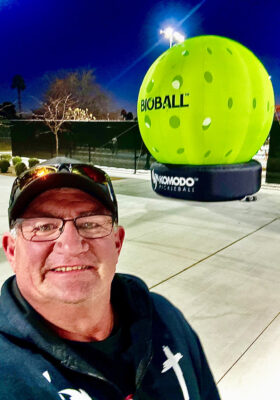
Equipping people with pickleball equipment also means they need places to play, practice and learn the game.
Komodo Pickleball provides lessons and a place to play and practice at 1077 22 Road, where one of the two Quonset huts on the property has two pickleball courts inside.
And those offerings led to the creation of a 501(c)3 nonprofit organization called Little Dragons.
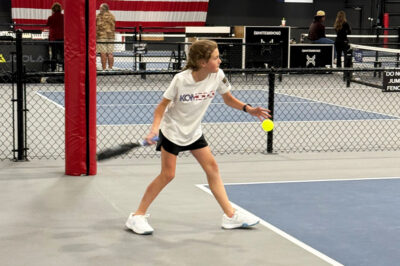
“Now we have a Little Dragons Academy, and we’re teaching kids how to play pickleball, and we’re trying to get kids out of the house and off the computer and off their phones and getting them out with another sport.”
Helping fund that is the Komodo Open pickleball tournament, from which all of the proceeds go to the Little Dragons Academy.
“I own six acres here, so we’re looking at expanding our indoor facility to possibly making six indoor courts, and then we would like to make some outdoor courts as well and make it more of a campus-style facility,” Milo said.
Komodo Pickleball also wants to develop and work with elite players, and Milo has one living in his home, his daughter, Ayree. She’s 11 years old, and Milo said she trains five day per week with Komodo Pickleball’s in-house coaches, and she probably will go pro at age 13.
“What my goal is for the kids is to be able to have a facility down the road to where we can put ADUs (accessory dwelling units) outside, and kids can fly in for camps from all over the country and all over the world,” Milo said. “And I would like to build this model here and then be able to do this in different cities around the country and around the world. Actually my true goal is to be able to offer these in Africa and South America and China and Taiwan, where kids that don’t have a lot of money can get scholarships.”
As the company grows, so does Milo’s vision and altruism.
“Not only on the business side are we trying to grow – we’re trying to do things and get market share – but we’re also trying to give back at the same time,” Milo said. “So, making it a really dynamic business growth and an opportunity to help out, it’s all tied into one thing.”
A CALLING TO DO MORE
There’s an ultimate goal in Komodo Pickleball that Milo believes is his calling. He doesn’t think any of what has transpired since December 2019 was unintended.
There’s a greater cause to serve.
And it starts with the model numbers he and his family select for the paddles Komodo offers.
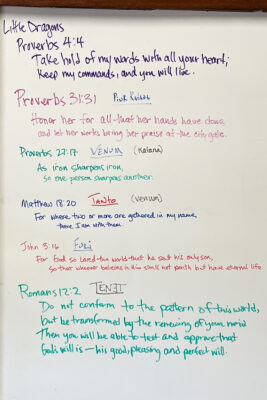
“I’m a very faith-based person. I’m not a Bible thumper, and I don’t push the Lord on people, but every one of my paddles, my model numbers on the paddles are Scripture, and you can see it on the board, every paddle has a Scripture to it,” Milo said.
A pink Katana paddle is PR31:31 is for Proverbs 31:31. A Furi 14 paddle is J3:16 for John 3:16. The soon-to-released Tenet paddle will be ROM12:2 for the Book of Romans 12:2.
At least three of the paddles refer to verses from Proverbs. There’s a mix of Old Testament and New Testament.
“My daughter has named them, I’ve named them, we just have certain verses in the Bible that means something to us and coincide with the name of the paddle that we have,” Milo said.
He added his goal is to help kids, but also to spread the word of the Lord.
“You may not be a believer, but if you play pickleball and you have this in your hand, it’s a form of: The Lord’s blessed it, and you’re gonna be blessed as well,” he said. “And maybe it’ll help you in your life somehow, some way, you know? And so, it just means a lot to me, and it means a lot to my company and my family.
“You know, I went ahead and did it, even though the masses told me, ‘You shouldn’t do that.’ It’s been a really, really great thing, and more and more I’m coming out with speaking that and talking about that, that we are a faith-based company, and the Lord is a huge part of our lives. And we want to make sure everybody else is blessed equally as well.”
WHERE TO FIND THEM
The Komodo Pickleball pro shop is at 1077 22 Road, where it sells paddles, balls, bags and other accessories.
SEE US WHEN YOU’RE REALLY READY
Komodo’s paddles are not cheap – newer models range in price from $130 to $225 and come with a four-pack of BioBalls – and are not for beginners.
“Once a person learns the game, and they actually know how to keep score and they’re physically playing games and having rallies back and forth, that’s when they need to change their paddle and upgrade to an intermediate style paddle,” Komodo owner Dave Milo said.
When a player upgrades from the big-box, cheap-o paddle, Milo said, “They’re gonna feel the ball more. Actually, you can feel the difference with the paddles, the vibration, the spin on the paddle, the way the ball comes off the paddle. There’s a noticeable difference, but to a beginner that’s just getting out there, they’re not going to feel anything of that sort.”
If someone wants to really get into the game, Milo said Komodo has coaches and lessons to help them.
Komodo Pickleball does have its original paddle, the Evolve 7, that a beginner could start with. It retails for $59.
DISPLAYING ADMIRABLE RESTRAINT
Even though they’re about the same age, Milo said 55-year-old men’s tennis legend Andre Agassi was his idol when Milo was growing up.
So, when he was introduced to Agassi at an event in Denver in 2023 and got to have lunch with him, Milo kept his fandom at bay.
“I didn’t get an autograph, I didn’t ask for a selfie, you know, nothing,” Milo said. “And within a week later, I had an autograph, and it was on a contract with him to become partners and be part owner of Komodo Pickleball.
“It was amazing. He had no association before that, but then became a partner.”
GLOBAL BUSINESS NEVER SLEEPS
When you want your company to have designing, manufacturing, distribution and retail on the other side of the world and all points in between, you better get used to one thing: sleepless nights.
“We’re working all hours,” Milo said. “I mean, I started at 1 a.m. this morning. That’s about my time that I get up, because my manufacturers are overseas, and we’re the opposite times of them, so their daytime is our nighttime. So, I work a lot through the middle of the night. I do all my U.S. stuff during the day and all my global stuff at night.”
TOUGH TO MAKE IT HERE
Milo said he would love to bring all of the Komodo paddle manufacturing to the United States, “but I can’t afford it.
“I mean, the price of material and the price of labor overseas is not even a tenth of what I would have to pay. I mean, it’s that much. We’ve looked into it. I’ve got the facilities to put in our own manufacturing, but I can’t hire the help to do that here. It would take a great feat of money to do it, and you would have to charge a lot of money for the paddles.”
Milo said there are probably two or three manufacturers that are making pickleball paddles in the U.S., and it’s expensive. He added some pickleball companies assemble paddles in the U.S., emphasizing the word “assemble,” not “manufacture.”
“They say they’re made here, and they’re not,” Milo said. “It’s just, it’s a really hard market here in the U.S. for manufacturing, because even if I make the paddles here in the U.S., I’ve still got to buy all the materials from overseas, the polypropylenes, the carbon fibers, the Kevlars, the different things. They’re not all manufactured here in the U.S. So, it’s still brought in, some way, some shape.”
SHOULD WE REALLY BUILD THIS TO LAST?
Milo said Komodo’s BioBall lasts 5 times longer than normal pickleballs, which leads to a dilemma: “Is it a smart thing to do in a business sense?”
“You want the turnover on the ball,” he said. “The more balls you sell, the more money you make.
“Or is it: Do you want something that you provide a product that is better for the consumer? And I’ve always been that way.”

A Greater Cause to Serve: Komodo Pickleball became a global company with timely help from tennis legend Andre Agassi added by The Business Times Staff on
View all posts by The Business Times Staff →
One Response to "A Greater Cause to Serve: Komodo Pickleball became a global company with timely help from tennis legend Andre Agassi"