
Tim Harty, The Business Times
Ryan Powell’s workday schedule is full, morning to night, each day as the sole practitioner at Acupuncture Solutions. That’s why he hasn’t been taking referrals since moving his business to 2505 Foresight Circle, Unit D, last month.
So, life’s good, right?
Well, that’s where he’d like to clear up a little misconception that he says a lot of people have about acupuncturists. Powell maintains most acupuncturists in Grand Junction – and there aren’t that many, maybe seven, he guessed – aren’t as busy as he is. Some probably are part-time and work another job to make ends meet.
Or, to put it another way, he said, “I think a lot of people think that I am just getting wealthy and probably have a helicopter and I’m jetsetting to the Virgin Islands on the weekends, and that is not the case at all. It is very marginal.”
Hence, the move from his prior location, which was 800 square feet and had five rooms, to his current location, which is one room, maybe 80 square feet.
Powell said his rent was about to go up, so he got out and now resides in his room inside the office space of chiropractor Dr. John Adams.
“I moved to save on my costs, so I can pass that along to my customers, quite honestly,” he said, adding he charges $115 for a first visit and $90 for a follow-up visit, and that’s for an hour of treatment.
Powell acknowledges he probably should charge more, but in Colorado most people’s insurance won’t cover true acupuncturists who went $145,000 in debt to go to school to be able to practice Chinese medicine. Instead, he said, what gets covered by insurance is a dry-needling session with a chiropractor or physical therapist or some such, who took a two-day class and got a certificate that allows them to do what the state says passes for acupuncture.
To be clear, Powell does not deem those certificate-holders acupuncturists, and the hypocrisy gnaws at him and costs him what would be more lucrative business.
Meanwhile, for Powell to get clients, he needs to charge rates that people are willing to pay out of pocket.
His small room won’t impress anyone, but it is all Powell needs to provide his clients with the benefits of acupuncture. Most of them seek pain relief, and Powell said 90 to 95 percent of them get exactly that from the needles he expertly places on their bodies.
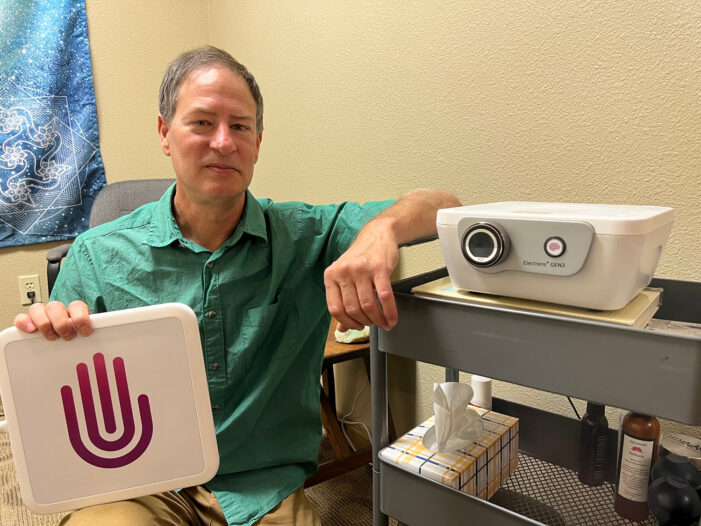
Or from the guided PEMF. That’s Pulsed ElectroMagnetic Field therapy administered by Powell via a machine that he said cost $28,000. He claims there are only 300 of them in the world, and one of them belongs to an acupuncturist in Aspen who charges $385 per hour to administer guided PEMF.
“I literally purchased that and did not raise my rates at all,” Powell said. “I’m providing probably 20 or 25 minutes of the PEMF treatment, and then I’m doing an acupuncture on top of that. And then no, I did not charge anymore for that, which I think is a great thing. I probably should (charge more), to be honest with you, but nobody on the planet right now says, ‘I need some PEMF,’ and so introducing this to people and getting a little buzz around it has been a huge thing.”
Many of his clients get the needles and the PEMF, “so I’m helping people at a much deeper level.”
Powell said he probably has more customers with lower-back pain and hip pain than anything else, but acupuncture can help people in many other ways.
“In addition to musculoskeletal – back, neck, shoulder pain – acupuncture, what I do in particular is extremely good for insomnia, stress and depression, too. I don’t think people think about it for that kind of thing,” he said. “I’d say for stress management and insomnia, acupuncture and PEMF can be very, very supportive.
“And in all fairness, most of us are stressed, and I’m not going to change the rest of your life, but what I can do is help you deal with it better when you get out there. So I may not change the nature of the ocean, but I can make you a stronger ship.”
Powell added one more example of acupuncture’s benefits: fertility.
And he had a perfect anecdote, thanks to his former mother-in-law. Powell said she had endometriosis and was told by doctors, “You’ll never be able to carry a pregnancy.” Yet, Powell said, “She found an acupuncturist in 1972, got treatment for three to six months, and carried my ex-wife.”
His former mother-in-law also was the first to suggest acupuncture as a profession to Powell, who got an environmental science degree from the College of Santa Fe in New Mexico, then learned there wasn’t any demand for people holding such a degree.
He eventually went back to school to become an acupuncturist and has been a practitioner for 19 years. Powell said he moved to Grand Junction in 2016 because the math suggested it was the right thing to do.
“There were 45 or so acupuncturists in Longmont, Colorado,” he said. “That’s about the same size population as the (Grand) Valley, if you count Fruita all the way to Palisade. There were four (in Grand Junction) when I moved here.”
Powell also believes more people are warming to the idea of using Chinese medicine and acupuncture.
“Overall,” he said, “I think that the knowledge of Chinese medicine, I think people are getting to the point to where they realize that surgery and drugs are not the answer to every single thing on the planet.
So, I think there’s a big market for it.”
The problem again is insurance. People want to be able to use their insurance for acupuncture, he said, but that doesn’t get them a trained acupuncturist in Colorado.
He knows when he complains it is to no avail, so he will continue to do what he’s been doing for nearly 10 years in the Grand Valley. And that’s OK. At age 51 he’s forsaken the idea of ever being rich. That was never his goal anyway.
“My joy comes from underpromising and overdelivering. It really is true,” Powell said. “I mean, the vast majority of the people that get to come in here are pretty blown away, and that’s because they feel different.”

Moving the needles: Acupuncture Solutions relocated to a smaller office in Foresight Circle to save on expenses added by The Business Times Staff on
View all posts by The Business Times Staff →