
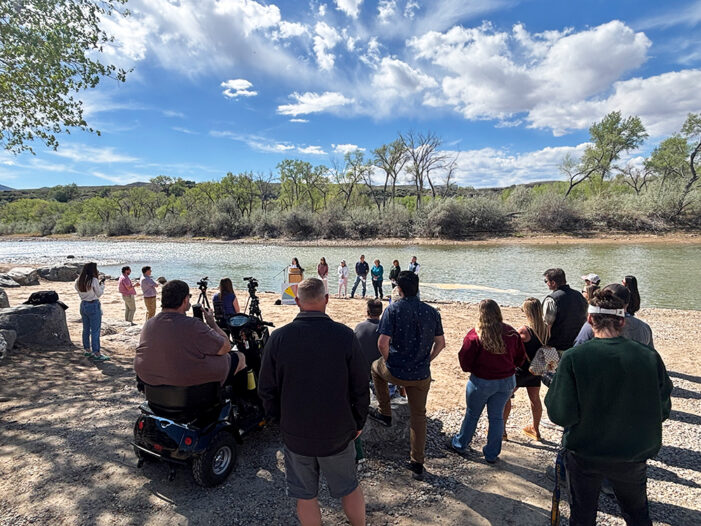
Grand Valley drought conditions worsen as officials warn of limited water supply
Brandon Leuallen, The Business Times
Water officials across Mesa County warned last week that drought conditions are rapidly intensifying, with historically low snowpack, early runoff and continued dry forecasts placing significant pressure on water supplies heading into the summer.
The update, led by regional water providers and the National Weather Service, outlined what officials described as a convergence of multiple extreme conditions not typically seen in a single year.
“This water year has presented a series of challenges: dry conditions heading into winter; record low precipitation and snowpack; unusually early runoff; and record-setting high temperatures,” said Andrea Lopez, external affairs manager for the Ute Water Conservancy District. “Any one of these factors can strain water operations, but experiencing all of them in a single year significantly tightens our system.”
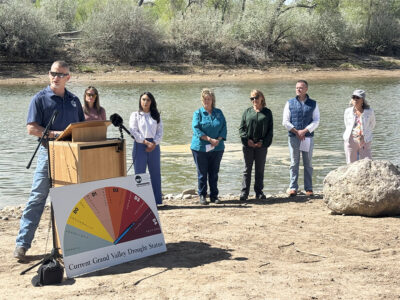
Lopez said 2026 is now on track to be one of the most severe drought years on record for the Grand Valley, following previous major droughts in 1977, 2002, 2012, 2018 and 2021.
“We are here today because of historically low snowpack and declining water levels across Colorado contributing to exceptional drought conditions,” she said.
Data from federal monitoring sites underscores the severity of the situation.
“SNOTEL sites peaked in early March at roughly 40 percent of a 30-year average,” Lopez said.
SNOTEL, or Snow Telemetry, is a federal system that measures how much water is stored in mountain snowpack, a key indicator of how much runoff will be available later in the year.
Snowpack, temperatures, runoff trending toward record lows
Erin Walter, service hydrologist with the National Weather Service, said the combination of record warmth and limited precipitation is driving the current conditions.
“I think the theme for this year is going to be record-breaking low snow and record-warm high temperatures,” Walter said.
March brought a stretch of extreme heat that accelerated snowmelt.
“In March alone, we saw eight consecutive days of record-high temperatures at the Grand Junction Regional Airport,” she said.
At the same time, precipitation levels dropped well below normal.
“We also had a record low rain amount and snow amount recorded at the Grand Junction airport for March,” Walter said.
Typically, snowpack continues building into early April. This year, however, peak accumulation came weeks early.
“We saw that in mid-March, that’s about four to five weeks earlier than normal,” she said.
As a result, runoff projections have dropped sharply.
“Our spring peak runoff is forecast at just 40 percent of average, and that water will move through our systems much sooner than normal,” Walter said.
Looking ahead, forecasts offer little immediate relief.
“The Climate Prediction Center expects this warm and dry trend to persist through June,” she said.
If those conditions continue, water-supply levels could approach historic lows.
“There’s a 10 to 30 percent chance that this water supply via the Colorado River or Gunnison River could drop below those historic lows that we saw in 2002 and in 1977,” Walter said.
There could be an early monsoon season, as Walter said, “Our early snowmelt and warm springs can sometimes trigger an early or stronger monsoon come July.
“With those early monsoons, we can also see quite a bit of lightning. We could see a higher risk for wildfires this summer.”
Local reservoirs stable, but conditions tightening
Randy Kim, utilities director for the City of Grand Junction, said the city’s primary water source, the Kannah Creek watershed, is well below normal.
“Our snowpack across the city’s Kannah Creek watershed was at 41 percent,” Kim said.
Warm temperatures have accelerated runoff timing.
“Runoff in Kannah Creek started on March 26, which is about five to six weeks earlier than normal,” he said.
While that shift raises concerns about how long water supplies will last through the summer, the city entered the season in a strong position.
“At the end of March, our city’s reservoirs were full with approximately 10,000 acre-feet of water stored,” Kim said. “This represents about 1.75 years of water supply.”
Even so, officials are urging residents to begin conserving water early.
“With Grand Junction currently in D3 extreme drought, the city is asking all of our customers to take actions to conserve water,” Kim said.
The city has declared April as Water Conservation Month and continues to offer rebates for water-efficient appliances, turf replacement and smart irrigation systems.
Irrigation districts warn of shortages
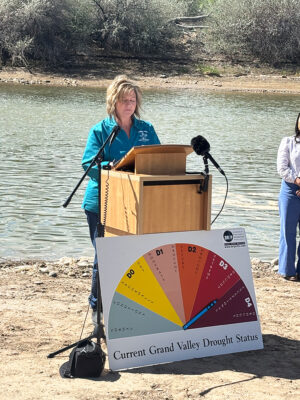
Jackie Fisher of the Orchard Mesa Irrigation District said the situation is especially concerning for agricultural users.
“In places like the Grand Valley, there may simply not be enough water to satisfy all rights,” Fisher said.
She said peak river flows at Cameo have already occurred unusually early.
“The peak runoff resulting in less than 3,000 cubic feet per second flow in the river at Cameo has already happened, which is over a month earlier than normal,” she said.
That shift has implications across the agricultural economy.
“That means less water in storage, tighter operations and difficult decisions for the growers who produce the food and permanent crops our communities depend on,” Fisher said.
Even users with senior water rights are closely monitoring conditions, she said, while junior users are preparing for potential shortages.
Clifton Water: Conservation critical as demand rises
Ty Jones, district manager of the Clifton Water District, said the district relies on the Colorado River as its primary source, supplemented during irrigation season by diversions from the Grand Valley Irrigation Canal.
Jones said warmer weather is already increasing demand as residents begin watering lawns before irrigation systems are fully running.
“With the warmer temperatures, we’ve seen our residential consumption go up significantly already,” he said.
In an interview with The Business Times, Jones went further into detail about what the drought could mean for rates for Clifton domestic-water users.
Jones said domestic water takes priority, and Clifton Water has senior water rights, and that water will continue to flow.
He said it can help if users are careful about how they use water. He said the most effective conservation step is reducing outdoor use.
“If they can hold off on watering the grass and just keep the trees and shrubs alive, minimize that outdoor use is huge,” Jones said. “The grass is pretty resilient.”
He also pointed to evaporative coolers as a major, often overlooked source of water use.
“If evaporative coolers run 24/7, they can use about 3,000 gallons a month,” he said.
Jones gave a few tips to help conserve water indoors as well.
“Shorter showers, don’t run your laundry unless you have a full load, same with the dishwasher,” Jones said. “Don’t let your water run when you’re brushing your teeth.”
Jones said that as the water gets lower, then treatment is more expensive. Jones said Clifton does not currently have rate increases tied to higher treatment costs, but he noted that increased drought rates could become necessary if conditions worsen.
“If we get to a point later in the year where some of the irrigation providers don’t have their full allocation and people turn to domestic to water their grass, at that point that’s probably a trigger for us to implement some drought rates,” he said.
He said May likely will provide a clearer picture of how the season will unfold.
“I think May is going to be a pretty good turning point,” Jones said.
Wildfire risk tied to water supply
Palisade Town Manager Janet Hawkinson said drought conditions also increase wildfire risks that could directly impact water systems.
“If a wildfire was to go through our watershed, it would actually damage our water supply where we might not be able to provide water anymore at all,” Hawkinson said.
She encouraged residents to reduce water use and replace high-water landscaping with drought-tolerant plants.
Ute Water urges early conservation
Greg Williams, general manager of the Ute Water Conservancy District, said the region’s largest provider — it serves about 90,000 residents — is closely monitoring conditions and preparing for potential restrictions.
“Water is a shared, finite resource, and current conditions are placing extreme pressure on both our existing supplies and those we are forecasting for the months ahead,” Williams said.
Ute Water’s primary supplies come from the north side of Grand Mesa and the Plateau Creek drainage, with secondary sources from the Colorado River.
Williams emphasized that 90 to 95 percent of the Grand Valley operates under a dual water system, where irrigation and municipal water are delivered separately.
“We encourage you to check with your irrigation water provider for restrictions on irrigation use,” Williams said.
Ute Water is asking customers not to use treated drinking water for outdoor irrigation and warned that drought rates or restrictions remain a possibility depending on water-supply conditions and customer demand.
Williams also said as the district shifts between available water sources, customers may notice changes such as increased hardness or mineral buildup, though all water will continue to meet state and federal standards.
Ranchers face uncertainty and rising costs
While municipal providers are encouraging conservation, agricultural producers say uncertainty around water availability is already affecting operations.
Joe Kelleghan of Kelleghan Farms said the lack of clarity around restrictions is one of the biggest challenges.
“I think we’re all assuming there are going to be some. It is extremely hard to make decisions and plan when you don’t know what is going to happen,” Kelleghan said of potential irrigation limits.
He and his wife raise cattle and grow hay on about 230 acres near Loma, relying heavily on irrigation.
“This is very much a desert without irrigation,” he said.
Kelleghan said uncertainty is making it difficult to plan for the season.
“The uncertainty of it is probably about as bad as anything, because you’ve got to try to decide what you’re going to do for buying fertilizer, fuel prices are up, and then: Am I going to have enough water to do three cuttings of hay or only two?” he said.
In a typical year, operations can produce two to four cuttings, depending on crop type and conditions. Reduced water flow would slow irrigation cycles and reduce output.
“It’ll take longer if we have a lower volume of water to get across fields than we normally would,” he said. “It just slows everything down.”
That slowdown adds labor and reduces productivity.
“If it takes me five extra days every time I water, all of a sudden you’re talking about 10 extra days over two months,” Kelleghan said.
He said those impacts, combined with dry conditions in the high country, could reduce available feed and drive up hay prices.
“We’re already going to be tight on grass. We’re going to be able to grow less down here, so that’ll drive prices higher,” he said.
At the same time, producers may face difficult decisions about whether to sell hay or keep it to feed livestock.
“You’ve got to decide, am I really going to keep hay at the house and feed the cows, or am I just going to sell the hay,” he said.

Area water officials sound drought alarm added by The Business Times Staff on
View all posts by The Business Times Staff →