
Mesa County now without USDA-inspected meat-processing plant, forcing some ranchers to ship cattle out of county
Brandon Leuallen, The Business Times
Mesa County no longer has a U.S. Department of Agriculture-certified meat processing facility, forcing local ranchers to transport livestock out of the area for federally inspected slaughter.
The shift follows the loss of USDA inspection at Mountain Meats in Fruita, which had been the county’s only federally inspected processing facility. Federal records show inspection activity tied to the Fruita plant in recent years, but that inspection is no longer in place, removing the county’s ability to process meat for retail sale under federal standards.
Without a USDA-inspected facility, producers who want to sell beef by the cut must have their animals processed elsewhere, requiring them to haul cattle out of the county and ship the meat back for sale.
Rules for selling meat
Under federal law, meat must be processed at a USDA-inspected facility to be sold commercially, including direct-to-consumer sales by the cut. That includes meat sold through grocery stores, butcher shops, restaurants, schools, farmers markets, online sales and other retail channels.
Ranchers can sell a whole or partial animal without USDA inspection if the buyer takes ownership before processing and uses the meat for personal consumption, according to the Food Safety and Inspection Service, which states custom-exempt meat cannot be sold. Meat sold by the cut must be processed at a federally inspected facility, according to the Colorado Department of Agriculture.
A new 2026 rule requires meat labeled “Product of USA” to come from animals born, raised, slaughtered and processed in the United States, according to the United States Department of Agriculture.
Ranchers face scheduling, market limits
For local producers, the loss of a nearby facility is creating challenges.
“We now have to go to Homestead in Delta,” said Rachel Schowalter of Rocking U7 Ranch near Collbran. “It makes it harder already. We have to schedule animals out a year in advance to make sure we can have spots.”
“Taking away a whole USDA processing plant puts more of a burden on those couple processing plants. It takes a lot of planning, and we can’t process as frequently as we would like.”
Schowalter said the impact extends beyond logistics to how ranchers reach customers.
“You can’t send it to them by the cut if you’re not USDA,” she said. “People really enjoy getting their meat directly from producers, and that’s going to affect that.”
She said the loss also limits sales to institutional buyers.
“I’ve sold beef to Plateau Valley School District, and we can’t do that if we’re not USDA,” she said. “We can still go to Delta, but it’s a longer drive and just takes a lot more planning.”
Timing has also been disrupted.
“Right about now, we would normally be calling Mountain Meats and taking animals down there,” she said. “We’re not able to, and we can’t get into Delta that quickly.”
Schowalter also said the loss of local processing capacity is adding to an already difficult year for ranchers amid severe drought conditions across Mesa County, where conditions range from extreme to exceptional levels, according to local and federal data.
“Everything just kind of seems to be stacking up at the same time,” Schowalter said, noting drought conditions and rising input costs. “It’s going to be an interesting summer.”
What options do ranchers have?
The closest option is Homestead Natural Meats in Delta.
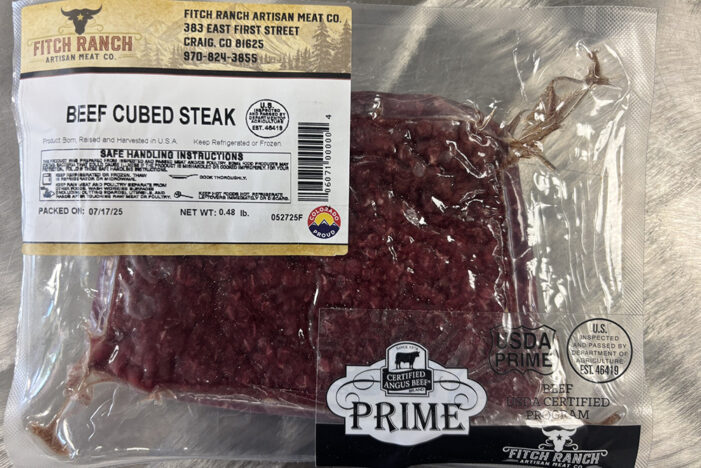
An option that is further away with additional capacity is Fitch Ranch Artisan Meat Co. in Craig.
The Business Times spoke with ranch manager and animal welfare supervisor Luhan Long, who said, “We are getting some of that overflow this way” at a USDA-inspected facility in Craig.
“We’re pretty efficient, and we’re not super far scheduled ahead,” Long said. “With the increased capacity, we can handle quite a bit.”
At Fishers Market in Grand Junction, packaged beef processed by Fitch Ranch Artisan Meat Co. is currently being sold with USDA inspection labeling, showing how those products are already reaching local shelves.
The Business Times also reached out to Homestead Natural Meats for comment, but did not receive a response before deadline for this edition. The article will be updated if a response is received.
What it takes to become USDA inspected
Becoming a USDA-inspected facility is a multi-step process overseen by the Food Safety and Inspection Service, according to USDA guidance on applying for federal inspection. Processors must submit an application, develop food-safety systems, including hazard analysis and sanitation plans, and demonstrate their facility meets federal standards before approval. Once approved, inspectors are assigned to oversee operations, including food-safety compliance and humane handling.
Grants and financial assistance
For smaller or rural processors, cost can be a major barrier. The USDA offers grants and financial-assistance programs aimed at helping facilities expand or achieve federal-inspection status, particularly in underserved areas. Those programs can help offset the cost of facility upgrades, equipment and compliance systems.
Fitch Ranch Artisan Meat Co. received a roughly $7 million federal grant in July 2024 through the USDA’s Meat and Poultry Processing Expansion Program to support construction of a new facility and expand processing capacity under USDA inspection.
Establishing or expanding USDA-inspected facilities takes time, leaving Mesa County producers to navigate limited access and longer transport distances in the near term.

Loss of local inspection capacity added by The Business Times Staff on
View all posts by The Business Times Staff →
One Response to "Loss of local inspection capacity"