
Brandon Leuallen, The Business Times
Grand Junction City Council reached consensus during a workshop discussion that it will not appoint a member of the Urban Trails Committee to the Housing Affordability Code Task Force, then went a step further by agreeing to begin drafting a letter outlining expectations for the committee’s role.
The discussion followed an April 23 letter from the Urban Trails Committee opposing proposed changes to the city’s bicycle-parking requirements. The committee said the Housing Affordability Code Task Force’s recommendations would reduce minimum short- and long-term bicycle parking requirements in Grand Junction Municipal Code 21.08.020. The committee argued secure bicycle storage is important for residents and employees who rely on bicycles for transportation.
The issue stems from ongoing discussions over whether the city should continue requiring long-term bicycle storage in apartment complexes, commercial buildings and other developments as part of Grand Junction’s zoning and development code.
Planning Commission previously debated long-term bike parking requirements
Disagreement over the rule was also on display back in a Jan. 13 Planning Commission hearing regarding proposed amendments to Grand Junction’s bicycle-parking requirements under Section 21.08.020 of the zoning and development code.
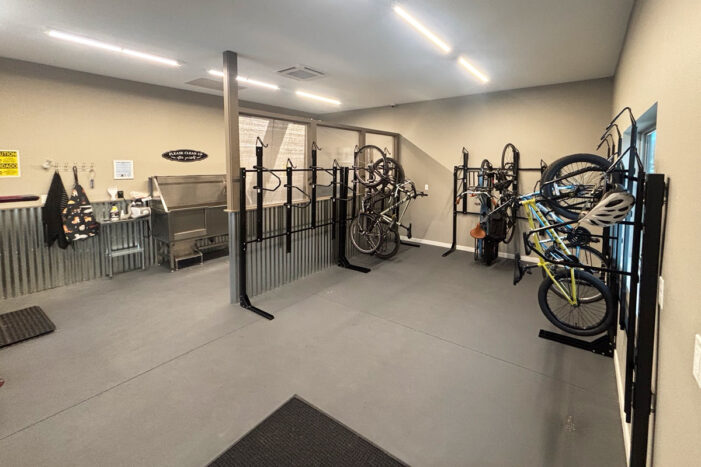
Principal Planner Daniella Acosta Stine told the Planning Commission the Housing Affordability Code Task Force had proposed eliminating all long-term bicycle-parking requirements and removing bicycle-parking requirements for many residential, industrial and nonresidential uses. Long-term bike parking differs from outdoor bike racks that someone can use temporarily outside of a building. These often are inside their own building and secured in a shared space that only the bike owners can access.
“The request would reduce the number of use types subject to the bicycle-parking requirements, and remove certain design and location standards,” Acosta Stine said.
Under the task force proposal:
- Long-term bicycle-parking requirements would be eliminated entirely.
- Short-term bicycle parking would remain only for select uses such as retail, office, recreation, and food and beverage businesses.
City staff opposed the full proposal and instead recommended a compromise that would:
- Retain bicycle-parking requirements.
- Reduce required ratios.
- Simplify standards.
- Remove some prescriptive-design requirements.
Staff argued completely removing the requirements conflicted with the city’s comprehensive plan and multimodal-transportation goals.
Developers describe low usage, added costs
A major focus during the Planning Commission hearing was testimony from developers and engineers who said long-term bicycle-storage requirements are increasing housing costs while seeing little use from tenants.
Civil engineer and Housing Affordability Code Task Force member Mark Austin said developers frequently question why short-term and long-term bike-parking requirements exist.
“Most of the time when I explain to applicants that we have two different types of bicycle parking requirements, they look at me like I’ve got three eyes,” Austin said.
Austin said requiring covered or enclosed bicycle parking creates additional engineering and permitting costs.
“If we put a shelter over the top of whatever this bicycle, long-term bicycle parking is, it now becomes a structure,” Austin said. “It’s got to have a structural stamp for a foundation. It’s got to have a building permit.”
Austin also cited the city’s recreation-center project, saying bicycle-locker units there cost approximately $4,800 each.
Developer John Gargasz, principal of Liberty Apartments and a Housing Affordability Code Task Force member, estimated long-term bicycle-parking requirements would add roughly $56,000 to the 72-unit Liberty Apartments affordable-housing project.
“That’s about $750 a unit,” Gargasz said.
Gargasz described housing affordability as “death by 1,000 cuts,” arguing that many smaller code requirements collectively increase housing costs.
Developers also argued that dedicated bike storage consumes valuable land and building space that could otherwise be used for additional apartments, parking, storage or amenities that tenants are more likely to use.
Several developers testified that tenants with expensive bicycles typically bring them inside their apartments rather than using shared bike-storage areas.
Apartment developers report enclosed bike rooms mostly unused
One of the most detailed examples came from Brian Shiu, director of development for Anthony Properties, which developed The Railyard behind Rimrock Walmart, The Slate on 25 and The Landing on Horizon in Grand Junction.
Shiu said Anthony Properties voluntarily built enclosed bicycle storage at The Railyard because of its proximity to downtown and the Lunch Loops trail system.
“We thought with the emphasis that there is on cycling in Grand Junction, that we should build some enclosed bicycle storage,” he said.
The company built: a fully enclosed bicycle storage building; controlled access; security cameras; and 40 indoor bike spaces.
But Shiu said the facility was largely unused.
“Much to our surprise, they didn’t get used,” he said.
According to Shiu:
- Half the bike racks were later moved to The Slate on 25.
- Only 3 of 20 spaces at The Railyard were reportedly being used.
- Only 3 of 20 spaces at The Slate on 25 were reportedly being used
“We turned the one at The Railyard into a pet washing station,” Shiu said.
When Anthony Properties later developed The Landing on Horizon, Shiu said the company decided not to build enclosed bike storage at all.
“There’s no question that our residents have bicycles,” Shiu said. “But it’s very clear to us that what they’re doing is taking them up into their own units.”
Developer McKenzie Thorn described similar experiences at Struthers Residences and other projects. Thorn said Struthers includes 24 garage-style bicycle-storage units.
“At best we’re 40 percent rented on those,” Thorn said.
Civil engineer Mark Austin also referenced Linden Avenue Apartments and Fruita Mews, saying secure bicycle storage at those developments also saw little use.
Developers argued that long-term bicycle storage should remain voluntary rather than mandated by code requirements, saying apartment complexes and commercial developments could still choose to offer secure bike storage as a competitive amenity if tenant demand increases.
Several developers said the market would naturally incentivize projects to add bike storage if residents wanted and used it, without requiring every project to build the infrastructure upfront.
Planning commissioners divided on future of requirements
Planning commissioners appeared sharply divided over whether long-term bicycle-parking requirements should be eliminated entirely or revised further.
Commissioner Keith Ehlers said the discussion was not simply “pro-bike” or “anti-bike,” but rather a question of who pays for transportation infrastructure and whether the current requirements are functioning effectively.
“We know 100 percent that cost of housing and cost of commercial related to all of these things is going up as a result of that,” Ehlers said.
Other commissioners argued the city risks undermining long-term multimodal-transportation goals if the requirements are removed entirely.
Commissioner Ian Moore speculated that required parking structures that are unused by those currently with bikes could be used in the future as city-wide bike infrastructure increases.
“It takes a while to get the network up to the point where, ‘Oh, my friend bikes to work. Oh, so I might try that,’” Moore said.
Moore argued the larger transportation system must function together.
“The entire route, the entire bike-ped-path plan together has to work,” he said.
Former City of Grand Junction Mobility Planner Henry Brown argued during public comment that transportation costs borne by residents can outweigh the development costs associated with bicycle infrastructure.
“The ability to get by with a single car versus having to finance, fuel, maintain and carry insurance for a second vehicle may amount to over $10,000 per year,” Brown said, citing American Automobile Association estimates.
Brown also challenged some of the cost figures discussed during the meeting, arguing that the estimated costs presented by developers appeared inconsistent.
“We heard initially that it was $4,800 a unit,” Brown said. “That quickly went down six times to $750.”
Austin later responded that Brown had the two separate figures backwards.
Austin said the roughly $700 figure came from earlier code-committee discussions he was involved in about installing shared, secure-bike parking as a requirement when staff had suggested bike parking would not significantly increase costs. And the $4,800 figure reflected actual current pricing from FCI Construction for the new recreation center’s individual bicycle lockers.
“The $4,800 number is the real cost,” Austin said. “That is an actual number from FCI Construction for what these bike lockers cost at the rec center.”
Part of the broader debate centered on whether builders should be required to install secure long-term bike storage speculatively in hopes that future bike usage increases as Grand Junction expands its multimodal infrastructure, even though many bike users currently prefer storing bicycles inside their own units.
Housing Affordability Code Task Force member Mike Foster argued developers would not voluntarily overbuild vehicle-parking spaces that may or may not be needed, because doing so would unnecessarily increase project costs and rents.
Foster argued the same principle should apply to long-term bicycle-parking requirements.
“If you over-vehicle-park a project, then you’re increasing the cost,” Foster said. “If you over-bike-park a project, you’re increasing the cost.”
Foster also argued current residents are effectively being asked to absorb higher housing costs now for transportation infrastructure that advocates hope may become more heavily utilized years into the future as bike connectivity improves.
Planning Commissioner Orynn Zyvan said he was not ready to support removing the long-term bicycle-parking requirements, because, while the commission had heard extensive testimony from apartment developers saying the systems were not being utilized, it had not heard similar testimony from commercial, industrial and other businesses that would also be affected by the code changes.
“One last piece of discussion would be just not heard from the commercial, the business side of this,” Zyvan said. “Like, what does this mean for businesses?”
Ultimately, the Planning Commission deadlocked on competing motions and forwarded the issue to City Council without a formal recommendation.
Council rejects UTC request for seat on housing task force
During the May 5 City Council workshop, council members rejected a request from the Urban Trails Committee to add a UTC representative to the Housing Affordability Code Task Force.
City Manager Mike Bennett said the request came after the UTC saw the reduction in bicycle-parking recommendations continuing to move forward through the task-force process.
Several council members said UTC members could still attend meetings, provide comments or be invited to discussions without formally adding another representative to the task force.
Council member Robert Ballard said adding members from one advisory board onto another could create broader complications.
“I think that’s a really dangerous precedent to set just across all of our boards and commissions,” Ballard said.
Mayor Cody Kennedy also raised concerns about a UTC letter citing U.S. Census data claiming roughly 29 percent of Grand Junction workers do not use a personal vehicle to commute.
Kennedy said the figure combined all non-car commuters together even though the bike-parking debate impacts a much smaller percentage of bicycle commuters.
“It was like that 2 percent disguising itself as 29 percent was my concern,” Kennedy said.
Kennedy said he became concerned after reviewing UTC meeting recordings and hearing comments about “waiting this council out” until future council membership changes.
Council later discussed drafting a “letter of expectation” or a course-correction letter, clarifying the UTC’s advisory role and expectations moving forward.
Interim City Attorney Jeremiah Boise noted the UTC was created by council and could have its bylaws or resolution revised by council if needed.
Councilmember Ben Van Dyke said stronger actions could eventually be considered if tensions continue, including potentially discussing disbanding the committee.

GJ City Council pushes back on Urban Trails Committee after bike parking letter added by The Business Times Staff on
View all posts by The Business Times Staff →
One Response to "GJ City Council pushes back on Urban Trails Committee after bike parking letter"