
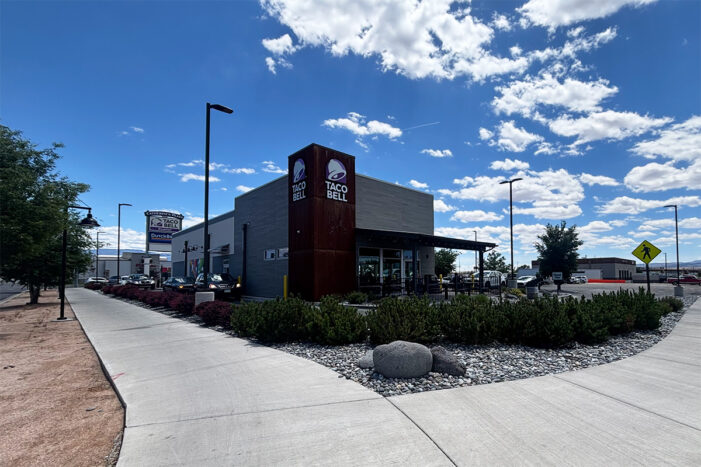
Brandon Leuallen, The Business Times
The Grand Junction City Council voted unanimously on May 20 to loosen zoning rules for drive-through businesses after developers, engineers and commercial real estate representatives argued the city’s existing code made some projects difficult or impossible to build.
The amendment removes portions of the city’s zoning and development code that restricted how drive-through lanes could be designed and located on commercial properties. The changes passed 7-0 after weeks of debate at both the Planning Commission and City Council level.
Drive-throughs remain prohibited in downtown Grand Junction and within the 24 Road corridor overlay district. The amendment only affects areas where drive-through facilities already are allowed under city-zoning regulations.
Rather than outright banning drive-throughs citywide, as some municipalities have done to discourage car dependency and reduce emissions, Grand Junction instead imposed design restrictions that developers said made it difficult or impossible for many vehicle-oriented businesses to build workable drive-through layouts on certain properties.
Developers and engineers argued the restrictions especially impacted national restaurant chains and other businesses whose operations depend heavily on vehicle access and drive-through traffic.
The issue exposed a broader philosophical divide over the city’s development direction, particularly around walkability, urban design and automobile dependence.
While supporters argued the rules had become impractical barriers to economic development, opponents on the Planning Commission warned the city was moving away from long-term goals tied to pedestrian-oriented design and reducing reliance on vehicles.
Grand Junction Planning Manager Thomas Lloyd said city staff received “ongoing feedback” from the development community over roughly the past year regarding challenges created by the regulations.
“We’ve received a lot of talk and feedback just that this is making site design pretty challenging,” Lloyd told City Council, “especially on more challenging lots, lots that have triple frontage or double frontage.”
The amendment removes language requiring drive-through facilities to be “designed and located to avoid impairing pedestrian mobility to or from the principal structure or creating risks to pedestrian safety.”
Lloyd said staff viewed the language as too subjective and difficult to administer, because pedestrian-related standards are already addressed elsewhere in city code through transportation-engineering-design standards, access standards and pedestrian-connection requirements.
The ordinance also removes a rule prohibiting drive-through lanes from being located between the front of a building and the adjacent public right-of-way.
According to staff, developers argued the requirement created major design problems on corner lots, irregularly shaped parcels and sites with multiple street frontages.
Supporters of the amendment also argued the restriction could unintentionally increase pedestrian-conflict points by forcing some businesses to create separate entrance and exit driveways that pedestrians would then have to cross.
Lloyd said the changes are intended to provide more flexibility while still maintaining other pedestrian and urban-design standards elsewhere in city code.
“Building orientation and where it’s located can also be from an urban-form standpoint encouraged in other ways,” Lloyd said.
Questions emerge over how rule got into code
During the Planning Commission debate, commissioners repeatedly questioned how the restriction was added during the city’s major-zoning-code-rewrite process and whether any evidence had ever been presented showing the regulation was necessary.
Planning Commissioner Ian Moore directly asked staff where the existing drive-through language originated and whether it had been based on studies or documented problems.
“I’m trying to figure out what problem we were solving,” Moore said.
Lloyd responded that he did not know the original justification for the provision.
“I was not present here at that time, so I am unsure of kind of the specific reasoning behind it,” Lloyd said. “It maybe seemed like a good idea at the time.”
Planning Commission Chair Sandra Weckerly, who served during the city’s larger zoning-code-rewrite process, said commissioners had never been presented with reports or evidence showing pedestrian incidents in drive-through lanes were a local issue requiring regulation.
“We never did see any reports or backup or reasoning,” Weckerly said.
She said Planning Commission members repeatedly asked city staff over the years whether the city had documented pedestrian injuries in drive-through lanes, and they never were presented with examples.
Planning Commissioner Keith Ehlers said he personally reviewed available traffic-incident information looking for examples of vehicle and pedestrian conflicts in drive-through lanes, and he did not find any documented incidents.
“I could not find any instances of a pedestrian-vehicle conflict within a drive-through lane in the last 10 years within the city of Grand Junction,” Ehlers said during the Planning Commission discussion.
The discussion highlighted broader frustrations among some commissioners and development representatives regarding portions of the city’s major-zoning-code rewrite adopted in 2023 and implemented in early 2024.
Civil engineer Mark Austin later told City Council that members of the original zoning-code committee believed they had agreed on a more flexible drive-through-design concept during the rewrite process.
Austin said the committee had specifically discussed and supported the design of the Taco Bell at 29 Road and North Avenue as an example balancing pedestrian access with practical site design.
“And that’s what we literally thought was going to be adopted with the new code language,” Austin said. “But unfortunately it wasn’t.”
Austin said the language ultimately adopted in the zoning code became far more restrictive than committee members expected, and he said he still did not know how the final language diverged from what the committee believed it had agreed upon.
“We’re here tonight to try to get that fixed,” Austin said.
Debate centers on walkability vs. development flexibility
Throughout the debate, both sides largely agreed there was little evidence presented showing frequent pedestrian injuries occurring in drive-through lanes locally.
Instead, much of the disagreement centered on broader planning philosophy, specifically whether city code should actively push developers toward pedestrian-oriented urban design even when businesses argue those requirements make projects harder to build.
Moore said he was frustrated by the removal of the language entirely, arguing the city was attempting to reduce automobile dependence through its long-term planning policies.
“We’re specifically actually trying to reduce our reliance on vehicles,” Moore said during the Planning Commission discussion.
Moore described the proposal as “death by a thousand cuts” for the city’s pedestrian planning efforts.
“Each little incidence … increases the resistance to take that trip,” he said, referring to walking and biking access around drive-through developments.
Planning Commissioner Orin Zyvan also opposed the proposal, arguing the city had spent years attempting to move toward “more dense urban form, more walkable city centers” and slower traffic design.
Zyvan said removing the restrictions entirely conflicted with portions of the city’s comprehensive plan focused on walkability and multimodal transportation.
Planning Commissioner Ian Thomas supported removing the broader, subjective, pedestrian-safety language but proposed keeping requirements for more direct pedestrian access between buildings and sidewalks.
“I think a small corridor for direct pedestrian access to the front of a building … is more than reasonable,” Thomas said.
Other commissioners argued the code changes simply corrected regulations that had become unnecessarily restrictive.
Planning Commissioner Robert Quintero said government had “created a problem that doesn’t exist.”
Planning Commissioner Gregg Palmer said the amendment was necessary if Grand Junction wanted to remain “welcoming and business friendly.”
Developers argue restrictions hurt investment
Several members of the commercial development community spoke in favor of the amendment during Planning Commission and City Council meetings.
Commercial real estate broker Sid Squirrell with Bray Commercial said the rules made it difficult to develop sites for businesses such as Starbucks and Chick-fil-A.
“These changes are absolutely necessary so that we can continue to do business and that these tenants can continue to have drive-throughs, which is absolutely necessary for their business,” Squirrell told the Planning Commission.
Austin said the current code would have prohibited several existing projects in Grand Junction, including Chick-fil-A and some Taco Bell, Starbucks, Dutch Bros. and McDonald’s locations.
He said many drive-through projects are allowed only one access point under city transportation standards, making it difficult to comply with the existing code while also meeting stacking, circulation and parking requirements.
Commercial real estate agent Kelsey Heath told council a proposed restaurant project at 2658 Tracy Ann Road in Orchard Mesa was terminated earlier this year because of the drive-through requirements.
“The requirement that drive-through lanes cannot be located between the facade of the building and the adjacent public right-of-way makes it impossible … to design and build a properly stacked restaurant drive-through on the property,” Heath said.
Council member Cody Kennedy said he personally heard from developers about projects that no longer were financially viable under the current regulations. Kennedy said the city must balance multiple priorities, but business development, jobs and tax revenue remain important considerations.
Council member Ben Van Dyke said the city received multiple emails from developers and site planners over the past year asking for the regulations to be reconsidered.
“We really need to get behind these businesses and really incentivize development,” Van Dyke said.
Despite the debate at the Planning Commission level, no council members voiced opposition before the ordinance passed unanimously.

City fulfills order for fewer rules on drive-thrus added by The Business Times Staff on
View all posts by The Business Times Staff →