
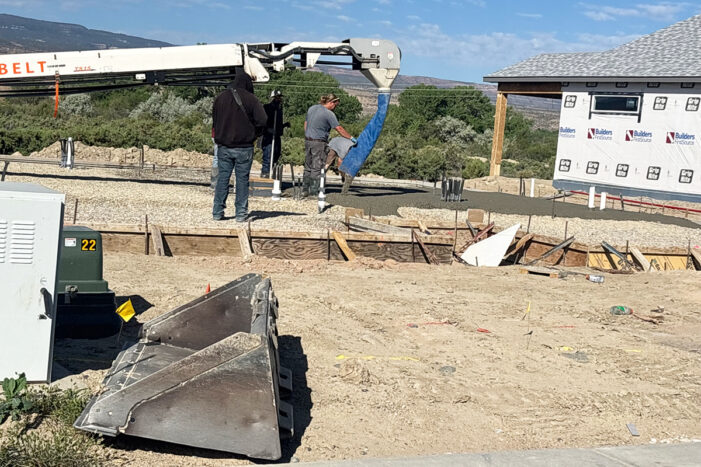
Brandon Leuallen, The Business Times
Grand Junction is beginning to build enough housing to keep pace with population growth, much of it driven by in-migration, according to a draft regional-housing-needs assessment.
But the report presented to the Grand Junction City Council on May 25 says simply matching new growth will not immediately restore affordability, because the region is still working through years of housing undersupply.
The draft assessment found Mesa County needs 1,661 additional “catch-up” units to address existing shortages, including 717 ownership units and 944 rental units. That need is separate from the housing required for projected growth through 2036.
Root Policy Research Managing Director Mollie Fitzpatrick said recent housing production is now keeping pace with projected need by total volume, and in some measures is slightly above the annual “keep-up” need. But she said that does not fully erase the existing supply gap or solve affordability problems at the lower end of the market.
The report says Mesa County’s rental vacancy rate is 3.4 percent, and its owner-vacancy rate is 0.5 percent, both below the state’s undersupply benchmarks of 5 percent for rentals and 2 percent for owner-occupied housing.
The shortage is also not evenly distributed by price. The draft report identifies Grand Junction’s largest rental gap below 30 percent of area median income, or rents around $566 a month. On the ownership side, the largest mismatch is below 100 percent AMI, with homes affordable at roughly $280,000 or less.
Growth driven by migration, aging population, CMU
The assessment shows Mesa County added roughly 7,400 residents between 2019 and 2024, with Grand Junction accounting for most of that growth at roughly 6,000 additional residents.
The report says population growth has been driven by net migration, not births. Natural increase is negative, meaning deaths exceeded births during that time, and that overall trend is expected to continue.
Mesa County also has a higher share of residents age 65 and older than Colorado overall, while Grand Junction has a higher share of residents ages 18 to 24, reflecting the influence of Colorado Mesa University.
Those trends point to a housing market shaped by retirees, relocating households and college students, while younger families face more difficulty staying in the market. The assessment notes Grand Junction has a slightly lower share of people under 18 than the county and state, and Mesa County and Grand Junction saw a decline in households with children.
That comes as Colorado remains one of the more expensive states in the country. A Colorado Chamber of Commerce scorecard cited by The Gazette ranked Colorado as the third-most expensive state in the country in 2025 and 48th for housing affordability.
Starter homes remain tightest part of market
The latest Bray Report shows the strongest demand remains in the lower and middle portions of Mesa County’s ownership market.
In April, homes priced between $300,000 and $399,000 had the lowest inventory level in the report, with 73 sales, 124 active listings and 1.7 months of inventory. Homes priced between $200,000 and $299,000 had 1.8 months of inventory. There are currently no new market-rate homes being built in the $200,000 to $299,000 range locally.
By comparison, higher-priced homes had much more supply. Homes between $500,000 and $749,000 had 4 months of inventory, homes between $750,000 and $999,000 had 4.6 months, homes from $1 million to $1.249 million had 33 months, and homes above $1.25 million had 9.7 months.
The same report showed Mesa County’s April median sales price at $410,500, up 2.6 percent from April 2025, and active listings increased 30.9 percent.
That creates a split market. Buyers looking for homes in the $300,000 to $400,000 range face the most competition, while more expensive homes are moving more slowly.
Incomes have not kept up with home prices
The housing-needs assessment says Mesa County home values remain about 25 percent to 30 percent below the Colorado average, but local prices have continued rising even as statewide values have moderated.
Between 2019 and 2024, the typical home value in Mesa County rose 53 percent, while median income increased 23 percent, according to the draft report.
That gap has changed what median-income households can buy. Fitzpatrick said a median-income household could generally afford a median-priced home in Mesa County for much of the period between 2008 and 2020. Higher interest rates and rising prices have widened the gap since then.
The result is more pressure on renters trying to become homeowners. In the resident survey, nearly half of renters said finding an affordable home to buy would make them feel more secure. Renters also identified help with a down payment and help getting a home loan as major needs.
Trying to reduce barriers to market-rate housing
Several council members emphasized that one of the city’s biggest roles is reducing barriers that slow market-rate housing construction.
Much of that work has already started.
Grand Junction created a Housing Affordability Code Task Force in 2025 specifically to review city regulations, zoning rules and development processes that increase housing costs or slow construction.
The task force was commissioned after builders, developers and housing organizations expressed concern that lengthy approvals, overlapping requirements and development regulations were increasing costs and limiting the amount of housing that could be built.
Recommendations from the task force already are being adopted after moving through the city process, including review by the planning commission and eventual council votes to amend city code.
The city also began working on broader planning and permitting reforms tied to Proposition 123, the statewide affordable-housing initiative approved by Colorado voters in 2022. Under Proposition 123, participating communities must create expedited review procedures for qualifying housing projects. Grand Junction committed to both increasing affordable-housing production and speeding up housing approvals in order to remain eligible for state funding.
As part of that effort, the city used Proposition 123 funding to support planning-capacity improvements and evaluate ways to streamline the development-review process for subsidized and market-rate housing.
The draft housing-needs assessment reinforced many of the same themes raised by the task force and development community. Stakeholders interviewed by Root Policy Research repeatedly pointed to regulatory and process barriers as one of the few local factors the city can directly control.
Fitzpatrick told council that while local governments cannot control national interest rates or construction costs, they can examine what parts of the local approval process may unnecessarily add cost, delay or uncertainty to housing projects.
Zoning density also affects affordable housing
Housing Resources Director Emily Powell told The Business Times in an interview that portions of Grand Junction inside city limits still carry relatively low-density zoning, limiting how many smaller and lower-cost market-rate homes can be built.
Powell said some areas inside city limits still allow only about three to four units per acre, making it difficult to financially support lower-cost market-rate housing such as smaller-lot single-family homes, cottage courts, duplexes, triplexes and other forms of “missing middle” housing.
“You don’t want to be pushing out this kind of leapfrog development,” Powell said. “But they have these pockets that are low density, and they can’t really build anything particularly affordable if you’re at three units an acre, four units an acre.”
Powell said many cities historically used zoning systems based on the concept of “compatible use,” often resulting in lower-density neighborhoods surrounding urban cores.
For comparison, some newer entry-level subdivisions outside Grand Junction are being built at substantially higher densities. In Whitewater, builder Ron Abeloe of Chaparral West Inc. has developed single-family homes in Whitewater Village on lots ranging from roughly 4,100 to 7,000 square feet. Development signage at the project advertises homes “starting at $339,000.”
Powell also highlighted the political and financial risks involved with changing zoning. She said projects that require comprehensive-plan amendments or rezoning applications often face lengthy public processes, uncertainty and neighborhood opposition, all of which increase costs and risks for builders before construction even begins.
State energy codes add construction costs
Builders and housing organizations have raised concerns about Colorado’s newer energy-efficiency requirements, saying they add significant up-front costs to entry-level housing construction.
Powell said builders increasingly struggle to make lower-cost homes financially viable.
She pointed to one local builder currently producing some of the area’s lower-cost new homes in the $400,000 range and said recent state energy-code changes were estimated to add roughly $20,000 to $30,000 per unit in additional costs.
Those added costs become especially significant in the city’s most competitive entry-level market.
Powell said nonprofit and public-sector housing groups cannot build at the scale needed to solve the broader market shortage.
“We will never reach the kind of scale that we need to move the needle for the entire community,” Powell said. “It has to be profitable to build this lower-priced, entry-level housing.”
Subsidized housing in Denver showing higher vacancy rates
Council member Ben Van Dyke asked about reports from Denver that show higher vacancy rates in some subsidized units than market-rate units.
Fitzpatrick said that can happen when income-restricted units are built at price points that still do not match where the deepest need exists.
She pointed to 60 percent AMI units as one example, saying many households with the greatest housing need are below that income level unless vouchers or additional subsidies reduce rents further.
Reports from Denver have shown some higher vacancy rates in units restricted around 80 percent AMI, where rents can approach market prices closely enough that some renters may choose market-rate housing with roommates instead.
Council questions focus on pets, hotels, multifamily housing
Council member Anna Stout asked whether pet-related rental policies are keeping people out of housing, saying many units advertised as pet friendly still have restrictions or costs that make them difficult for renters with animals. She said only a small percentage of units may truly be accessible to renters with pets once fees, breed restrictions and other limitations are considered.
Council member Scott Beilfuss asked how hotel and motel conversions into studio apartments are affecting the market, along with the purchase of several mobile-home parks by one company.
Fitzpatrick said she will look further into the effect of motel conversions and said manufactured-housing communities are generally considered naturally occurring affordable housing, though affordability can be difficult to measure, because residents may own the home while still paying rent for the lot.

New homes outpacing growth, but more needed added by The Business Times Staff on
View all posts by The Business Times Staff →