
Why does Mesa County account for such a large share of Western Slope homelessness?
Brandon Leuallen, The Business Times
As the Grand Junction City Council debated whether to amend city code to strengthen enforcement of the camping ordinance, questions about shelter capacity and the size of the local homeless population took on new importance.
The shelter-capacity discussion is further complicated by the fact the shelter system serves more than just Mesa County residents. Many neighboring communities have either no shelter at all, only seasonal shelter options, or significantly fewer homeless services.
The question of whether Mesa County is carrying a regional burden has also surfaced during Grand Junction City Council discussions. During a Nov. 19, 2025, meeting regarding additional funding for HomewardBound, Council member Anna Stout suggested the city consider structuring its contribution as a matching grant to encourage participation from neighboring communities.
“To the extent that the city can be a leader in getting other jurisdictions to pony up, that might be a good use of our funding,” Stout said.
That leaves several important questions that extend beyond the camping-ordinance debate:
- How much of the demand for shelter beds and homeless services originates within Mesa County?
- To what extent has Mesa County become the region’s default homelessness-services hub, and how much demand comes from neighboring communities that offer few comparable services and no permanent year-round shelter in their own communities?
- How many additional homeless individuals arrive in Mesa County from elsewhere in Colorado or other parts of the country, because it offers a greater concentration of services than some other communities in the country or the region.
Finding answers to those questions is difficult, because there is relatively little publicly available administrative or independently verified data addressing them. Much of the available information comes from self-reported surveys, which provide valuable insight, but rely on respondents’ recollections and statements rather than verified records and are often based on relatively small sample sizes.
The primary publicly available sources are the annual Point-in-Time (PIT) count, which measures homelessness on a single night and tracks factors such as sheltered versus unsheltered homelessness and chronic versus non-chronic homelessness, and a series of Unhoused Needs Assessments conducted by the City of Grand Junction.
While those datasets provide valuable insight into the local homeless population, they also leave many questions unanswered about migration patterns, service utilization and the extent to which Mesa County may be serving a broader regional population.
A relevant outside source examined by The Business Times is a 2017 Guardian investigation titled “Bussed Out: How America Moves Its Homeless.” The project mapped where homeless individuals were reportedly sent. The interactive map appears to show Grand Junction receiving a large number of homeless arrivals through such programs.
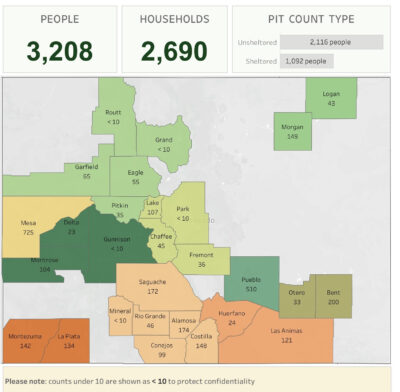
Simply comparing the PIT counts to the total populations of the counties does show one thing clearly: Mesa County has by far the largest homeless population on the Western Slope and accounts for a disproportionately large share of the region’s homeless individuals.
The findings from the Guardian investigation, along with other evidence related to migration and service utilization, are examined in greater detail in this article.
Is housing affordability enough to explain the disparity?
The City of Grand Junction’s unhoused-needs survey identifies housing affordability, rising rents, stagnant incomes and economic hardship as primary drivers of homelessness. Those factors are widely recognized by researchers and service providers and undoubtedly play a role in Mesa County’s homelessness challenges.
However, local-housing-affordability issues alone may not fully explain why Mesa County reports a disproportionately large homeless population compared to neighboring communities.
Many Western Slope counties face housing-affordability challenges that are similar to or even greater than those found in Mesa County. According to Colorado Association of Realtors market data, the median home-sale price in Mesa County was approximately $420,000 in 2025. By comparison, the median home-sale price was approximately $769,000 in Garfield County and $1.83 million in Eagle County.
While incomes are generally higher in those communities, housing costs are dramatically higher as well.
The 2025 Point-in-Time count identified 725 homeless individuals in Mesa County, compared with 104 in Montrose County, 65 in Garfield County, 55 in Eagle County, 35 in Pitkin County and 23 in Delta County.
Combined, those five neighboring counties reported 282 homeless individuals, compared with 725 in Mesa County alone.
According to U.S. Census Bureau population estimates for 2025, Mesa County has approximately 163,000 residents, while Delta, Montrose, Garfield, Eagle and Pitkin counties combined have roughly 211,000 residents. Despite accounting for only about 44 percent of the population in the six-county region, Mesa County accounted for approximately 72 percent of the homeless individuals counted in those counties in 2025.
Also, the decline in homelessness counts across the Western Slope between 2025 and 2026 suggests other factors besides housing affordability are influencing homelessness. During that period, Mesa County’s Point-in-Time count fell from 725 to 613, Montrose County’s from 104 to 72, Garfield County’s from 65 to 43, Eagle County’s from 55 to 25, Pitkin County’s from 35 to 20 and Delta County’s from 23 to 19, all while housing-affordability issues persisted.
Mesa County has more homeless services than surrounding counties
One factor that may contribute to homeless individuals coming to Mesa County from outside the area is the concentration of services available in Grand Junction. HomewardBound of the Grand Valley, which operates the Pathways shelter on 29 Road and previously operated the North Avenue shelter before its closure and consolidation, describes itself on its website as the only year-round, open shelter system in Western Colorado and Eastern Utah. The organization says it serves as the closest emergency shelter option for a 12-county region with a combined population of more than 400,000 people.
In a 2025 interview with The Denver Voice, HomewardBound Board Chair Doug Clayton said the shelter’s reach extends even farther.
“We are the largest homeless shelter between Denver and Salt Lake City,” Clayton said. “We serve clients from 14 counties.”
According to the article, that service area stretches from resort communities such as Aspen and Telluride to rural communities including Delta and Rangely.
Services that assist individuals experiencing homelessness and are located in Grand Junction include the VA Western Colorado Health Care System and Grand Valley Catholic Outreach, which provides meals, showers, laundry facilities, mail services and other assistance to veterans and nonveterans experiencing homelessness. These and other resources are largely unavailable elsewhere in the region.
What do the surveys say?
The Unhoused Needs Assessment report is a survey separate from the Point-in-Time Count, and it states that more than 80 percent of survey respondents reported living in the Grand Junction area before becoming unhoused. By implication, slightly less than 20 percent reported not living in the area before becoming homeless.
For example, if that percentage were applied to Mesa County’s 2025 Point-in-Time count of 725 homeless individuals, it would suggest that approximately slightly less than 145 individuals may not have been living in the Grand Junction area before becoming homeless. That by itself would amount to more than 50 percent of the other above-mentioned counties combined total.
Furthermore, the survey sample was heavily weighted toward chronically homeless individuals.
The distinction may be significant, because, based on a rough calculation using the survey data, nonchronic respondents appeared to be more than twice as likely as chronic respondents to report being bused to Mesa County or coming because of available services. Because the survey sample contained a much smaller share of nonchronically homeless individuals than the overall homeless population identified in the Point-in-Time count, the survey-wide average may understate the prevalence of those factors in the broader homeless population. Additional analysis and information would be needed to determine the extent of that effect.
The Business Times reached out to the City of Grand Junction Housing Department for clarification of the methodology and questions asked to determine a person’s local origins and will report the answers and further information at a later date when a response is received.
The report notes a couple limitations that should be considered when interpreting the survey results:
The assessment relies on self-reported information from voluntary participants, meaning responses could not always be independently verified and may not fully represent the entire unhoused population.
The survey also reflects a sample of respondents rather than a complete census, and some questions required participants to recall past events and circumstances. As a result, the report states that its findings should be viewed as indicators of trends and experiences among survey participants and used alongside other sources of information, including Point-in-Time counts and service-provider data.
Local approach in Delta
Not every community has chosen to open its facilities to the broader region.
In a 2025 public statement, the City of Delta said the Riverbend Resource Center “remains focused on serving individuals and families who reside in Delta and Delta County.” The city also stated Riverbend “was not designed to operate as a regional hub for homelessness services” and that its staffing, facility capacity and funding are aligned with local needs.
According to the statement, “The Center does not have the capacity to absorb demand from outside municipalities.” City officials also noted Delta’s housing, behavioral health, food assistance and shelter resources are already strained by meeting local demand, and the city encouraged individuals to seek assistance within their home communities whenever possible.
Delta City Council member Janet Rowland said local residents initially worried that establishing the center would attract homeless individuals from outside the area.
Riverbend operates as a year-round day center, offering case management, counseling, assistance obtaining identification, employment support and housing assistance. During periods when Delta’s seasonal Abraham Connection shelter is closed, Riverbend also provides overnight shelter beds.
Rowland said Delta’s services are far more limited than those available in Mesa County. Because of those limitations, she said Delta does not tend to retain homeless individuals seeking extensive services.
“They might swing by to see what’s available. They might stay a few days, but they’re not gonna stay long term, because we just don’t have those levels of services,” she said.
What about homeless relocation programs?
Rumors that large cities are dropping off busloads of homeless individuals in Grand Junction have persisted for years. However, The Business Times was unable to identify any publicly documented cases of cities simply transporting large groups of homeless individuals to Grand Junction and leaving them here.
That does not mean transportation programs do not exist. A 2017 Guardian investigation titled “Bussed Out: How America Moves Its Homeless” documented at least 34,240 homeless relocations through transportation-assistance programs between 2011 and 2017. The programs typically provided bus tickets or other travel assistance to individuals seeking to reconnect with family, friends, employment opportunities or support networks in another community.
The Guardian’s interactive map appears to show Grand Junction receiving by far the largest numbers of homeless arrivals through such programs on the Western Slope and even one of the largest in Colorado, potentially ranking behind only Denver and Colorado Springs. However, the map itself does not provide detailed city-by-city totals, and the underlying data is not publicly available in the article.
The Business Times has requested the underlying Colorado data from The Guardian in order to verify the figures, determine the number of arrivals attributed to Grand Junction and better understand how those numbers compare to other Colorado communities.
The Business Times will continue this investigation and follow up as more information becomes available.

Is Mesa County a magnet for homelessness? added by The Business Times Staff on
View all posts by The Business Times Staff →
4 Responses to "Is Mesa County a magnet for homelessness?"