
Brandon Leuallen, The Business Times
The Grand Junction City Council signaled support for a proposed bicycle and pedestrian corridor along Ninth Street during a June 15 workshop. The corridor would connect Colorado Mesa University, downtown Grand Junction and the Las Colonias development while keeping cyclists separated from some of the city’s busiest traffic corridors.
The concept represents a significant departure from a previously proposed active-transportation corridor along Seventh Street that generated substantial opposition from residents, Colorado Mesa University, St. Mary’s Medical Center and historic-preservation advocates. They were concerned about lane reductions, traffic impacts and changes to one of the city’s most recognizable corridors.
City staff said during the council workshop the Ninth Street alignment emerged in a presentation by Colorado Mesa University President John Marshal after those concerns prompted officials to reconsider the original concept.
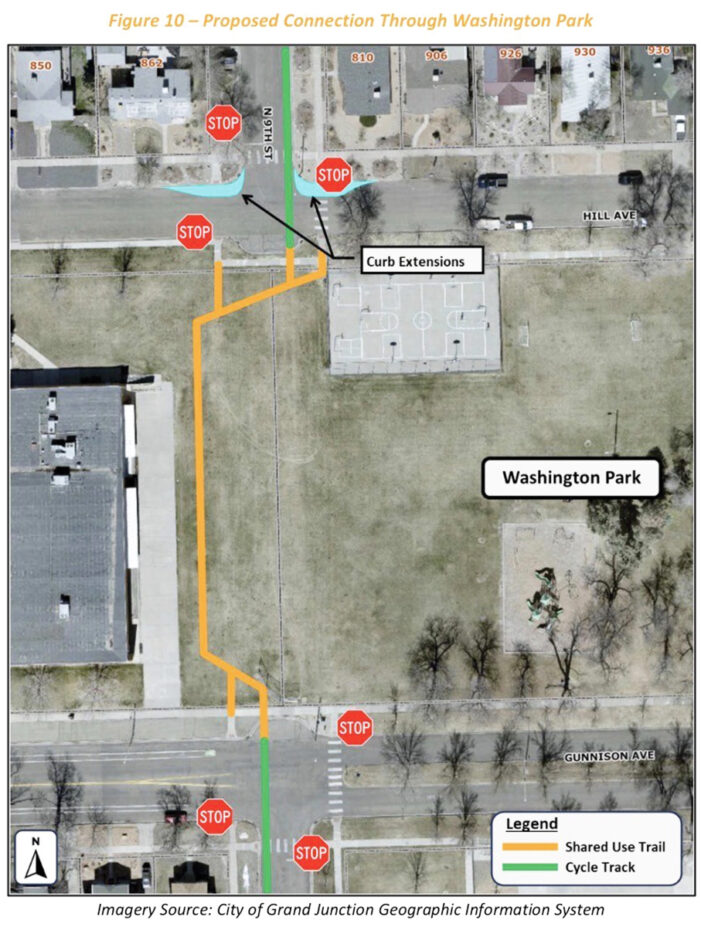
The proposed route would connect CMU, Washington Park, downtown, the Riverfront Trail and Las Colonias through a combination of cycle tracks and multi-use paths. The corridor also aligns with long-term plans by Colorado Mesa University, which is studying moving the North Avenue traffic signal from 10th Street to 9th Street as part of future campus redevelopment.
A major theme of the discussion was asking what makes the Ninth Street proposal different from the original Seventh Street concept and the city’s recent Fourth and Fifth Street projects.
Several council members said one of the biggest advantages is the route would place cyclists and pedestrians on a quieter corridor while separating them from vehicle traffic whenever possible.
Council member Cody Kennedy said the approach is exactly what the city should be pursuing.
“In my opinion, this is what we should be focused on when it comes to multimodal infrastructure,” Kennedy said. “Keeping the bikes, keeping the pedestrians separate from the vehicles.”
Kennedy also mentioned Intermountain Health St. Mary’s Regional Hospital had concerns about a lane reduction causing potential issues for emergency vehicles coming to the emergency room from Seventh Street.
Not every council member viewed the concerns surrounding Seventh Street the same way.
Council member Jason Nguyen pushed back on the argument that bicycle infrastructure on Seventh Street would necessarily interfere with emergency-response vehicles. Nguyen said emergency vehicles could potentially use bicycle lanes or cycle tracks during emergencies, arguing that multimodal improvements and emergency access do not have to be mutually exclusive.
“I just kind of want to push back on that idea that those things have to be in tension,” Nguyen said.
Even so, Nguyen said he generally supports the proposed Ninth Street alignment.
Council member Ben Van Dyke said the quieter character of Ninth Street is one reason he prefers the corridor.
“I know as a father, I would much rather take my kids down a separated pathway without a bunch of vehicles around than try to fight down Seventh Street and hope for the best and try to get out of the way of emergency vehicles,” Van Dyke said.
Council member Anna Stout brought up concerns from residents that moving the plan from Seventh street to Ninth street could increase car traffic on Ninth Street and affect home owners on Ninth.
Grand Junction Transportation Director Trent Prall described Washington Park, about three blocks south of North Avenue, as a “modal filter,” meaning cyclists and pedestrians coming from CMU down Ninth Street can continue through the corridor while vehicle traffic must divert onto surrounding streets.
Kennedy also pointed to the corridor’s ability to connect key destinations throughout the city. Kennedy said the route would provide direct access between CMU, Washington Park, Lincoln Park, the skate park, downtown and the Las Colonias riverfront area.
“I really want people down to the riverfront,” Kennedy said. “Whether people are coming down for concerts or just trying to get down into that trail system.”
No formal vote was taken during the workshop discussion, but staff indicated they plan to return to council with a resolution establishing a preferred alignment moving forward.

Ninth Street gets serious look for bike corridor added by The Business Times Staff on
View all posts by The Business Times Staff →