
Brandon Leuallen, The Business Times
The Mesa County Sheriff’s Office says automated license-plate readers have helped investigators identify suspects, recover stolen property and solve cases, while residents who spoke during an Aug. 18 meeting raised concerns about privacy, the Fourth Amendment and the potential for misuse.
Sheriff’s Office Operations Division Chief Art Smith gave an informational presentation about the technology to the Mesa County commissioners. No vote was taken.
Smith said automated license plate readers, commonly known as ALPRs, are one of several tools the Sheriff’s Office uses to investigate crimes. The agency has used Motorola license-plate-reader technology for about 15 years and began installing Flock cameras about a year ago.
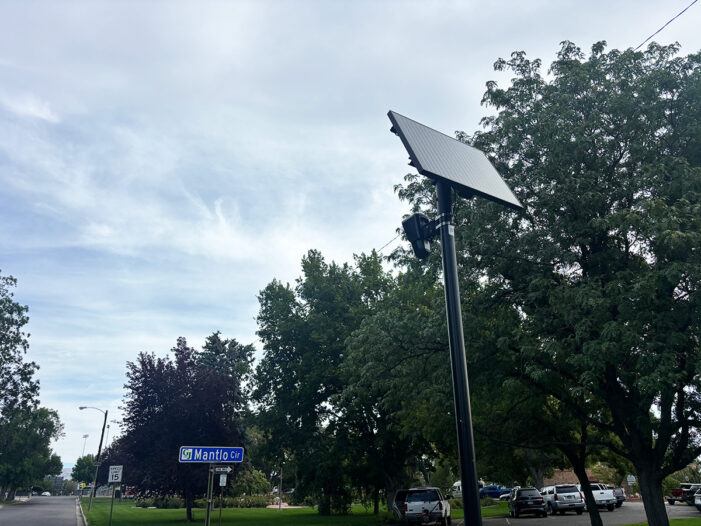
When all equipment is deployed, the Sheriff’s Office has 11 Motorola units and leases 11 Flock cameras located at strategic intersections around the county.
The cameras capture still images of passing vehicles and license plates and record the location, date and time. The system compares plate numbers against law enforcement “hot lists,” including lists involving stolen vehicles, Amber and Silver alerts and qualifying investigations involving people with active warrants.
When a camera detects a listed plate, authorized users can receive an alert and direct deputies in the area to look for the vehicle.
Investigative successes
The Sheriff’s Office reviewed 108 cases in which investigators conducted ALPR searches between Jan. 1 and July 29, 2025. The agency reported that the technology provided some benefit in 95 cases, or about 88 percent, while 13 searches generated no leads.
ALPR information helped locate or apprehend 40 offenders, establish 37 investigative leads, locate 10 missing people and recover stolen property in eight cases, according to the agency. The figures include searches via the Motorola and Flock systems and represent the Sheriff’s Office’s analysis of its own cases.
The Sheriff’s Office also reported a vehicle-theft case in Mesa County was about 3.5 times more likely to be solved in 2025 than the statewide average, based on Colorado Bureau of Investigation information presented at the meeting.
Smith highlighted a case involving a man accused of entering a woman’s home with the intention of sexually assaulting her. Her surveillance system provided a general vehicle description, but no clear image or readable plate. Investigators combined the footage with other techniques and used ALPR information to identify a matching vehicle.
“We were starting from zero,” Smith said. “We were able to identify that person and have that person in custody in less than 24 hours from the time that the crime was reported to us.”
Commissioner Cody Davis said the technology warrants skepticism, criticism and transparency, but he supports the Sheriff’s Office’s use of the cameras.
“It gives the good guys the tools to catch the bad guys,” he said.
Commissioner Bobbie Daniel said the commissioners do not oversee the Sheriff’s Office, and the sheriff is an elected position.
Search restrictions and auditing
Smith said Mesa County restricts ALPR searches to official law-enforcement investigations. The Sheriff’s Office prohibits searches conducted solely for immigration or routine traffic enforcement, along with harassment, personal use, unauthorized searches and searches targeting people solely based on race, sex, religion or another protected classification.
Smith said the office is responsible for ensuring proper use, just as it is with other law-enforcement equipment. Users must enter a case number and explanation for each search, while Flock records who conducts it and when. Misuse could result in discipline, termination, loss of peace-officer certification or criminal prosecution.
“We can’t tell you how every other agency uses this technology. We’re not responsible for every other agency that uses this technology,” Smith said.
Participating Colorado law-enforcement agencies can search data collected by Mesa County cameras. Smith said the county does not make its locally collected data directly searchable by federal agencies, including Immigration and Customs Enforcement, or agencies outside Colorado.
In an Aug. 13 announcement on its website, Flock recommended reducing its default retention period from 30 days to seven days, saying more than 90 percent of searches without a complete plate number occur within a week. Existing customers may retain previously approved periods, while information needed for an active investigation may be preserved longer.
Smith said Colorado law generally requires ALPR data to be purged one year after it is collected unless it becomes evidence in an active investigation.
Residents raise privacy, misuse concerns
All residents who addressed the Flock system during public comment opposed its use or raised concerns. They argued the cameras collect information from motorists who are not suspected of crimes and create a searchable record that could be used to reconstruct people’s movements.
They also questioned whether Mesa County can ensure other Colorado agencies will use locally collected information only for appropriate purposes, and they pointed to documented cases of abuse elsewhere.
In Georgia, three former Bibb County sheriff’s deputies were arrested Aug. 10 after allegedly using Flock data to track people with whom they had personal relationships. The accusations involve personal searches rather than legitimate law-enforcement purposes.
Residents also raised concerns about technological and human errors. In Aurora in 2020, police mistakenly connected the license plate on Brittney Gilliam’s Colorado SUV to a stolen motorcycle registered in Montana. Officers detained Gilliam and members of her family, including children, at gunpoint. Aurora later agreed to a $1.9 million settlement.
No cases involving misuse by Mesa County personnel or wrongful local stops resulting from ALPR errors were identified during reporting for this article. The Sheriff’s Office did not report any during its presentation.
Smith acknowledged that technology intended for legitimate purposes can also be misused, but he said the Sheriff’s Office is accountable for its own employees.
“In the meantime, we do know how we use this technology,” Smith said. “Our intent is simply to continue to use ALPR technology responsibly, ethically and within the confines of the law to solve crimes committed against citizens of Mesa County.”

Sheriff’s Office details usage of Flock cameras added by The Business Times Staff on
View all posts by The Business Times Staff →