
Alfalfa is entrenched in area agriculture, but drought drives search for alternative and complementary forage
Brandon Leuallen, The Business Times
Alfalfa has long been a vital part of Mesa County’s agricultural economy. It grows well in the region and provides farmers with a dependable, unsubsidized, cash crop that can be sold directly to dairy and other producers without relying on the grain infrastructure largely absent from the Western Slope.
As drought and uncertain irrigation supplies limit some growers’ ability to produce alfalfa, Colorado State University researchers are studying the crop while revisiting sainfoin, a forage crop widely grown throughout the United States before alfalfa became dominant. Researchers are examining whether sainfoin could help fill part of the resulting forage and income gap.
Sainfoin is a perennial forage legume that may use less water and remain productive through intermittent shortages. It could also provide dairy and livestock producers with high-quality feed earlier in the season and remain productive for more years without replanting.
Perry Cabot, a CSU Extension professor specializing in irrigation and water resources who is helping lead the research, said sainfoin is being examined as a complementary or alternative forage during ongoing water shortages.
Cabot emphasized the research is not intended to criticize alfalfa or pressure farmers to change what they grow. Instead, researchers are exploring additional crops and management practices that could help Western Colorado farmers remain productive and profitable through potentially ongoing intermittent water shortages.
CSU Tri River Area Agronomist Todd Ballard said sainfoin covered more acres before World War II. After the war, seed companies increasingly concentrated their forage research and breeding efforts on alfalfa.
“Eighty years of focusing genetics work on alfalfa has made it a great crop,” Ballard said.
Generations of experience and established varieties have also made alfalfa difficult to replace.
Cabot said water shortages can be particularly difficult for producers with junior water rights, because their irrigation supplies may be curtailed partway through the growing season long before those with senior water rights.
Dairy crop and major export
Although alfalfa is frequently associated with beef production in public discussions about agricultural water use, Ballard said much of the alfalfa grown in Western Colorado is sold as feed for dairy cows. Texas and California are major destinations for the locally produced crop.
Horses and beef cattle also consume alfalfa, but dairy cows require particularly high-quality feed to support milk production.
“Dairy is, other than racehorses that are super high-value animals, most demanding of the feed quality of any of the animal producers,” Ballard said.
Alfalfa from the region is particularly sought after for its quality. The crop grows especially well in the irrigated, dry-climate regions of the West. Dry conditions during harvest also help preserve hay quality, because rain can leach proteins and soluble carbohydrates and cause the loss of protein-rich leaves.
Together, Western Colorado’s dry climate and irrigation systems are actually part of the reason local farmers are able to profitably produce the crop.
Why don’t more Western Slope farmers switch to grain?
The CSU Extension estimates seasonal consumptive water use near Fruita at approximately 44 inches for alfalfa, compared with 19 inches for winter wheat and 22.2 inches for spring grains.
However, unlike grains, hay does not have to be delivered to an elevator and loaded onto trains to be profitable. Alfalfa growers can feed it to their animals or sell it directly to customers for truck transport.
Ballard pointed to the inactive grain elevator near Interstate 70’s Exit 19 as an example of what Western Colorado is lacking to be able to increase grain production. He estimated it has been unused for 15 to 20 years.
Ballard said expanding Western Slope grain production would likely require a private company to operate an elevator and collect enough grain for rail shipment. Without one, transportation costs make grain difficult to grow profitably, limiting farmers’ options of what to grow when water is scarce.
“If you’re going to grow grain out here, you have to ship it somewhere,” Ballard said. “For the most part, if you grow grain, you’re shipping it to Denver or shipping it to Salt Lake because there’s no rail that picks it up here.”
Although rail lines cross the region, no local operation aggregates and loads grain. Ballard said bean growers near Cortez and Dove Creek may receive about $2 less than a commodity benchmark price because their crops must be hauled to rail service in Albuquerque, N.M.
Alfalfa’s ability to be shipped by truck directly to the customer and strong prices allow Western Slope farmers to earn money from the crop without depending on that infrastructure. Ballard said hay prices also have been near a 10-year high amid basin-wide drought.
Revisiting sainfoin
If prolonged shortages leave farmers without enough water to grow profitable crops, and if no viable alternatives are available, some could face pressure to sell their farms. CSU’s research is intended to provide information that producers can use before reaching that point.
Sainfoin has a history of U.S. production and is grown in places such as Montana. Ballard said some Colorado producers are growing 40- to 50-acre fields for their livestock or for sale.
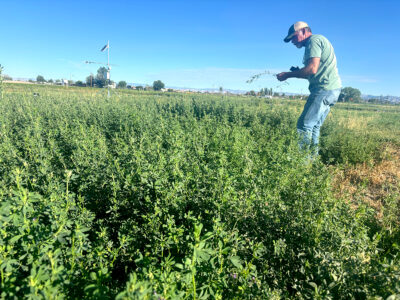
At the research center, multiple sainfoin varieties are being compared with conventional alfalfa. Researchers meter irrigation applied to the plots and measure yield, forage quality, water consumption and responses to reduced irrigation. Some plots receive full irrigation, while others receive partial irrigation or have water discontinued during the growing season. CSU is also studying Kernza, peas, wheat and other forage options.
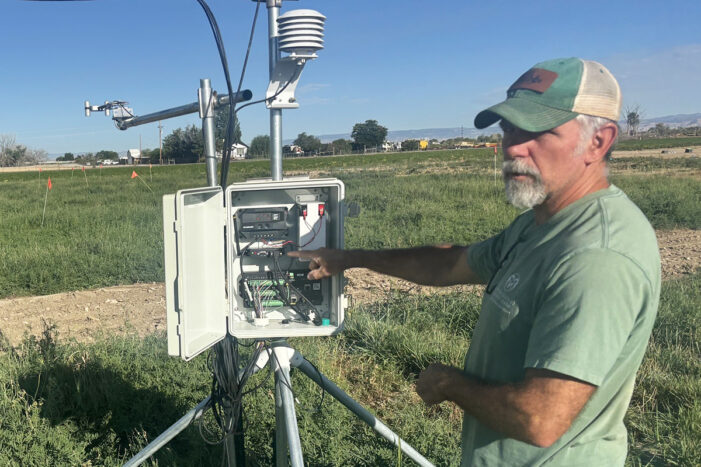
Field sensors help researchers estimate evapotranspiration, the water transferred to the atmosphere through evaporation and plant transpiration. The work compares how much forage and potential income each crop produces for the water consumed.
Cabot said previous data showed an established sainfoin field using approximately 10 percent to 30 percent less water than neighboring alfalfa fields over four years. However, researchers did not measure yields in that comparison, and the current controlled study is not complete.
He cautioned that lower water consumption does not automatically mean greater water-use efficiency. A crop that produces less biomass may also consume less water. The economic question is whether lower water use, reduced planting costs and potential price premiums could allow farmers to earn comparable net income despite harvesting fewer tons.
“If a guy is making the same amount of money off of consuming less water, then that matters,” Cabot said.
Researchers are examining several potential economic advantages.
One is timing. Ballard said sainfoin may be ready for harvest about two weeks before alfalfa, when livestock producers are more likely to need hay and may be willing to pay a premium.
Another is its reduced potential to cause bloat. Alfalfa’s nutritional characteristics can cause dangerous gas buildup when animals graze it directly, requiring producers to manage how it is fed or mix it with other forage. Sainfoin presents a lower bloat risk.
Sainfoin also has a more hollow stem than alfalfa, which becomes woody and fibrous as it matures.
A third potential advantage is the longevity of the stand. The research is investigating whether sainfoin could remain productive for about five years in situations where an alfalfa stand might begin declining after three years.
“If you look at your planting expense over a 10-year, 20-year window, then you are better off planting every five years than every three,” Ballard said.
Cabot said observations so far suggest treating sainfoin and alfalfa identically may be a mistake. Applying irrigation practices developed for alfalfa may overwater sainfoin and reduce its productivity.
Cabot said the controlled study is ongoing, and researchers have not yet published findings comparing the crops’ water use, yield and forage quality, and he is also gathering input from farmers that have started to grow the crop.
The university is distributing sainfoin seed to selected producers interested in trying the crop. Cabot hopes those growers will provide additional observations about its performance under real farming conditions.
“We didn’t invent this crop,” Cabot said. “We’re bringing it back and acknowledging the inflection point that we’re at right now.”

Alternatives to alfalfa added by The Business Times Staff on
View all posts by The Business Times Staff →