
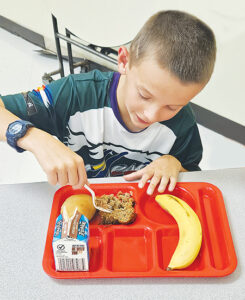
What started out as an idea conceived by a Grand Valley rancher became a reality when locally sourced beef was provided to Mesa County School District 51 and then served to students.
“From the onset, this has been a collaboration between the school district and our local ranchers, 10 of whom ended up participating in this year’s program,” said Janie VanWinkle, a Grand Valley rancher and beef producer who’s also a fellow with the AgriWest initiative.
“Well all agree that it’s incredibly rewarding to know where your beef is going. But to see the direct benefit it’s providing to local students, now that’s just amazing. And the meatloaf was delicious, too,” VanWinkle said.
Locally sourced beef — 7,000 pounds in total — will be in the rotation for District 51 meals seven times throughout the school year. Beef provided to the district came from cattle that received a body score from a veterinarian of five or greater, which indicates healthy animals.
Dan Sharp, director of nutrition services for District 51, said the partnership offers a win-win situation. “Partnering with local ranchers allows us to provide our students with fresh, nutritious meals that not only support their health, but also strengthen our community. We are excited about the opportunity to offer meals that are both high in quality and locally sourced.”

VanWinkle said she first thought of what she dubbed the Bring a Cow to School initiative in 2019.
In addition to Janie and Howard VanWinkle, participating ranchers included Angelina and Joe Kellighan of Kellighan Farms, BJ and Sharah Russsell of Russell Cattle Co., Brian Koetter and Lindsey Weber, Charles and Angie Burenheide of Bar G Ranch, Kim and Debbie Albertson, Chuck Nichols and Vicky Law, Porter Brisco of Regenerative Meats, Brady and Hayley Pearson of Razor Creek Beef and Jeff Snyder.
Janie VanWinkle said she’s passionate about connecting consumers to high-quality beef as part of her work with the AgriWest initiative.
The Business Incubator Center in Grand Junction launched the AgriWest initiative with a federal grant from the Economic Recovery Corps. The goal is to gather stakeholders in the agriculture sector to identify and address problems that could affect the industry. VanWinkle provides planning and technical assistance during a 2.5-year fellowship.
According to numbers from the U.S. Small Business Administration Office of Advocacy, the number of small, family owned and operated farms are declining, VanWinkle said. That makes initiatives that promote sustainability important.
“I often talk about success in agriculture using the three-legged stool metaphor,” VanWinkle said. “You can’t be successful without considering the economics, the social impact and our environment. In other words, as producers we need to be able to make a profit, feed people and care for the planet or it won’t be a sustainable industry.”
As part of the AgriWest initiative, VanWinkle recently conducted a meeting with more than agricultural 100 producers from western Colorado to discuss obstacles to sustainability.
“As we move into the next phase of our work with AgriWest, we know that helping our producers remain sustainable, profitable and in operation will be critical,” VanWinkle said.
Six months into her fellowship with AgriWest, VanWinkle said she’s pleased with the progress so far. “As we hear from more voices, we will continue to better understand the needs for each sector of agriculture, but the themes around business and succession planning, breaking down cultural barriers and having our local voices inform national policy decisions are rising to the top. And I am excited by that, because despite our differences in how we produce food, there are a lot of commonalities we can begin to rally around and solve for.”

Bring a Cow to School: Collaborative efforts add beef to District 51 meals added by The Business Times Staff on
View all posts by The Business Times Staff →