
 By Brandon Leuallen
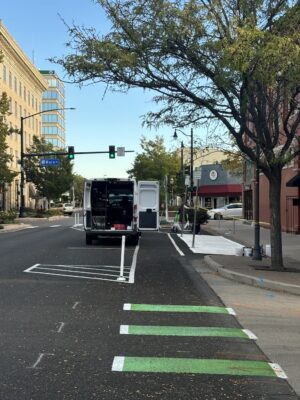
Work is set to begin next Tuesday, Sept. 2, to remove the bollards and other barriers that were installed along Fourth and Fifth Streets south of Grand Avenue as part of the controversial “complete streets” pilot project.
The Grand Junction City Council adopted a resolution at its Aug. 20 meeting to revert the two streets in the downtown core to their original configuration, ending the pilot program. Voting in favor were Council members Ben Van Dyke, Robert Ballard, Mayor Pro Tem Laurel Cole and Mayor Cody Kennedy. Voting against were Council members Anna Stout, Scott Beilfuss and Jason Nguyen.
The pilot started in the Downtown Development Authority. A resolution (No. 36-22) to adopt the 4th and 5th Street Feasibility Study from 2022 says that in late 2020 the DDA hired the consulting engineering firm Bohannon Huston of Englewood to conduct a feasibility study on the conversion of 4th and 5th Streets from one-way to two-way traffic in coordination with city staff.
The goals for the project included enhancing safety, improving walkability and bikeability, activating economic development and optimizing traffic circulation.
Under Executive Director Brandon Stam, the DDA advanced the redesign, which had also been identified as a priority in the 2019 Downtown Vibrant Together plan to go from one-way to two-way streets.
The decision to remove the bollards marks the end of more than a year of debate that pitted business owners, citizens and cyclists against each other, even to the point of electing a new council majority that voted to end the program south of Grand Avenue. Construction crews are expected to begin work immediately after the Labor Day weekend.
Complete Streets
The original intent was to restore two-way traffic on 4th and 5th Streets, an idea dating back to the 1981 DDA plan of development and reaffirmed in the 2019 Vibrant Together plan. But when the pilot was implemented, the streets were changed to one lane with a bike lane and remained one-way under the city’s Complete Streets Policy, which commits the city to adding bike and pedestrian facilities on all transportation related projects.
Rather than seeking community engagement for the implementation of Complete Streets facilities on a street-by-street or on a category basis, the policy directs the city to incorporate Complete Streets designs into all transportation-related projects.
It states, “While the City has historically incorporated complete streets concepts in the design of transportation corridors, this policy memorializes that commitment for all transportation-related projects. The Grand Junction complete streets policy recognizes the importance of all modes of transportation and is established for the areas under the jurisdiction of the City of Grand Junction.”
The policy came from the Urban Trails Committee and states, “It has been a long-standing goal and desire of the Urban Trails Committee, whose planning jurisdiction is limited to the Persigo 201 service area, to develop and adopt a complete streets policy. That goal was incorporated into the 2017 City Council Strategic Plan as a Key Initiative.”
The city’s 2020 Comprehensive Plan reinforced the approach, stating an objective was to “incrementally implement the adopted Complete Streets Policy on all public streets.”
Then, Grand Junction City Council approved Resolution No. 36-22, adopting the 4th and 5th Street feasibility study, which states “the City’s updated Comprehensive Plan also identifies utilization of Complete Streets within the Downtown core.”
This mandate led ultimately to the redesign of 4th and 5th Streets. What began with a recommendation to eventually return the one-way streets to two-way traffic evolved into a single-lane pilot project with a bike lane, shifting parking and access patterns downtown. The design was ultimately reversed south of Grand Avenue.

Council votes to return 4th, 5th Streets to former design added by The Business Times Staff on
View all posts by The Business Times Staff →