
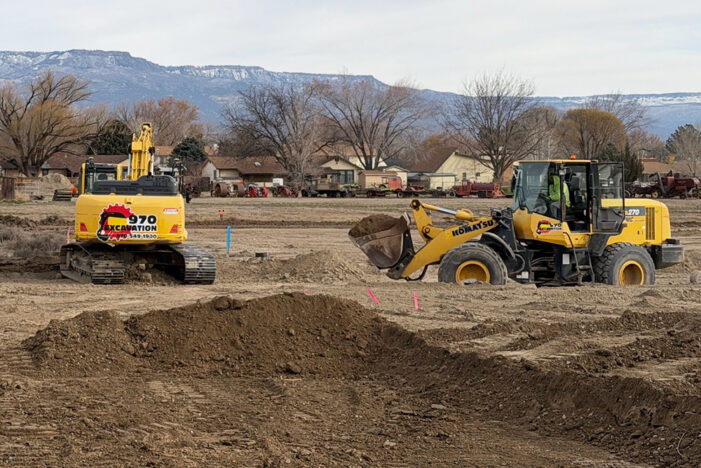
Cross Orchard Development LLC started groundwork and looks to begin building homes in the spring
Tim Harty, The Business Times
The sound of heavy machinery moving dirt in November on an 8-acre, L-shaped parcel that used to be the south end of Cross Orchards Historic Site must have been akin to a sigh of relief for Erik Olson.
Olson and his stepdad, Ted Martin, were business partners in Cross Orchard Development LLC, which took possession of the property via quit claim deed six weeks after his mother, Juliann Martin, with Evergreen Mesa LLC bought the property from the Museums of Western Colorado for $360,000 on June 16, 2021.
Then, the property sat there with no activity for nearly four-and-a-half years. Four-and-a-half frustrating years for Olson, as the project was delayed first by a heartbreaking loss – Ted Martin got sick and eventually passed away – then ran into the obstacle course that local building contractors know better as the City of Grand Junction planning and permitting process.

Olson diplomatically described the latter by saying, “It was kind of a tricky little infill to get designed.”
So, when asked about work finally starting on the property that will result in 28 single-family homes, Olson’s answer was short and sweet: “It was a long time coming.”
In addition to being a co-owner of Cross Orchard Development, Olson owns another business that had to wait patiently: his construction company, Belle Rose Builders.
The work that commenced in November is the excavation and dirt moving to install infrastructure for each lot and the L-shaped street that will connect Hoisington Avenue on the east end to Wellington Avenue on the west end. Those will be the two points of entry into the Cross Orchards Valley subdivision.
And there will be a small, new street, Elin Belle Street, named after Olson’s oldest daughter, who is in the ninth grade.
As for the homes that will populate the subdivision, that’s a much more fun story for Olson to tell, evidenced in the enthusiasm that permeated his voice when discussing the subject.
“Yeah, it’s going to be pretty cool,” he said. “They’re actually good-sized lots. I think it averages out to 10,500 square feet per lot, so they’re good, really good-sized lots.
“And I’ll be building – I mean, the term entry-level isn’t quite, that’s a pretty broad stroke these days – but they’ll kind of be between 1,450 and 1,800 square feet. … And the price range will probably start around 450 (thousand dollars), something like that. That’s why it’s funny, you say entry level, and these days it’s still crazy to wrap my head around 400 (thousand dollars).”
The majority of the homes will have three bedrooms and two bathrooms, and Olson anticipates almost all, if not all, of the homes being single-story, ranch-style homes.
None of that sounds all that different from a lot of single-family housing developments in Grand Junction, and Cross Orchards Valley is in the city, thanks to an annexation in November 2021.
Where his development will distinguish itself, Olson said, is in what the lots will include in addition to the homes.
“Almost all the lots will have three-car garages and RV parking, which is kind of unheard of for that size lot in that price range,” he said, adding there still will be room for fenced-in back yards. “I think that’s the main thing that sets it apart is it’s pretty unique in that regard. … They’ll be really nice houses starting in that $450,000 range.”
Olson said Cross Orchard Development will market the homes as “kind of Colorado-living-ready-type houses that you can actually afford to get into for either first-time home buyers or someone wanting to downsize or retire into it.
“As far as our marketing, that’s kind of what we’re shooting for is to really market that three-car garage and RV parking and, you know, still kind of have a fenced-in yard without houses right on top of you.”
Olson said the setbacks on the lots are bigger than usual, and limiting the number of homes to 28 is intentional in a development where others might target 40-plus homes and leave no one with a back yard or privacy.
“Our back yards are all 25-foot setbacks,” he said. “You’re not crammed up on your neighbors.”
Olson is targeting springtime for actual home construction.
First, he needs warm weather and paved roads.
“We’ll be paving and putting in roads and everything as soon as the weather breaks in the spring,” he said. “Late March if we’re really lucky, or April, just whenever the asphalt plants open up.”

Managing projects with drones and LiDAR
It looked like Summit Services Group Western Slope Operations Manager B.J. Russell and his crew were at the Cross Orchard Development site on Jan. 19 to have some fun flying drones.
No such luck. They were there to work at the request of Belle Rose Builders owner Erik Olson. But it still looked like fun.
Russell operated the largest of three drones that Summit Services Group was using that day, and his drone had to be big, because its cargo is the LiDAR unit, which is heavy.
LiDAR, by the way, stands for Light Detection and Ranging, and Cross Orchard Development needed Summit Services Group’s help for things like stormwater compliance and measuring the volume of large dirt piles.
Russell gave an example of Olson having a big stockpile that he needs to get rid of, but he doesn’t know how much is there, so he has no idea what the removal might cost. Summit Service Group’s drone with the LiDAR unit will use laser light to get measurements, create a three-dimensional ground model and calculate the volume of the pile.
“It’s much more accurate than having a guy in a loader,” Russell said, adding, “The LIDAR stuff is really cool, because we can go out and do a survey where it’s really tough or even impossible for ground crews to get to. We can go set up ground-control points and fly these heavily treed or wooded areas, and get that ground model from that stuff.”
Russell said Summit Services Group got started with aerial surveying about two years ago when it started seeing the need for it in the oil fields.
“We got started out there, but we’re doing more and more of the residential stuff,” he said. “You know, owners, GCs (general contractors) are using it. … It works a lot for project management for these guys.”
Russell added, “We’re pretty new to this, but really wanting to get more involved in the day-to-day stuff for guys like Erik that can maybe benefit from this stuff.”

Cross Orchard construction commences added by The Business Times Staff on
View all posts by The Business Times Staff →