
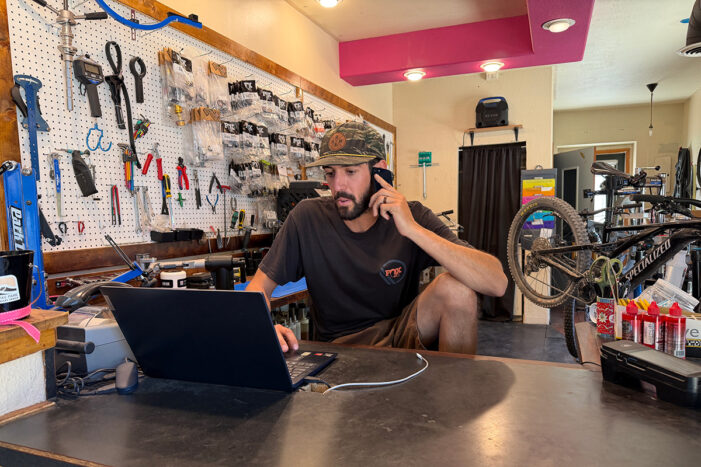
Electric bicycles and service work help bike shops offset decline in traditional bike sales
Tim Harty, The Business Times
When Chris Brown announced in mid-June he would soon close Brown Cycles, he shared his reason and applied it to more than his own downtown Grand Junction shop.
“It’s not a sustainable business model, this thing we do in bike shops,” he said.
Brown detailed what bike shops face nowadays, said they have to adapt or die, and he opted to close Brown Cycles after a 25-year run at 549 Main St.
Of course, that outlook for the future of bike shops led The Business Times to check in with other bike shops in Grand Junction to see how they’re faring. And without a doubt, these are tougher times for the traditional bike shop.
However, faced with the prospect of adapt or die, there is an adaptation that’s making a difference for local bike shops: selling electric bikes. Brown chose not to sell e-bikes, but other bike shops have made peace with breaking from tradition, and their owners say it’s helped their bottom line considerably.
The Business Times interviewed owners or managers from five Grand Valley bike shops. Three other bike stores either didn’t respond to requests for an interview or politely declined.
The Bike Shop, Bicycle Outfitters, Colorado Backcountry Biker, Colorado Electric Bikes and Naked Bike Works shared their experiences, and summaries of the conversations with them follow:
The Bike Shop
950 North Ave., Suite 108, Grand Junction
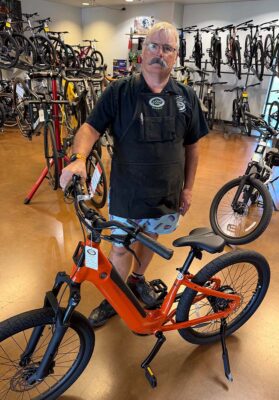
Bryan Miick, co-owner of the Bike Shop, said Brown’s words about the bike-shop business model ring true.
“Retail’s definitely tough,” he said, then provided a sizable list of reasons. Among them: the Covid-19 pandemic; inflation; tariffs; and too many bike shops in the Grand Valley.
“Since the pandemic, things have definitely been different,” Miick said. “There used to be a relatively stable pattern of our cycle of our year. When the pandemic happened, people’s lives changed. I think their habits changed. What they do, how they buy has changed.
“And in the pandemic, we went wild and sold everything we could get our hands on. After the pandemic, all those people that bought bikes during the pandemic, well, they don’t need a new one just yet. So, bicycle sales have been off.”
And now people are dealing with higher gas prices, higher food prices, and Miick said, “Our customer is disposable income, what you have left after you’ve bought the essentials.”
He said people may want a bicycle, but they don’t need a bicycle. They need food. They need to buy gas. They need to pay their mortgage or rent.
Miick also mentioned the T-word, tariffs, and had plenty to say about their effect. His short answer is they will lead to increasing costs and force bike shops to decide if they want to raise prices or lessen their margins.
He said another factor for area bike shops is “there are too many shops in town, no doubt about that.”
Miick added, “I don’t know the exact count, but per capita, most big cities have one shop for 500,000 people. I think there’s 10 or 11 shops between Palisade and Fruita and not 500,000 people. Oh, maybe 130,000.”
He acknowledged the Grand Valley is a logical exception, though.
“Cycling people come here for recreation,” Miick said. “They live here for recreation. And we have a great cycling culture here. That’s been road riding, mountain riding, casual riding around town. You can almost get from one end of town to the other faster on a bike than a car. It’s a great cycling culture.”
But, there are still too many bike shops, so each one has to work to stand out. For The Bike Shop, Miick said that starts with bike repairs and service.
“Our number one thing that we do here is service,” he said. “You cannot buy service online. And you cannot buy service from a big-box store. And our goal is to service your bike, get you turned around within a day. Usually quicker than that. … We want to get the bike back to you as fast as possible, so you can continue riding it, not have it sitting here waiting for service.”
Miick said electric bikes have helped where the decline in sales of traditional bikes have lagged. Still, he said, “Our annual revenues, compared to pre-pandemic, are way down, and that does create a little bit of a struggle.”
More optimistically, he thinks The Bike Shop may have weathered the worst of things.
“I’m going to say we’ve maybe leveled out on the Valley floor. And that’s good enough to be able to continue on with the business,” he said. “Definitely we’re watching our costs. We’re not working with as many employees as we would have had in the past. There’s things we’re doing to cut where we can cut, to absorb that and to rely more heavily on service dollars than sales dollars, if that makes sense.”
Bicycle Outfitters
537 N. First St., Grand Junction
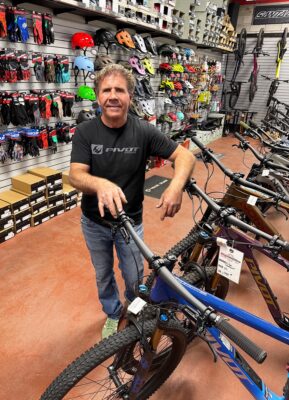
Like Miick, Bicycle Outfitters co-owner Brad Stewart detailed what the pandemic did in terms of the initial burst of sales of traditional bikes, then the fallout from vendors buying up way too much inventory and having to offload the glut on retail bike shops.
That did traditional bike retailers no favors. Then, there’s competition from Amazon, Walmart, Target and the like, where people turn to buy standard bikes.
Stewart said sales of traditional pedal bikes are down, but he’s offsetting it with the sale of electric bikes, which he estimated to be about 40 percent of his bike sales and growing.
“It’s the way the market is going,” he said.
But Stewart still sells standard bikes, as he said on June 15, “I just sold three, $9,000 bikes today without a motor on it. So, you never know.”
Helping push electric-bike sales, he said, is a state tax credit of $225 that is given at the register.
“Basically,” Stewart explained, “what that is, it’s state to business, meaning that if you go buy a bike online, you don’t get that $225. You only get it if you buy it from your dealer, your local dealer.”
Stewart said Bicycle Outfitters is doing well overall.
“We typically sell three to five bikes a day, of whatever it may be (standard or electric),” he said.
In addition to increasing electric-bike sales, he said its bike-rental business is doing well, and service work is up.
“We’re up probably 10, 15 percent in the last couple years,” he said of service work, adding Bicycle Outfitters services all brands of bikes, not just the ones it sells.
Stewart added, “You know, 2020 and ’21 were phenomenal years. I know that we will never do that again, but we’re not too far off of it.
“But the e-bike, like I said, it brought in a whole new customer base, and we still have our regulars that we’ve always had, but we also get new ones.”
Colorado Backcountry Biker
150 S. Park Square, Fruita
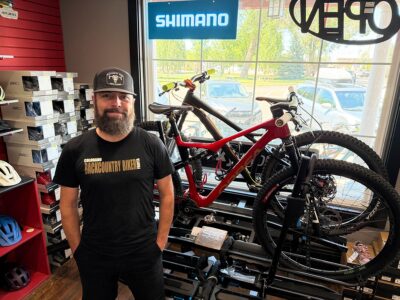
General Manager Gary Plante said in mid-June that Colorado Backcountry Biker’s year-to-date revenues were ahead of last year.
“We’ve had a really good 2026 so far,” he said.
Colorado Backcountry Biker, also known as CBB, has a few advantages just from it’s location, Fruita, and the city’s proximity to Colorado National Monument and mountain-bike trails, plus the open road for road bikers. That goes for tourists and locals.
Plante said CBB also brings in customers because of its customer service, and its rental business is as important as retail sales of bikes, pedal and electric.
Plante said CBB’s rental business “has been pretty big,” and this year it is seeing bigger groups of rentals.
In addition to the tourists, he said, “We’re seeing new faces. Even today (June 17), we had a couple guys come in that decided to switch their shops for whatever reasons. I think our shop has a really good local vibe. … So, it’s not just tourists coming through this door that we want to make sure we can help them get out on the trails … but our locals and the vibe that we create, we have a pretty tight-knit group of guys and gals here. It’s important.”
Those are things that Plante said “you don’t get at every, not just bike shops, at every place you go, that kind of customer service that seems to be lacking in a lot of businesses these days. So, that’s very important to us.”
Plante said electric-bike sales and rentals are on the rise at CBB, and “it’s not going to slow down.”
“We keep getting more and more people interested,” Plante said. “If they haven’t tried one, they want to try one. And sometimes after they try one, they don’t want to go back to the regular bike. So, that will just continue to be big.
“Any shop that carries e-bikes will probably tell you the same thing, so you have to be on top of it. It’s an ever-changing technology, though. Motors change, batteries change, and as that happens, people want the newest and latest. So, you’re always trying to kind of stay ahead of the game. But e-bikes, there’s going to be a bigger volume of e-bikes next year than there was this year, and that will probably continue to trend.”
Plante said CBB still sells more regular bikes than electric bikes, “so that’s a big part of our business, too. We’re not at a 50-50 mark or anything like that. But (electric bikes are) getting more popular as the years go by.”
When Plante sums up what sells at Colorado Backcountry Biker, he goes back to customer service instead of specific products and services.
“Before the sale even happens, you have to establish a good relationship with that customer,” he said. “Once they walk in the door and once they trust you, then you can move on to everything else.”
Colorado Electric Bikes
2751 Riverside Parkway, Grand Junction
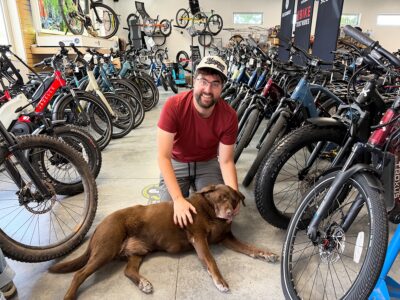
What Brown experienced with retail of traditional bicycles doesn’t apply in any way to Colorado Electric Bikes, because it sells only electric bikes, and they’re a hot commodity.
That’s what Justin Manupella, who co-owns Colorado Electric Bikes with his parents, Scott and Diane, and brother, Kyle, started with in Diane’s infra-red heater store in Delta, just a few electric bikes.
Then, they moved it to Grand Junction, and in 2014 Colorado Electric Bikes rented space in the back of Brown Cycles.
“He was very welcoming,” Justin said of Chris Brown. “He understood that (electric bikes) were gonna be something that was coming out, and he was willing to help. So, we love Chris.”
Eventually Colorado Electric Bikes moved to a store on 25 Road, then made its way to 2751 Riverside Parkway, where it stocks more than 100 e-bikes.
“I’ll be honest, we probably have too many bikes at the moment,” Justin said, adding what they stock are mostly Class 1 and Class 2 cruiser-style bikes, “because that really is the bulk of the bike industry as a whole right now, the cruisers. Basically, it really has gone that way.”
Nowhere to be found in the store, though, are e-motorcycles. Justin said for now Colorado Electric Bikes intends to stick to the cruisers, the pedal-assist electric bikes.
Many of the e-bikes at Colorado Electric Bikes fall in the $1,500 to $2,500 range, and Justin said, “That gets you a really nice, bike-shop-quality, good-warranty bike.”
As positive as the experience has been in recent years for Colorado Electric Bikes, Justin said inflation and its effect on customers is showing.
“I have noticed that our average sale price of models has gone down, so I do think that the consumer is looking to spend less money right now,” he said.
High gas prices could change that, as some people may look into an electric bike to ride to work instead of a gas-engine car.
“I do see more and more people coming in like, ‘Hey, I need something practical and affordable to get to work and back,’” Justin said. “And that is actually why we sell the most of the Class 2 electric bikes that go up to 20 miles an hour and do have the throttle, because that allows people to get to work in the heat without really sweating too much in their work clothes.”
Naked Bike Works
502 Colorado Ave., Grand Junction
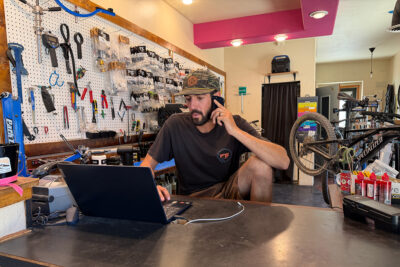
Co-owner Brandon York started Naked Bike Works with Tegan Maree, who he calls “his lady” (and he’s “her man”), in their garage in 2020, knowing one thing for certain: The business would only service bikes, not sell them.
They wanted nothing to do with selling bikes then, nor do they now after moving into their store in 2023, because Brandon said he learned enough working in other bike shops to steer clear.
“I’ve been in this industry for 16 years or so, starting in retail shops, and I just feel like margins are getting slimmer as cost of retail prices are going up,” he said. “And you can just buy everything online at a discount now, and I just think that, for what we do here, we just do service and repair, specialize in rebuilding shocks, and I hope that we never sell bikes. … It’s kind of hard to compete with online sales, a lot of consumer direct, it’s just really hard to compete, and for us, this seems to be working.”
He pointed to the brick wall in the waiting area of the store and said, “This is all the retail that we’ll probably ever have, on the walls, just your normal T-shirts and the tires. Like, we’re a repair shop, so we need parts on the walls to take right now for normal tuneup stuff.
“Just kind of want to keep it good, clean service, have it done quick, have it done well, and you’re back on your bike pretty quick. Not carrying a lot of retail in the shop, and/or bikes to sell, kind of helps us focus on the core of what we are, which is getting the bike in the stand and getting it going well again.”
York said Naked Bike Works has been growing gradually in recent years, about 10 to 15 percent each year, but so far this year, “Numbers are little down. I would say overall, foot traffic’s a little down, sales are a little down.”
But business is good enough to keep going.
“Honestly,” York said, “this is more than we ever thought we would have. We just wanted to, you know, rebuild shocks and do tuneups.”

Cycle of Change added by The Business Times Staff on
View all posts by The Business Times Staff →