
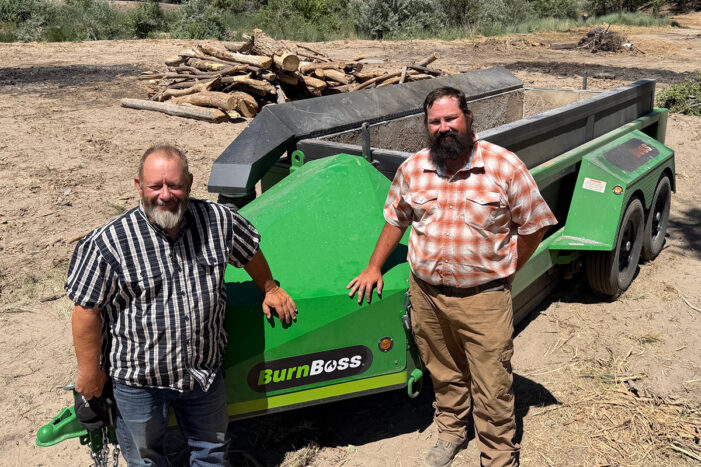
ECOBurn uses air-curtain destructors to burn large amounts of wood quickly and without smoke
Tim Harty, The Business Times
Sheep grazing led their inquisitive minds to ask a burning question. Research begot an answer that engaged their problem-solving mentality. Then, their entrepreneurial spirit produced their latest business venture: ECOburn.
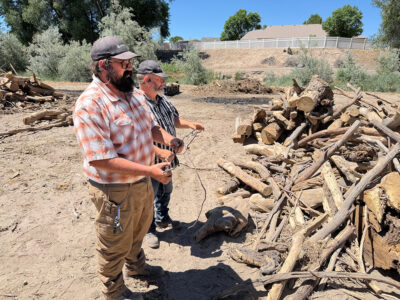
Robert Andrews and his son, Kyle Andrews, now burn wood and vegetative waste for a living, providing fire-fuel mitigation from the likes of tree deadfall in a park, large slash piles or a giant, dying, shade tree that a property owner needed to take down before a windstorm dropped half of it on the house.
They spell out the vision of ECOburn on their website, www.ecoburnllc.com, by saying it “specializes in removing excessive fire fuels by decreasing the volume of combustible vegetative waste. We employ systems designed to effectively reduce smoke emissions by up to 97 percent, ensuring a cleaner burn and a healthier environment.”
Those systems also reduce the overall mass by 98 percent, leaving ash and biochar, the latter of which they deem a value-added benefit for its ability to absorb six times its weight in water and serve as a soil amendment.
The Andrews tout ECOburn’s services as a cost-effective way for local communities, property owners and businesses to dispose of downed trees and slash piles, saying it’s significantly less expensive than having the wood hauled to the landfill or reduced to wood chips. Robert Andrews says ECOburn’s cost will often be less than half of those other methods.
Slash piles are what got the gears going in the Andrews’ heads, and they can thank their sheep for the inspiration. They have several other businesses based out of Robert’s home in Mack – High Country Environmental Grazing; New Liberty Wool Pellets; and Ewe So Soft (sheep-milk lotions and soaps) – in which sheep play a starring role. So, the animal’s involvement in a seemingly unrelated business actually makes sense.
The Andrews have anywhere from 250 to 350 sheep, depending on the time of the year, and the grazing operation has led to the uncovering of “tons and tons of material that is prone to potential wildfire,” Kyle Andrews said. “We discovered that there are tons of locations that are very similar, where somebody maybe cut a tree down 30 or 40 years ago and just said, ‘We’ll just leave it there, and we’ll get to it at some point.’”
Robert added those people are prone to saying they will get to it next week, next month, “then it’s 30 years later, and it’s been overgrown.
“So, we found a lot of these things that looked like small hills and stuff like that that were actually overgrown piles of slash that had just been taken over by bindweed or kochia, things like that.”
He added those slash piles “were just tinder dry.”
That led the Andrews to ask: How can we address that? What’s the next step? How can we eliminate that potential hazard?
“Naturally,” Kyle said, “you try to discover the most appropriate and direct way to go about it. Not necessarily easiest way, but the most efficient way. And so, in doing so, we sat down for a while and discussed what other options are out there.”
That led to research that led the Andrews to air burners, or air-curtain destructors, and their use and why they’re necessary in certain environments.
“And here it’s a perfect location to get them in, implement them into a project and allow for them to be seen,” Kyle said. “We want the community to see them and their effectiveness.”
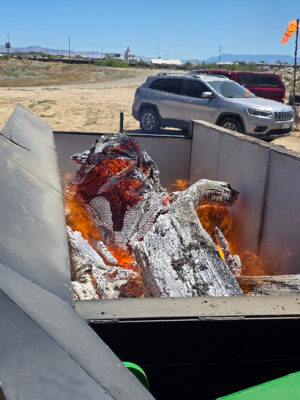
What the community won’t see is much smoke, as the air curtain that is created by a diesel engine and a fan creates a vortex that keeps the flames and the smoke inside the metal walls of the system.
“The only thing that comes out is heat,” Robert said, adding the wood inside “burns 1,800 to 2,400 degrees, hotter than a crematory.” He added the materials burn 40 times faster in the air-curtain destructor than they would in open burning.
The Andrews say the journey to where ECOburn is now, doing work for the City of Fruita at The Launch mixed-use development and Little Salt Wash Park, officially began in January of this year.
“That is when we got everything started,” Robert said. “We did significant amounts of research, talking with the systems manufacturer, talking with other people running systems throughout the country.”
They talked to different entities, such as the Colorado State Forest Service, U.S. Forest Service, Colorado Parks and Wildlife, and local parks and recreation departments through Grand Junction, Palisade and Fruita, and asked all of them: Is this a need based on what you’re seeing?
Robert said the response was: “Absolutely. They all agree across the board.”
Then, the Andrews talked with large land owners who have been affected by wildfires in the past, and Robert said they were voicing how expensive it is to have a mulcher or masticator come in, and they were concerned about the short-term effects of it on the overall environment. He said a lot of those landowners have slash piles that they’re trying to get funding to get rid of, so he told them how an air-curtain destructor would be a more cost-effective alternative for them and have value-added benefits such as biochar.
“So, we had a huge amount of support,” Robert said.
And one more reason the Andrews believe ECOburn will be needed is Colorado will fully implement new rules in 2029 to limit methane emissions in the state’s landfills. That will limit the green waste people can take to the landfill, so it will have to be disposed in another way.
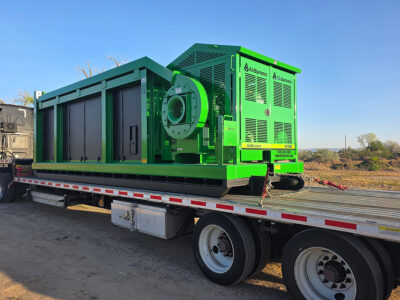
Once the Andrews were convinced they had customers waiting for a business like ECOburn, their research led them to Florida-based Air Burners Inc. to purchase two systems: the T24 Burn Boss, which is a trailer and can burn one to two tons of vegetative waste per hour; and the S116R, which is a roll-off version, much larger in size and capable of burning two to four tons per hour.
ECOburn received those systems in late April, and the Andrews have been burning ever since, thanks in large part to the City of Fruita, which immediately provided work to the new business.
It was the Andrews’ sheep that exposed Fruita’s need in the first place, before ECOburn was formed, as the sheep had been brought in to graze at The Launch and Little Salt Wash Park.
“When we grazed The Launch area,” Robert said, “we uncovered a ton of deadfall and slash piles that had been there, and we started asking that question of, ‘Well, what now? How do you get rid of it? What do you do with it?’”
Then, they started grazing the Little Salt Wash bike trail, where tall growth hid a lot of giant logs and such that Robert said had been there dating back to a mitigation program 30 to 35 years ago.
Kyle said he and Robert had a conversation with the City of Fruita to identify how best to remove the logs, some of which were two to three tons.
“It’s too big to fit in a chipper,” Kyle said. “It’s too big to set anywhere else. Can’t take it to the landfill. Can’t get equipment in there. So what do we do with it?”
The answer, of course, was: Start a company that can take an air-curtain-destructor burning system in there.
And ECOburn will be there for a while.
“We have a semi permanent site over there that we’ll have for the next six months to a year,” Robert said, “where the city’s bringing us stuff, and different businesses, land clearing, development and the rolloff businesses are bringing us stuff there.”
Got vegetative waste to burn?
Find out more about ECOburn on its website, www.ecoburnllc.com, or call the business at 970-260-2130 or email ecoburnllc@gmail.com.
Marine experience carries over
ECOburn’s father-son owners Robert Andrews and Kyle Andrews both served in the U.S. Corps, which prepared them well for running a business like ECOburn, which specializes in removing excessive wildfire fuels.
Robert was a career Marine who retired after 26 years, and Kyle spent five years in the Marines.
“We were both chemical, biological, radiological, nuclear (CBRN) defense specialists, and essentially what that means is: Anything that can and possibly could hurt you, those aspects we dealt with, hazardous materials, all that,” Kyle said. “We also built a lot of hazardous-materials and fire-type stuff, dealing with: How do you respond to it? How do you prevent against that? The defense aspect of it.
“And so we learned a lot about what doesn’t belong, what doesn’t need to be around … for certain areas. But as we went through, we found that there’s certain parts of that that will apply to a lot more than just what we did.”
Kyle augmented his military experience with an education from the University of Missouri, where he got a bachelor’s degree in agricultural-systems technology and agribusiness management, plus a certificate in precision agriculture. So, he said he learned “about all the different threats that agriculture faces, and one of those is fire and potential fire fuels within agriculture.”
Host a neighborhood burn party…?
ECOburn expects to get business from people who balk at the cost to have their vegetative waste hauled to the landfill or masticated and spread on their property.
Robert Andrews characterized chipping as fairly expensive and said it has the additional drawback of being bad for the soil.
“It’s a great, quick solution, but the secondary and tertiary impacts of that are significant,” he said. “And again, it’s very cost-prohibitive for most people.”
It’s not that ECOburn is inexpensive, though, so the Andrews suggest homeowners get together with neighbors to offset costs.
“If you split that between four, five, six neighbors for the day, each of you might pay a couple-hundred dollars,” Robert said. “You have that potential fire hazard gone, and at the same time you get some nice biochar out of it if you want to keep it. And if you don’t, we’ll take it with us.”
… Or see if trash hauler can help
Robert Andrews said another alternative for homeowners is using a local waste-hauling business like Dumpster Dan or RonSon Roll Offs, both of which ECOburn is contracting to bring the vegetative waste to ECOburn.
“They can come drop off a Dumpster. You fill it up with your woody material. They’ll come pick it up, and they bring it to us in Fruita,” Robert said.
Big thank-you to the BIC
Like many new businesses in the Grand Valley do, ECOburn turned to the Business Incubator Center for help getting started.
“They supported us 100 percent, and they provided a significant amount of funding for us to purchase the system,” Robert Andrews said.
The funding came in the form of loans, which the incubator could provide when other lenders would not.
“We looked at traditional lenders, things like that, and because it’s unique, nobody was really sure how to handle that,” Robert said.
Plans for growth
ECOburn is looking to take on several large projects, and if those materialize, it may experience an early growth spurt.
“That’s our goal,” Robert said, “is once people see the value in the service is that we can continue to grow, and then we can have teams, a system, and a couple of crew members throughout the state, different locations, continuing fire-fuels mitigation, beetle-kill mitigation, things like that on an ongoing basis.”
If ECOburn takes off, the Andrews have a dilemma, as they and family members operate three other small businesses. The solution will be hiring people.
“Part of working with the Business Incubator is we believe that we’ll be able to bring on three to five full-time employees here within about six months,” Robert said. “That’s our goal. And then as we can expand operations to different areas, we hope to have basically a three-person team, say one up around the Vail-Eagle area, one up around the Aspen-Glenwood area. One or two on the Front Range, and so on and so on.”
For the Andrews’ other businesses, particularly High Country Environmental Grazing, Robert said in the past they’ve hired some people part-time to check on the water, check on the sheep a couple times a day. This year, he said, “I think we’re gonna go ahead and hire somebody full time, basically checks on the flocks. You know, they’re a shepherd.”

Equipped to slash and burn added by The Business Times Staff on
View all posts by The Business Times Staff →