

Apartment building and dining hall featuring Panera Bread are the Formation District’s newest additions
Tim Harty, The Business Times
With the Ember Eatery now open and students about to populate the new Centennial Village Apartments, Colorado Mesa University’s future continues to take shape.
Or form.
That’s the key word in the university’s strategic plan for the southwest quadrant of its campus, because it’s called the Formation District.
Those new student-housing and campus-dining options are the most recent completed projects in that plan, which envisions Colorado Mesa further weaving itself into the fabric of Grand Junction.
CMU President John Marshall is intent on that, because there’s great value in the integration for the university and the community at large. Both benefit from it, and it doesn’t require Colorado Mesa economics professor Nathan Perry to explain it, which he would do splendidly, by the way.
The Formation District is the logical campus real estate for multi-use development that dissolves the conception that the university is an isolated community within the community.

If you could pick up CMU’s campus, just drop it in any other city in America and it would go on with life as usual – as Marshall suggests you could do with many Ivy League universities – then he’d say he has failed as president.
“I hope that is never true for us,” he said. “I hope that we’re so woven into the fabric of this place that you couldn’t take this university and city apart with a crowbar. Like, we are one.”
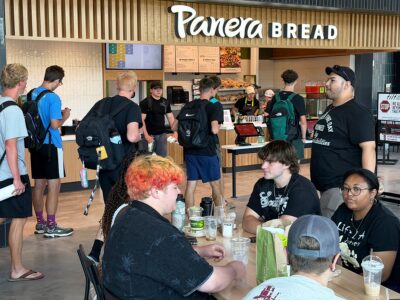
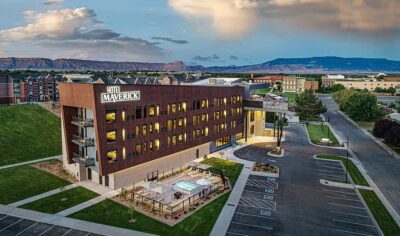
The Formation District is designed to welcome the outside in. See a play at Asteria Theatre, which opened in 2024 and is touted as one of the district’s anchors. Dine among the college students at the Ember Eatery, which brought the likes of Panera Bread and Jamba (formerly Jamba Juice) to the Grand Valley. Stay at Hotel Maverick, another district anchor, which opened in 2020 and as a higher-end boutique hotel is something Marshall said the Grand Valley did not have previously.
Marshall can and does wax poetic about the Formation District, whether it’s the district’s past (its conception goes back 20 years), present or future (the plan doesn’t come with a sunset date). He did that for The Business Times on Aug. 5, starting with, “We have envisioned that to be something very different than the rest of campus.”
Then, he said, “And here’s what I mean by that,” and Marshall exhaled the following:
“The rest of campus is a gorgeous, residential, very walkable, ride your bike, skateboard around campus, with very common architecture, very common design, very great spaces for students to gather and study and enjoy. We’re a Tree Campus USA. We have groundskeepers that love and are very passionate about their job. It feels good.
“But this campus also needs an additional element, we think, which is something that looks like a commercial, residential, academic and retail, mixed-use district that will add vibrancy, not just to the campus, but to the city. And so it’s not intended to replace the big-box stuff out on (Highway) 6 and 50. It’s not intended to replace the historic Main Street. It’s intended to be additive for our community.
“So, you’ve got this mixed-use district that’s starting to take shape, where students in the community, retailers and the like can set up shop, but then you could also inject into this some version of commercial and academic. So, right now, if you go to Boulder, you see this really vibrant space where academics and startups and entrepreneurs and business people are taking advantage of that dynamism, right? Smart young people who are working on a mechanical engineering degree, but maybe they’re also walking next door to a software startup, or something like that maybe sets up shop here.
“That dynamism of a university campus is where it really starts to crank as an engine for the economy. That’s something that we see as a future in this Formation District. So, it’s a place people want to be. It’s a place people want to work. It’s a place people want to invent and build and create and a place people want to enjoy culture and recreate.”
And now you know what Marshall means.
While Colorado Mesa has placed a few key pieces in the southwest quadrant in the past six years, that was only possible because it started acquiring property 30 years ago (when CMU was Mesa State College) inside the rectangle that is formed by 12th Street, North Avenue, Seventh Street and Orchard Avenue. Marshall credited the likes of Mesa State president Ray Kieft, Enstrom Candies owners Doug and Jamee Simons and the City of Grand Junction for kickstarting the property purchasing.
Then, after Tim Foster became Mesa State’s president in 2004, “that goes into hyperdrive,” Marshall said. “Tim really had a vision for how to make that work and started acquiring property.”
While Colorado Mesa has attained most of the property in that Orchard-12th-North-Seventh rectangle, properties owned by others remain. Among them were four properties in the 700 block of North Ave. between Fiesta Guadalajara restaurant and the Subway sandwich shop. That was until CMU bought two of them in December last year, then bought the other two in May this year.
“We’ve been in a conversation with those retailers for 20 years, and all of a sudden all four of them hit,” Marshall said.
“It’s funny,” he added, “these things sort of ebb and flow. … In some years, we don’t make a lot of progress. In other years it feels like the dam breaks, and we get a bunch.”
After asbestos remediation concludes on those four buildings, Marshall said they probably will be “torn down for parking as soon as we can reasonably do that.”
Parking is a precious commodity on CMU’s campus, which is why one of the next Formation District projects people will see is a multi-use parking structure. It will add more than 500 parking spaces, including spots for Grand Valley residents who come to the campus to dine or shop or go to the theatre, etc.
Work is ongoing on the parking structure as well as another suite-style residence hall that will be immediately south of Asteria Theatre. Those two projects represent the Formation District’s priorities of parking and beds.
“Because,” Marshall said, “I think any good developer will tell you that if you’re gonna do a mixed-use development, you gotta have humans. So we’ve got to have beds kind of anchoring that.”
After that, he anticipates some retail pad sites in the near future, and “that’ll be our opportunity to begin a conversation with potential retailers that want to be interior to campus, want to have a footprint in the Formation District and access to both community and student traffic.”
Because the Formation District has to be patient (more properties still to buy to clear space), it does not have strict timetables or rigid plans. It has to be adaptable, take things as they come, but CMU’s braintrust can still dare to dream.
Marshall said one of the concepts that’s been discussed with CMU’s development partners and architect partners is the Seventh Street and North Avenue corner as a big, inviting pedestrian space that welcomes the community in. He thinks it would be ideal for a small grocery store, like a Trader Joe’s, maybe an Apple store, Sephora, just to name a few.
He’s more certain about the next academic building that Colorado Mesa will build: “an engineering complex that’ll be anchored by construction management probably.”
With a diagram of the campus in front of him, Marshall said, “All of those things are just shapes on a page over here right now. But little by little, I think you’re going to see us start to build that out.”
The Formation District has a distinct character in terms of the design elements of its structures, and Marshall said that is intentional.
“The idea,” he said, “is that when you’re in the Formation District, you know it, and it has a very distinct feel in terms of attracting the community and businesses.”
What is the Formation District?
Summarizing a Colorado Mesa University summary sheet:
The Formation District is a developing mixed-use area in the southwest quadrant of Colorado Mesa University’s 141-acre main campus in Grand Junction.
More than a collection of buildings, it is a deliberate expression of CMU’s identity, a place where the university’s deep connection to the Western landscape and the soul of the West comes to life through architecture, views, gathering spaces and daily experience.
As CMU continues to grow, the Formation District will offer modern housing, vibrant dining and retail, arts and culture, and intimate gathering spaces.
The Formation District serves as a southern gateway to the university, anchored by Hotel Maverick and the Asteria Theatre and situated near other arts, housing and campus-life facilities. The district is both a destination and a connective thread between campus and community. It is designed to foster connection, curiosity, and community.
Creating a new North Avenue campus entrance
Access to the Formation District will include a new Ninth Street entrance from North Avenue. It will tie in with the City of Grand Junction’s improvements to Ninth Street, such as bicycle lanes, and connect the downtown area and CMU.
The Ninth Street entrance to the Formation District also will create efficiency for visitors and Grand Valley residents to access amenities such as the Ember Eatery and Asteria Theatre.
Colorado Mesa President John Marshall said the Ninth Street entrance was recommended by design architects.
“So, we took that recommendation and kind of pondered it and started sketching up what that would look like, and for a whole host of reasons it makes a ton of sense,” Marshall said. “It makes more sense to have a traffic signal halfway between 7th and 12th, so you don’t create weird traffic and loading problems.
“It makes a lot of sense to get rid of Cannell (Avenue). It’s just not safe. It’s got that dog leg in it. There’s a lot of cars in that area. There’s shopping. There’s not great visibility. It’s just not a safe ingress/egress onto a state highway like North Avenue.”
Marshall added the Ninth Street entrance off North Avenue will bring drivers right to the front door of the Formation District.
“Think front door of Asteria Theatre, the Ember Eatery, apartments and … a whole mixed-use shopping district,” he said. “All that, we think, is best accessed by this. And so we’ll be working with the city and CDOT over the coming years to try and bring all of those kind of sensible improvements into alignment.”

Further Formation evident at CMU added by The Business Times Staff on
View all posts by The Business Times Staff →