
Brandon Leuallen
The Business Times
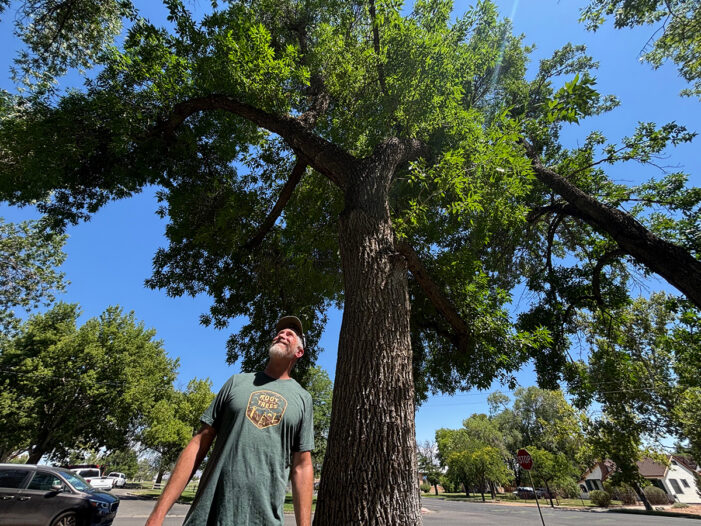
Standing beneath a group of mature trees across from the City of Grand Junction Parks and Recreation office at Lincoln Park, City Forester Rob Davis pointed an infrared thermometer at two patches of grass only a few feet apart.
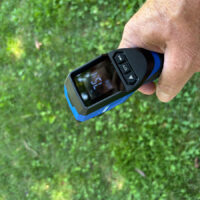
Grass in direct afternoon sunlight measured about 97 degrees while nearby shaded grass registered about 76 degrees. Asphalt in a nearby parking lot reached about 148 degrees before dropping to about 90 degrees beneath the shade of the trees.
The readings showed roughly a 72-degree difference in surface temperature between shaded grass in the park and unshaded asphalt just a few feet away.
The simple demonstration illustrated what city officials say is one of the most effective tools available for reducing the urban heat island effect: large shade trees.
The demonstration mirrored findings from Grand Junction’s recently completed urban heat island study, which documented significant temperature differences across the city and identified tree canopy as one of the most effective long-term strategies for keeping neighborhoods cooler as the community continues to grow.
Davis said many people think of trees as landscaping, but he sees them differently.
“Trees are not landscaping,” he said. “Trees are infrastructure.”
Davis also encouraged residents to strike a balance during the drought by conserving water while continuing to care for established shade trees that have taken decades to grow.
Mapping the city’s heat
In the summer of 2024, Grand Junction participated in the National Oceanic and Atmospheric Administration’s Urban Heat Island Mapping Campaign, joining communities across the country in measuring how temperatures vary throughout a city.
According to the study, “Urban heat islands are developed areas that experience higher temperatures than their surroundings. Buildings, roadways and other infrastructure absorb and re-emit the sun’s heat. When these man-made structures are highly concentrated and there is limited greenery, pockets of heat form to create the heat island effect.”
Volunteers drove predetermined routes, equipped with temperature sensors, during one of the hottest days of the summer, collecting thousands of air-temperature readings used to map where heat concentrates across Grand Junction.
The study found air temperatures varied by as much as 13.8 degrees across the city, depending on location.
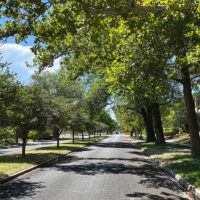
Neighborhoods with established tree canopy, parks and other green spaces generally recorded cooler temperatures than commercial corridors, industrial areas, large parking lots and other locations dominated by asphalt, concrete, bare ground and rooftops.
While the NOAA project measured air temperature, Davis’ infrared thermometer illustrated how much hotter surfaces can become. Those elevated surface temperatures contribute to higher cooling costs, create more stressful conditions for pedestrians, increase heat exposure for pets and accelerate wear on pavement and other infrastructure.
More than a desert town
For many longtime residents, it can be easy to take Grand Junction’s tree canopy for granted.
Davis said historic photographs from the late 1800s and early 1900s show a much different community with relatively few large trees.
Today’s canopy exists because generations of residents invested decades planting and caring for trees that they would never see reach full maturity.
Many of the mature ash trees surrounding the Parks and Recreation office are estimated to be 80 to 90 years old.
“It is our job to try to protect those and preserve them,” Davis said.
He said one of the biggest misconceptions people have is believing a mature tree can simply be replaced if it dies.
Depending on the species, it can take 50 years or more before a newly planted tree begins providing the amount of shade, cooling and environmental benefits produced by an established canopy tree.
“You can’t replace these overnight,” Davis said.
Trees as infrastructure
Davis believes communities should think about trees the same way they think about roads, bridges, water lines and parks.
“If there were no trees downtown, who would want to go down there and spend time?” Davis said. “They bring people.
They make places comfortable.”
Businesses along shaded streets often benefit from increased pedestrian activity, while numerous studies have associated mature tree canopy with improved public health, higher property values and stronger community connections.
According to the U.S. Department of Energy, carefully positioned trees can reduce a household’s energy use for heating and cooling by up to 25 percent while also lowering annual energy costs.
“They’re probably one of the best air conditioners ever created,” Davis said.
Balancing water conservation and tree preservation
As western Colorado continues to face periodic drought and increasing pressure on water supplies, Davis said some residents mistakenly believe they should stop watering mature trees in an effort to conserve water.
“Don’t think of it as a waste of water,” Davis said. “Think about it as protecting something on your property, or adjacent to your property, that is incredibly valuable.”
He said that shade also slows evaporation, so grass does not need as much water.
When selecting new trees, Davis recommends choosing climate-appropriate species suited to western Colorado while diversifying plantings, so neighborhoods are not dependent on a single tree species.
The city maintains an “All-Star Tree List” on its website to help residents select tree species well-suited to the Grand Valley’s climate.
Davis also gave a recommendation for those looking to eliminate grass altogether.
“If you’ve got a yard with big trees, if you’re gonna try to eliminate the grass, you need to be really thoughtful about how you continue to water,” Davis said. He recommended using organic mulch, perennials and shrubs with drip irrigation to distribute water throughout a tree’s root zone rather than relying on a single drip emitter near the trunk.
The hottest areas in town
The study found Grand Junction’s hottest areas were generally concentrated in commercial corridors, industrial districts and large retail centers where expansive parking lots, bare ground, rooftops and paved surfaces absorb heat throughout the day before releasing it well into the evening.
Davis said those findings were not surprising.
“It’s just gonna radiate heat,” he said. “That’ll make cities hotter than their surrounding rural areas.”
While the city’s Urban Forestry Management Plan includes canopy goals for all land uses, Davis said the city prioritizes investing water where trees provide the greatest public benefit.
“If we’re gonna invest water in trees, where will it have the biggest benefit?” Davis said. “That’s gonna be parks, residential neighborhoods.”
He said those areas provide shade where people gather and recreate while encouraging walking and other public-health benefits.
Davis said he would like to see more commercial and retail developments incorporate additional trees into parking lots.
“I would personally love to see more thoughtful design in our parking lots to increase plantable spaces,” he said, noting many shoppers already seek out the few shaded parking spaces on hot summer days.
The study also recommends: breaking up large expanses of pavement with landscaped islands, shade trees and other green infrastructure; preserving established trees during redevelopment; considering reflective paving and roofing materials; and using heat-mapping data to guide future planning.
Davis said Grand Junction is “always trying to find that sweet spot” as it balances competing priorities.
Investing in next generation
Davis said homeowners and businesses also play an important role by planting climate-appropriate trees, protecting established shade trees and diversifying species to build a more resilient urban forest.
Residents with irrigated, public right-of-way adjacent to their property may qualify for the city’s free street tree program, in which the Forestry Division selects, plants and maintains the tree while the adjoining property owner provides the water needed to establish it. Each spring, the city also distributes free tree seedlings during Arbor Day and Southwest Arbor Fest.
Davis encourages residents to plant a variety of species to reduce the risk that a single insect or disease could devastate large portions of the city’s canopy.
“Don’t worry about being so matchy-matchy,” he said. “Be a little more creative.”
Standing beneath established ash trees outside the Parks and Recreation office, Davis said they are reminders that today’s shade exists because previous generations invested decades caring for the city’s urban forest.
“I think that the critical part for us is that we have a lot of trees that have been here for decades, if not a century, that people have invested years and years of time to keep them healthy, to grow them and make them these valuable assets,” Davis said. “It is our job to try to protect those and preserve them.”

Grand Junction’s trees help curb the heat island effect added by The Business Times Staff on
View all posts by The Business Times Staff →