
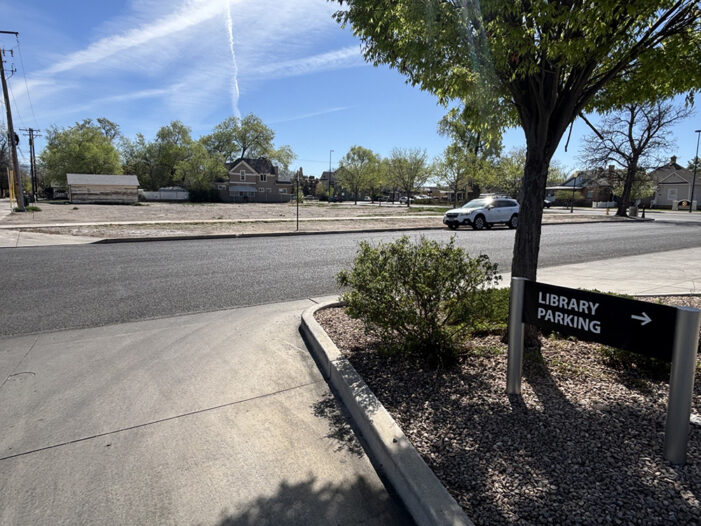
City requirements complicate library plan for parking lot; other priorities emerge
Brandon Leuallen, The Business Times
A downtown property purchased by Mesa County Libraries in 2024 as an investment that could help address parking challenges is now at the center of a broader debate over cost and priorities. Trustees now must weigh whether limited resources should instead be directed toward more pressing needs in Fruita or Orchard Mesa.
Library officials said during the Mesa County Libraries Board of Trustees meeting March 24 that the parcel, acquired last year near the main library, cannot be used as a simple private parking lot. The city’s downtown zoning rules require a primary building and stormwater detention infrastructure on the site. Those requirements have significantly increased projected costs and prompted the board to reconsider the project.
“We thought it was going to be used for a parking lot, and it cannot have that as a primary use,” library Executive Director Michelle Boisvenue-Fox said during a recent board discussion.
Fundraising challenges shape decisions
Boisvenue-Fox also said the current fundraising environment makes it difficult to pursue multiple large capital projects at once, forcing the board to more closely evaluate which projects at branches across the county should take priority.
“The reality of fundraising for capital projects in the current environment makes our case harder,” Boisvenue-Fox said, noting donor capacity is stretched across many competing needs.
That constraint has led trustees to more closely evaluate whether the downtown lot project represents the most urgent use of available funds.
Zoning limits flexibility
In addition to the cost of constructing a building, the discussion raised concerns about requirements tied to stormwater management and other development standards under the downtown zoning code.
Boisvenue-Fox expressed frustration about the inability to obtain a variance to use the property as a simple private parking lot, noting additional requirements increase project costs.
To comply with the code, the proposed project included a building to house the Friends of Mesa County Libraries, as their current location was not considered a suitable long-term location for the organization, according to Boisvenue-Fox. The bid received for the building showed it would cost upwards of $1.2 million.
Trustee Lisa Fry said the expanding scope of the project raises questions about whether it aligns with the district’s core mission.
“The library mandate is to provide library services,” Fry said. “When you get too far astray, I think you move outside what our mission is.”
“If you build on the lot across the street and it wipes out all of our reserves, then you’re starting from ground zero for any other priority,” library Finance Director Laura Pedge said.
Costs collide with competing priorities
Trustee Sheryl Fitzgerald said the estimated cost of building, roughly $1.2 million or more, may be difficult to justify to taxpayers given the limited return, noting the organization generates about $30,000 to $50,000 annually.
As trustees reviewed potential development options for the site, including an administration building or a building for the Friends of Mesa County Libraries, the conversation quickly shifted beyond the downtown property itself, particularly to needs in Fruita and Orchard Mesa.
Fruita, in particular, was repeatedly identified as a higher-priority need, with trustees describing it as a growing area with increasing demand for library services.
“I think we should do Fruita,” Fitzgerald said during the discussion, reflecting a broader sentiment that more immediate investment may be better directed toward expanding or improving services there.
At the same time, board members acknowledged ongoing concerns about the condition and long-term viability of the Orchard Mesa branch, including rising rent.
Exploring alternatives and next steps
Trustees also spent significant time discussing options to address concerns about the Friends of Mesa County Libraries’ current location.
Fitzgerald said the Friends’ existing building is limiting both visibility and participation, and customers and volunteers are often discouraged by the condition of the space.
“It’s one of the best-kept secrets in Junction that there is a Friends facility,” Fitzgerald said.
Board members described the facility as outdated and not fully accessible. Mary Watson said she would not return to volunteering in the current building, citing safety concerns.
At the same time, trustees emphasized the Friends organization continues to provide an important service by accepting donations and supporting library programs.
“A big part of what the Friends do is providing a service and accepting all of those donations,” one trustee said during the discussion. “They don’t ever turn donations away.”
Trustees discussed a range of possible solutions. Fitzgerald raised the possibility of utilizing the Clifton Branch campus or purchasing an existing house or building nearby as a lower-cost alternative, though she and others noted parking could be a challenge, depending on the location.
Considering off-site administration
Trustees also briefly discussed whether some administrative functions could be moved to a separate building as a way to free up space and potentially reduce pressure on the main library facility.
Trustee Rosanne Croft said the board should remain open to different configurations, including models used in other communities.
Fry raised concerns about operational impacts, including security and liability, if functions were split between locations.
Others said the concept is not new to Mesa County Libraries. Pedge said the district has previously operated with administrative functions in a separate building.
“We did do that 20 years ago,” Pedge said. “Admin was in a separate building.”
Croft referenced similar models used by other library systems.
“I worked for a library in Portland, and their administration was in a separate building,” Croft said.
Pedge also said any relocation likely would require modifications to the existing library building.
“If we’re moving somewhere else, that means there’s going to be cost associated here with renovation,” Boisvenue-Fox said.
No formal decisions were made, but trustees agreed to continue exploring alternatives and to bring the discussion to a joint meeting with the foundation scheduled for early April, where funding capacity and next steps will be discussed.

Library parking plan gets zoned out added by The Business Times Staff on
View all posts by The Business Times Staff →