
Brandon Leuallen, The Business Times
A long-planned effort to transfer the Town of Palisade’s wastewater system to the Clifton Sanitation District is entering a critical phase after construction bids in the fall came in too high for the amount of funding available and as state regulatory compliance and funding deadlines approach.
Town documents show Palisade has been working toward a long-term wastewater solution for more than a decade, following changes to state discharge standards. According to the “Palisade Sewer Fact Sheet – Final,” the Colorado Department of Public Health and Environment reduced allowable organic load limits in 2009, prompting the town to begin evaluating alternatives.
The same document explains that additional effluent limits are anticipated to take effect in 2027, and failure to meet those limits could expose the town to penalties of up to $54,833 per day per violation.
Also, an agreement signed between the Clifton Sanitation District and The Town of Palisade says funding for the project is tied to a completion date of 2027.
The project was previously expected to move into construction in 2024 and to be completed by 2027. However, construction has not yet begun, and after delays the timeline is now running tight.

Seasonal construction constraints
An added complication is that once construction does begin, construction schedules are constrained by irrigation operations, which require work affecting irrigation ditches along the route to be completed after the irrigation season, when the ditches are not in use.
In the Palisade area, the irrigation season typically runs from mid-April through mid-October, limiting ditch-related construction to late fall and winter.
In an interview with The Business Times, Town Manager Janet Hawkinson said this restriction applies primarily to portions of the sewer pipeline and not to the lift station. The lift station can be constructed year-round, while much of the pipeline work must occur during winter months, and the lagoons can be completed after that point.
With the next round of bids due in February, the lift station could be constructed during the summer months, but there would be little opportunity to begin pipeline construction before the ditches are filled, and the work must wait until the following winter. This creates a narrow window of roughly six months to complete pipeline work before irrigation ditches fill again in April 2027.
A project years in the making
Efforts to replace or supplement Palisade’s lagoon-based wastewater system began well before current town leadership. According to the “Palisade Sewer Fact Sheet – Final,” the town provides wastewater service to approximately 2,400 customers and has evaluated compliance options since at least 2009.
In 2020, the town completed the formal sewer study comparing alternatives.
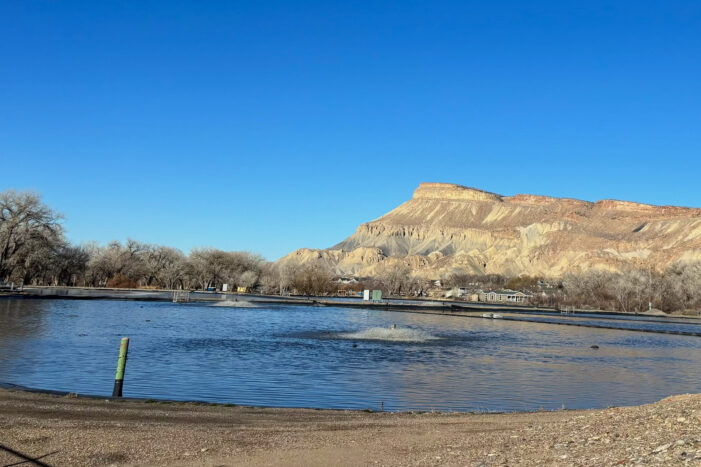
At the time, the sewer transfer option was identified as the most cost-effective and environmentally preferable approach, allowing Palisade to utilize an existing mechanical treatment facility rather than constructing a new plant along the Colorado River.
Hawkinson said the project was a high priority from the time she was hired as town manager in 2018.
“I want to say when I came on that was the number one priority of the board of trustees,” she said. “We needed to get this project done.”
Hawkinson said the concept of transferring Palisade’s wastewater to Clifton dates back decades and was contemplated when Clifton built its mechanical-treatment facility.
“Clifton Sanitation District, they did construct a mechanical plant, and I don’t have it in front of me when it was constructed, but it was 20 or 30 years ago,” she said. “It was constructed to take Palisade’s sewer, so that it can be treated. It never really took place.”
Hawkinson said consolidating wastewater treatment at Clifton avoids constructing multiple mechanical-treatment plants along the Colorado River.
“You don’t want a whole bunch of mechanical plants along the Colorado River,” Hawkinson said. “That’s not good for the environment or people.”
Construction delays and rising costs
Initially in 2020 after the town completed its Sewer study, Hawkinson had spoken to the Daily Sentinel, which wrote, “A brand new plant would cost around $15 million, Hawkinson said, while utilizing Clifton’s existing facility would cost around $7 million.”
As planning advanced, the scope and estimated cost of the sewer-transfer project grew to approximately $24 million by 2026, which includes a $6 million sewer tap fee to the Clifton Sanitation District. Hawkinson said only about half of that amount is tied to physical construction.
Hawkinson said construction costs account for roughly $11 to $12 million of the total. She said the project also includes about $2 million in engineering costs, approximately $1.5 million in contingency funding and roughly $1 million in interest associated with the federal loan.
Additional costs include land acquisition, easements, legal and administrative expenses, and the investment or tap fee paid to the Clifton Sanitation District of approximately $6 million.
Hawkinson said all of those components together bring the total project cost to just over $24 million.
Funding structure and financial exposure
Resolution 2025-17 – Amended Intergovernmental Agreement with Clifton Sanitation District, including Exhibit A, ties the sewer transfer project to federal loan and grant funding and says, “The funding is tied to a scheduled completion date of 2027.”
Asked about the funding deadline, Hawkinson said the city is still working on the 2027 timeline and is in communication with its partners throughout the process. When asked about if the deadline was not met for some reason, she confirmed the town could file extensions if additional time is needed.
Redesign and rebidding strategy
Hawkinson said the initial round of bids received last fall exceeded the portion of the budget allocated for construction. Engineering estimates placed construction costs at about $11.5 million, she said, but some bids came in as high as $23.5 million for construction alone.
Because those bids far exceeded the available construction budget based on the engineering estimates, the town rejected all proposals and chose to rebid the project rather than award a contract. Hawkinson said the contractors bidding originally were out-of-town contractors.
To address the cost gap and attract more local contractors, Hawkinson said the town restructured the project into three separate bids: sewer pipeline construction, lift station construction and lagoon decommissioning.
She said the approach is intended to allow multiple contractors to work simultaneously by moving the project into separate bids that can be completed independently.
“We have local companies now that are interested in bidding on this project ,because they just want to lay the line,” Hawkinson said.
New bids for the redesigned project are due Feb. 4 at 4 p.m. at Palisade Town Hall.

Palisade running tight on time, money on sewer transfer project added by The Business Times Staff on
View all posts by The Business Times Staff →