
Protecting your Mesa County property from wildfire before the flames arrive
Brandon Leuallen, The Business Times
As western Colorado continues to experience drought conditions and elevated wildfire danger, fires have burned across the region this summer, including along the Colorado River corridor and in neighborhoods in Mesa County. Some have been sparked by lightning, others by downed power lines, and authorities say some have been intentionally set.
The Two Rivers Wildfire Coalition says one of the most effective ways to protect a home begins long before smoke appears on the horizon.
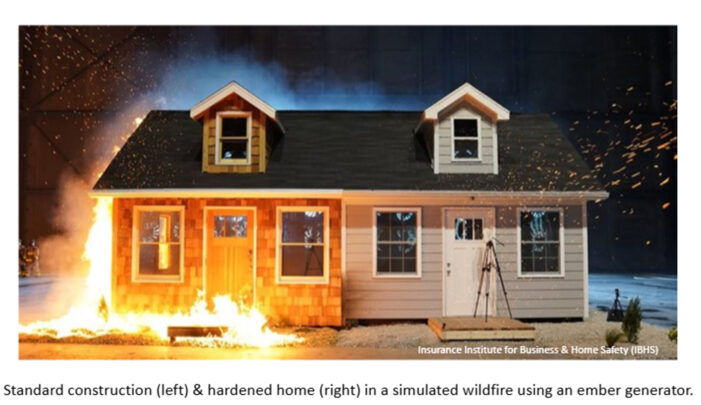
While many people picture homes catching fire as flames reach the structure, Two Rivers Wildfire Coalition Executive Director John Rizza said most homes are actually ignited by wind-blown embers that can travel well ahead of the main fire. Rizza shared a list of tips and resource guides with The Business Times for hardening homes and properties against wildfire risk.
“Most homes ignite by embers, not the fire front,” Rizza said. “You can find photos where the house is gone, but the trees around it are still green.”
Those embers can accumulate on roofs, decks and in gutters or be pulled into attic and crawl space vents, igniting a home from the inside. Rizza said research has shown that reducing places where embers can enter and removing combustible debris build-up from on and around a home can significantly improve a structure’s chances of surviving a wildfire.
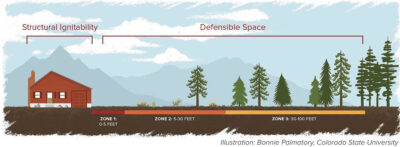
In addition to hardening homes against embers, Rizza recommends creating three defensive zones around a home, known as the Home Ignition Zone. Each zone focuses on reducing vegetation and other combustible materials at increasing distances from the structure to slow the spread of fire and improve a home’s chances of survival. Rizza said property owners can also use a variety of mitigation methods, including livestock in some situations, to help reduce wildfire fuels.
Wildfire risk extends into the valley
Many residents associate wildfire danger with the forests surrounding Mesa County, but Rizza said the Grand Valley also faces significant risks, particularly along river corridors.
Dense vegetation, dead plant material and human activity along waterways can create hazardous fuel conditions near homes and recreation areas.
“People think we don’t really have high wildfire danger here in the valley,” Rizza said. “Our river corridors are actually pretty hazardous places.”
Focus on the Home Ignition Zone
Rather than relying on firefighters to save every structure during a fast-moving wildfire, Rizza said homeowners should prepare their properties in advance.
“Our focus is on passive defense,” he said. “We want the house and property ready to go when a fire gets there, because resources are spread so thin during large wildfires that active firefighting is not the norm for most houses.”
The coalition encourages homeowners to reduce wildfire risk by starting at the home and working outward through the Home Ignition Zone.
Rizza shared the Colorado State Forest Service’s Home Ignition Zone Guide with The Business Times as a resource for homeowners. The guide defines the Home Ignition Zone as the home and the area surrounding it, taking into account the potential of the structure to ignite and the quality of the defensible space around it.
The first five feet surrounding a home are considered the most critical. Rizza recommends removing combustible vegetation and materials immediately adjacent to the structure and using noncombustible landscaping whenever possible.
From about 5 to 30 feet, homeowners should keep vegetation “lean, clean and green.” That includes mowing grasses, removing dead vegetation, spacing trees appropriately and pruning lower branches that can act as “ladder fuels,” allowing fire to climb from the ground into tree canopies.
Beyond that area, property owners should continue thinning vegetation and reducing fuel loads for at least 100 feet from the home whenever possible. On steep slopes or in areas where prevailing winds push fire toward a structure, Rizza said extending those treatments even farther can provide additional protection.
“We’re trying to disconnect fuels,” Rizza said. “Whether it’s tall trees or shrubs underneath them, we want to reduce those pathways that allow fire to spread.”
Harden your home against embers
Rizza said creating defensible space is only part of wildfire preparation. Because wind-driven embers ignite many homes before the main fire arrives, he recommends “hardening” the home itself to reduce the number of places where embers can ignite or enter the structure.
Rizza also shared the University of Nevada, Reno Extension’s Wildfire Home Retrofit Guide with The Business Times as a resource for homeowners. The guide notes embers can travel more than a mile ahead of a wildfire under the right conditions and often accumulate on roofs, in gutters, on decks and around vents before igniting a structure.
The guide recommends keeping roofs and gutters free of leaves, pine needles and other combustible debris, protecting attic and crawl space vents with ember-resistant metal mesh, screening chimneys with spark arrestors and sealing gaps where embers could enter the home.
Homeowners replacing roofs, siding, windows or decking should also consider fire-resistant materials whenever practical, especially during planned remodeling projects.
Rizza said homeowners do not have to complete every improvement at once. Many of the most effective steps, such as cleaning roofs and gutters, removing dead vegetation near the home and replacing older vent screens with ember-resistant materials, are relatively inexpensive. Making incremental upgrades over time, while maintaining defensible space around the property, can substantially improve a home’s chances of surviving a wildfire.
Livestock can help reduce vegetation
Mechanical thinning isn’t the only tool available.
Rizza said goats, sheep and cattle can be an effective way to maintain vegetation after initial clearing projects are completed, particularly on larger properties.
The City of Grand Junction has used goats to reduce vegetation in portions of its river corridor, while larger grazing projects have helped maintain treated areas that would otherwise require repeated mowing or mechanical work.
“They act like little lawn mowers,” Rizza said. “They’re a great maintenance tool in the right situations.”
Janie VanWinkle, a longtime Mesa County rancher, said in an interview with The Business Times that cattle can also reduce the fine fuels that allow wildfire to spread quickly across a landscape. Grazing lowers grasses and other vegetation, including cheatgrass, that dry out and can rapidly carry fire when winds increase.
VanWinkle said she has seen the benefits firsthand. She recalled a fire near Whitewater that slowed after reaching fields her cattle had recently grazed. She has observed similar patterns during other wildfires, with grazed areas often experiencing less severe fire behavior than areas with heavier fuel loads.
While grazing is not a standalone solution, she said it is another tool for reducing vegetation and helping landscapes better withstand wildfire.
Working together lowers costs
The coalition also encourages neighbors to organize projects together. Rather than treating one property at a time, grouping multiple neighboring properties into a single project can reduce contractor costs and make larger mitigation efforts more affordable.
The organization provides property assessments, technical recommendations and education for homeowners, homeowners associations and community groups. It also helps connect landowners with contractors and, when funding is available, financial-assistance programs for eligible projects.
Following a wildfire, the coalition also assists property owners with erosion, invasive weeds, damaged trees and post-fire recovery planning.
How to get help
The Two Rivers Wildfire Coalition serves Mesa County and works with private property owners to reduce wildfire risk.
Homeowners can request information or schedule a property assessment through the coalition’s website. The site includes information about defensible space, the Home Ignition Zone, educational resources and an online contact form for requesting assistance. The coalition also offers presentations for neighborhoods, community organizations and homeowner associations.
Rizza said wildfire mitigation is most effective when homeowners begin preparing before fire season arrives.
“It takes everybody working together,” he said. “The more we can prepare ahead of time, the better chance we have of protecting homes and our communities.”

Protection from wildfire starts with preparation added by The Business Times Staff on
View all posts by The Business Times Staff →