
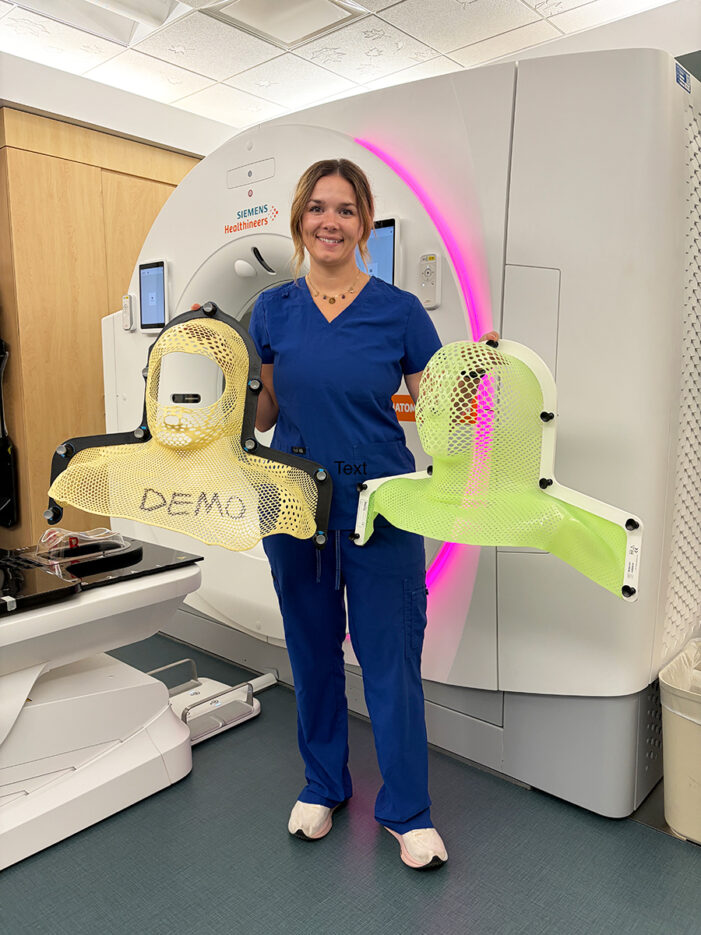
Intermountain Health St. Mary’s Regional Hospital this summer received more than $2 million of new equipment and technology to improve care and comfort of cancer-care patients.
St. Mary’s Cancer Centers of Colorado, 750 Wellington Ave. in Grand Junction, purchased a new computed tomography (CT) scanner that offers several enhancements over the center’s existing scanner. The new model, a Siemens SOMATOM go.SIM CT Simulator, has access to the latest tools, St. Mary’s Hospital said in a news release.
Physicians rely on having clear images of a patient’s cancerous tumor, so the dosimetrist can create plans of how radiation can target that tumor, the news release said. Intermountain Health manager of oncology services and radiation oncology April Grumley said it is important to be as precise as possible when delivering radiation, so only the tumor is impacted and surrounding tissue and organs are protected.
One of the new tools provides the ability to do a CT scan with contrast. This is a standard imaging procedure in which a dye is injected into the body, and it allows the dosimetrist to better see critical anatomy and certain tumors. This helps the dosimetrist be more precise and develop better treatment plans for patients.
The new CT machine also removes metal artifacts – such as a pacemaker, dental implants, or the hardware in a shoulder, hip or knee replacement – from the images it produces. When those artifacts are removed from the scan, the physicians and dosimetrists can see structures more clearly and create more accurate treatment plans. Previously, patients went to the hospital to have a CT scan with contrast.
The cancer center has expanded the technology that improves how radiation treatments are delivered. Vision RT Surface Guided Radiation Therapy allows the radiation therapist to continually monitor the position of patients throughout treatment. The technology detects even the slightest movement of the patient in real time and can stop the treatment until the patient is positioned correctly. The cancer center has used this type of technology since 2015. Now, with the latest version added to the linear accelerator, they can serve more patients who have a wider range of cancer diagnoses.
“Perhaps most important for patients is the ability to now wear an open-face mask during treatment,” Grumley said. Previously, patients wore a full-face mask that attaches to the patient’s board and keeps them from moving throughout the treatment, which often lasts as long as 15 minutes.
The final piece of equipment the cancer center acquired literally makes a small degree of change with the patient but has a big impact on the precision of their treatment, Grumley said. The 6 Degrees of Freedom Treatment Couch can tilt in six directions enabling greater precision in placing the patient, improved treatment accuracy for difficult treatment sites, and better alignment between the daily imaging and treatment delivery.
“This new equipment and technology is a major advancement for our patients in Western Colorado and shows our commitment to bringing the most advanced capabilities to the Grand Valley,” Grumley said.
The new technology will benefit patients diagnosed with several types of cancer including head and neck, brain and lung.

St. Mary’s purchases new cancer-care tech added by The Business Times Staff on
View all posts by The Business Times Staff →