
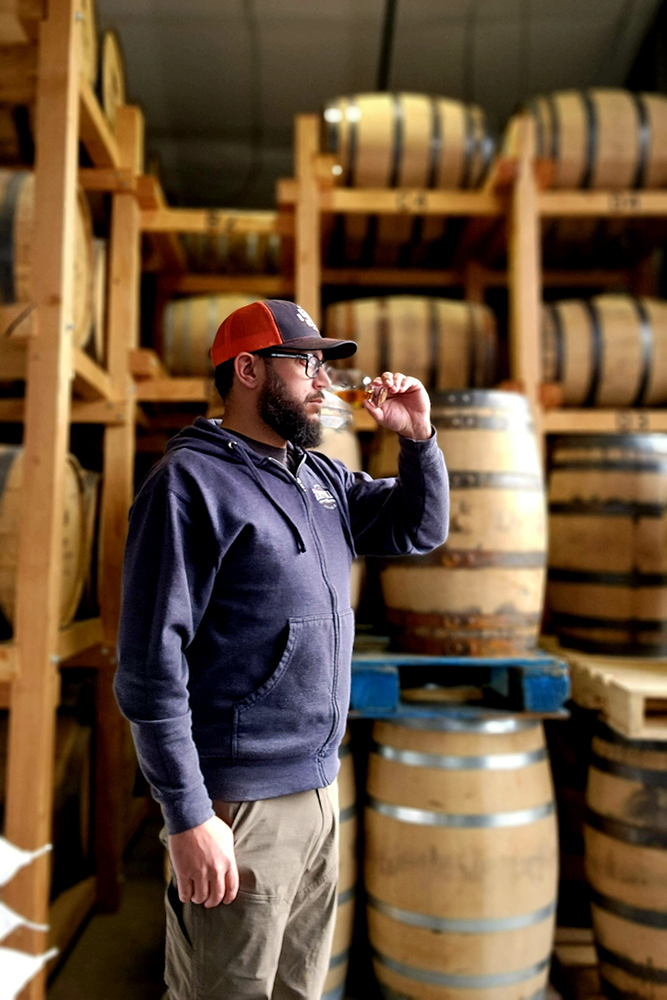
Bill would increase excise tax from 8 percent to 13 percent on brewers, vintners, distillers
Tim Harty, The Business Times
Colorado House Bill 26-1271, A Bill For An Act Concerning the Creation of Enterprises to Address the Impacts of Alcohol Use, has a worthwhile cause. There’s not much arguing against the merits of alcohol-use treatment and recovery services and prevention programs for youth and communities.
Funding it is where opposition arises, and the bill proposes getting the money by increasing the excise taxes on the makers of alcohol in its various forms. The bill proposes raising the excise tax from 8 percent to 13 percent, which is a 62.5 percent increase.
Of course, the brewers, winemakers and distillers, of which the Grand Valley has plenty of each, don’t want to foot that bill. They say their profit margins are minuscule as is, and passage of the bill would be needlessly damaging to their respective industries during a time when they’re already struggling with other challenges.
The bill gets its first hearing in the House Health & Human Services Committee on March 17. That means amendments to the bill are likely, and if it passes in the House, the Senate then gets its say, so the bill can change significantly in the coming days and weeks.
Addressing the bill before any changes, House District 54 Republican Rep. Matt Soper acknowledged HB26-1271 “may be for a good purpose,” but it’s poorly timed.
“It’s hard to talk about raising taxes when everything within Colorado has gotten more expensive,” he said.
And going after the beer, wine and spirits producers is even worse timing.
“This comes at a time when alcohol consumption in Colorado is at, at least, a 50-year low. It may even be an all-time low,” Soper said. “Our alcohol manufacturers here in Colorado are certainly not doing as well as they were even just five or six years ago during the pandemic. And this, in my opinion, is a real slap in the face to be talking about raising a tax on them when already their volumes and sales are down.”
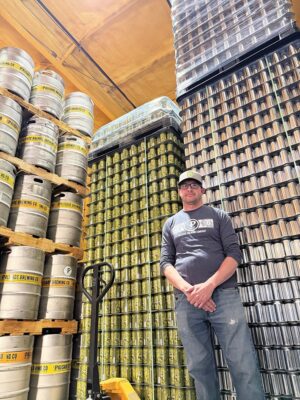
Palisade Brewing Co. Production and Sales Manager Brett Zahrte expounded on that line of thought.
“We’re trying not to bleed to death from 1,000 knife wounds, and this is going to be one more thing,” he said of the bill. “Between the increased cost of raw materials, the global-supply-chain stuff that got shaken up last year, a nickel per six pack may not seem like a lot to anybody. That’s around that number where that increase would imply, and when you package thousands and thousands and thousands of six packs a year, it’s a big number, a very big number.”
A 60 percent tax increase sounds alarming, but House District 41 Rep. Jamie Jackson, one of the two Democrats who sponsored the bill in the House, put it in a different perspective.
“It’s important to clarify that this bill establishes a fee structure for manufacturers and distributors, not consumers, through an enterprise, not a general tax increase,” Jackson said.
What HB26-1271 proposes, she said, had a cost impact of: less than 1 cent per beer; about 1 cent per glass of wine; and approximately 1 to 2 cents per mixed drink.
“For example, a brewer producing 10,000 gallons of beer annually would pay about $500 per year,” she wrote in an email interview with The Business Times. “Given the scale of the public costs associated with alcohol misuse, the bill is designed to be a very modest contribution from the industry toward addressing those impacts.”
There, the affected industries beg to differ. Greater cost will accrue through tiers that lead to the customers ultimately paying more.
Colorado Brewers Guild Executive Director Shawnee Adelson said the addition of 5 cents per gallon to beer via the increased excise tax may not seem like a lot.
“However, every time an input cost goes up, the price manufacturers must charge also goes up,” she wrote in an email interview. “Beer going through the three-tier system (manufacturer, wholesaler and retailer) will see that $0.05 go up each time, because each tier will need to cover their increased costs. This in turn affects the final price a consumer pays for beer.”
Adelson added beer is not priced incrementally by the penny. Rather increases will cause beer to go up by 50 cents or $1 per glass or six pack.
“Ultimately,” she said, “each business will have to determine for itself if and how it can absorb this massive tax increase. Some will likely raise prices on consumers, while others might feel they’re already priced high and raising prices more puts them at a competitive disadvantage. Regardless, this tax increase means less revenue for these businesses with already razor-thin margins.”
Jackson argues the state’s brewers, vintners and distillers should help foot the bill for what she calls “the very real public costs associated with alcohol-related harm in Colorado.”
She said alcohol misuse contributes to “significant impacts across our public systems, including health care, public safety, courts and behavioral health services. Those costs are currently borne largely by taxpayers through state and local government budgets.”
And HB26-1271 “helps ensure that some of the costs created by alcohol-related harm are supported by the industry whose products contribute to those impacts, rather than falling almost entirely on taxpayers,” she said.
Opponents such as Soper criticize the funding approach, the enterprise model, which he said is being used to dodge limitations from the Taxpayer’s Bill of Rights.
Jackson said the enterprise model comes with the benefit of “creating a dedicated funding stream specifically for prevention, treatment and recovery related to alcohol misuse.”
She added, “Using the enterprise structure ensures that the funding is dedicated to addressing alcohol-related harms and cannot be diverted to unrelated state spending. It also creates transparency and accountability around how those funds are used.”
“The bill establishes separate enterprises for beer, wine and spirits, because those products are already treated as distinct categories under Colorado law and tax policy. Each category has its own regulatory framework and excise tax structure, so structuring the enterprises this way simply aligns the program with how the alcohol industry is already organized.”
Soper acknowledged the bill is likely to pass both houses and reach the governor’s desk, not just because Democrats control both houses of the legislature. Rather the sponsors, Jackson and Jennifer Bacon in the House and Judy Amabile and Iman Jodeh in the Senate, he said, “are legislators who tend to be very successful. And I would be surprised if they’re just doing this as a messaging bill. I mean, I think their intent is to get this through.”
Soper would like to be wrong about that, as he said, “I represent the majority of Colorado’s wineries, so obviously, I’m against any new taxes that are, in this case, a fee that’s dressed up like a tax, against our wine manufacturers. And wine is more than just manufacturing and selling alcohol. Colorado wine is tourism. And Colorado wine is how we help promote the Western Slope, and we have visitors who come to places like Palisade or the West Elk region around Paonia.
“And so to be tacking on more fees and taxes onto alcohol really is a way to attack the marketing, the promotion, the tourism, and those people who want to live in Colorado and support our local, small businesses. Because guess what? Every winery in Colorado is a small business. None of them are large enough to be considered even a medium-sized business.
“So, to me, this just feels like kicking the little guy while they’re struggling to make it.”
Q&A with Cassidee Shull and Dave Fishering
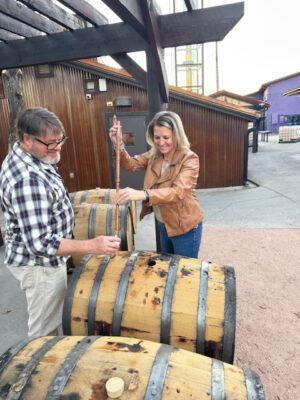
The Business Times did email interviews with Cassidee Shull, executive director of the Colorado Association for Viticulture & Enology in Palisade, and David Fishering, co-founder and distiller at Storm King Distilling Company in Montrose, regarding HB26-1271, a bill introduced in the Colorado House of Representatives on Feb. 19.
The bill’s title is “A Bill For An Act Concerning the Creation of Enterprises to Address the Impacts of Alcohol Use.” Its first reading is scheduled for March 17 in the House Health & Human Services Committee.
The Business Times’ intent was to use select quotes from Shull and Fishering for a story about the bill and potential effects on local brewers, vintners and distillers. After reading Shull and Fishering’s in-depth answers to the same questions, The Business Times decided they deserved more than a few excerpts in a story. Instead, we’re printing their entire interviews in the following question-and-answer format:
If this bill, HB26-1271, passes as it currently reads and the excise tax goes from 8 percent to 13 percent, how does that affect distillers?
Fishering: The current excise tax on spirits is $0.6026 per liter (this is more than beer and wine), and HB26-1271 looks to increase this to $0.9526 by way of a $0.35 tax, disguised as a “fee.” This is a huge 60 percent increase in taxation, targeted at manufacturers. We are seeing massive declines in the drinking population, spending on higher-end goods is down, costs for supplies has gone up due to tariffs, the cost for employment has gone up with mandatory wage increases and unfavorable housing market, commercial property taxes and business personal property taxes are extremely high and unfairly target manufacturing businesses in Colorado, and amid all of that this bill wants to increase our excise taxes.
How does that affect winemakers?
Shull: If the excise tax increases from 8 percent to 13 percent, Colorado winemakers, especially small and mid-sized producers, will face a significant cost increase. Many local wineries operate on very narrow margins, and absorbing this extra tax would be difficult without passing it along to consumers.
Winemakers have told us they would likely have to evaluate pricing, reduce production investments, or in some cases rethink expansion plans. Unlike large beverage producers, smaller wineries don’t have the flexibility to spread these costs across high-volume sales, so the impact is more immediate and tangible.
For your distillery specifically, and if you’ve spoken to others, what have they suggested they might have to do?
Fishering: The way excise taxes work, is that we have to pay them before we can sell the consumer a product and cover our costs. So before I can sell you a bottle of whiskey I have to pay taxes to the government (state and federal) for the privilege. With this tax increase, over 7 percent of the cost of a bottle of spirits will be Colorado taxes. With all the other hits we are taking, the only way to defer that cost is to increase our prices, which only hurts the consumer, who is already less likely to spend $85 on a bottle of whiskey, than they were five years ago.
Will this lead to price increases that the average consumer of spirits will notice?
Fishering: See previous answer.
Shull: Yes, it is very likely. Even modest increases in excise taxes tend to be passed on to consumers, and a jump of this size, a more than 60 percent tax increase, would be noticeable, particularly for premium and craft wines. Local consumers who support Colorado wineries may see higher prices in tasting rooms, retail stores and restaurants. This could inadvertently discourage customers from buying local wine, which is a concern for both tourism and the state’s growing wine industry.
Are distillers going to be affected differently than brewers or winemakers?
Fishering: Spirits have always been taxed at a higher rate than beer and wine, and even though the increase is similar, we still are taking the brunt of it, particularly in Colorado, where the state taxes us on volume in a bottle, and not on volume of alcohol in said bottle; a bottle of 80 proof whiskey gets taxed the same as a bottle of 120 proof whiskey. If this bill gets passed we all might start releasing higher-proof products to cut down on the overall volume that is being taxed!
Are winemakers going to be affected differently than brewers or distillers?
Shull: Small producers across all three sectors will feel this excise tax increase. Many Colorado wineries, breweries and distilleries are small, family-owned businesses producing limited quantities of high-quality products. For these businesses, the tax increase represents a significant portion of revenue and is harder to absorb. Because wineries often sell directly to consumers through tasting rooms or wine clubs, the cost is felt immediately by both the business and the customer. While each sector has its own business model, the impact on small producers is similar: It creates real financial pressure that could lead to higher prices or reduced growth.
Is this tax increase really needed, as the bill suggests, or do you think existing measures are sufficient, making this bill unnecessary? Or might this bill be acceptable at a lesser increase?
Fishering: No, the increase is not necessary. The State has a $800 million budget shortfall, and the legislature is looking to the alcohol industry to make up some revenue, it is as simple as that. HB26-1271 clearly states that we the manufacturers are the cause of alcoholism, and therefore we should pay for substance-abuse programs. This is blatantly untrue, as we are not the cause of substance abuse (this would be like taxing Hostess for making Twinkies and causing obesity in America).
Our industry does a ton of work to promote the responsible use and consumption of our products. If the programs that HB26-1271 is seeking to fund are of such great importance then the State should go to the people for a vote on a tax increase, or better yet, better manage the budget. The alcohol manufacturing industry already contributes over $7 billion in taxes to the State of Colorado, the majority is from the distilling industry. There is no amount that would be agreeable by our industry, as the proposal is to use the funds to set up “enterprises” and boards for those enterprises, which doesn’t solve alcohol abuse, it simply would be government taxing us to set up more government bureaucracy.
Shull: We support funding important public programs, but this excise-tax increase could place extra strain on Colorado’s small beverage producers, including wineries, breweries and distilleries.
These local businesses already contribute more than $56 million in alcohol tax revenue each year, though none of that revenue is currently earmarked for addiction and recovery services.
Do you have other thoughts you want to share beyond what The Business Times questions address? Please share whatever you think consumers should know.
Fishering: The biggest issue with the bill is that it seeks to target and harm an industry that has put Colorado on the map. We make some of the best spirits in America, including some of the best whiskey in the world (look at the previous winners from international spirit competitions, and there is always a Colorado distillery in the mix). Craft beer made Colorado famous, and now craft whiskey is continuing that trend. Our state used to be a huge proponent of the craft beverage industry. The bill’s sponsors claim that the increase is justified, because we have some of the lowest taxes in the country on alcohol. This is true, but that is why we have a vibrant, thriving industry that attracts people to the State. Increasing taxes will severely damage what our industry has built.
Shull: Colorado’s wine industry is still young and growing, and it relies heavily on local consumer support, tourism and small businesses. A steep excise-tax increase risks making Colorado wine less accessible and could slow the momentum of an industry that contributes to economic development, agritourism and the state’s identity as a wine destination. Consumers should know that any additional tax costs are likely to be reflected in the price of the wine they purchase, and that supporting local wineries directly benefits the state’s economy and preserves the quality and diversity of Colorado wines.

Will new tax put alcohol producers over a barrel? added by The Business Times Staff on
View all posts by The Business Times Staff →