
Effort to eradicate Japanese beetles showing early signs of success in Mesa County
Brandon Leuallen, The Business Times
Early indications suggest Mesa County’s effort to stop Japanese beetles before they become permanently established are working.
Sharply declining trap counts signal an aggressive eradication campaign may be preventing the Western Slope from facing the widespread infestations seen along Colorado’s Front Range and other parts of the country.
County officials say that goal is especially important because of the Grand Valley’s orchards, vineyards and other agricultural operations. They also say stopping the beetle before it becomes widely established could prevent significantly higher pesticide use in the future.
“The first year we did treatments, we caught 5,700 adults,” said Ryan Surad, Mesa County’s noxious weed and pest coordinator. “Last year we caught 1,500 adults, and as of Monday this week we’ve currently caught 350 adults (this year).”
Surad cautioned that this year’s numbers remain preliminary because adult-beetle activity typically peaks around July 18, but he said the downward trend is an encouraging sign that the eradication effort is working.
Japanese beetles were first detected in Mesa County in 2022 during routine monitoring conducted at a local nursery. Nurseries regularly trap for invasive insects, because they move plant material that can spread pests.
Although the beetles were discovered at a nursery, Surad said state inspectors found no evidence the business introduced the insects.
“We don’t have any confirmed evidence, but we believe this pest was transported here through untreated turf grass,” Surad said.
He said the county experienced substantial housing development and landscape renovation in north Grand Junction around the time the beetles likely arrived. Officials believe untreated sod brought from the Denver area is the most likely source, although no direct evidence has confirmed that conclusion.
Following the discovery, Mesa County expanded trapping throughout 2022 and into 2023. County commissioners subsequently declared the Japanese beetle a public nuisance and authorized an eradication program rather than waiting for the insect to spread throughout the valley.
That decision was driven largely by the potential threat to agriculture.
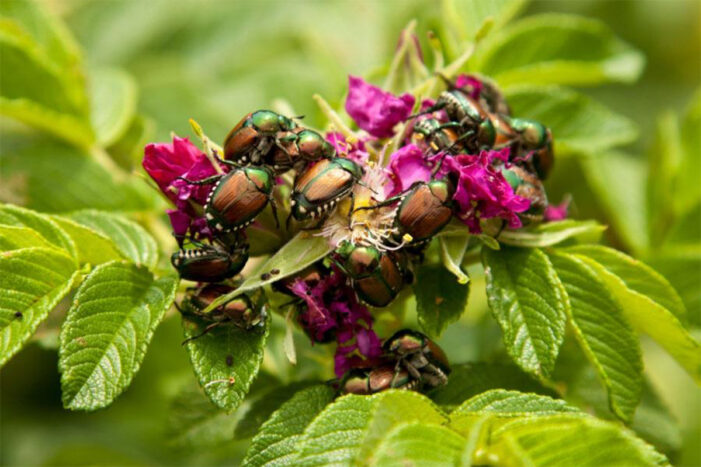
Japanese beetles are considered one of the nation’s most destructive landscape and agricultural pests because they feed on an unusually wide variety of plants.
“They’ve been observed feeding on up to 300 different species of plants,” Surad said.
Unlike many insects that specialize in only a few host plants, Japanese beetles attack fruit trees, grapes, roses, ornamental landscaping, gardens and numerous other species.
“The adult is really what causes a lot of the damage we are concerned about,” Surad said.
Adult beetles feed on leaves by consuming the soft tissue between the veins, leaving behind only the leaf’s framework in a process known as skeletonization.
“They can completely defoliate leaves,” Surad said.
The insects also feed on flowers and fruit, making them an expensive pest for homeowners and commercial growers.
Despite those concerns, Surad said Mesa County has not yet experienced significant crop losses, because officials detected the infestation while it was still relatively small.
“No,” he said when asked whether local farmers have suffered substantial damage. “Thankfully, we got involved early enough that there would not be significant damage from the population levels that we’re seeing right now.”
He said that early response is what separates Mesa County from much of Colorado’s Front Range.
Communities around Denver, Colorado Springs and Fort Collins now have widespread Japanese beetle populations and generally focus on managing the insect rather than attempting eradication.
Surad said organizations such as the Denver Botanic Gardens devote staff during beetle season to hand-picking Japanese beetles from roses and dropping them into buckets of soapy water to reduce damage.
“They’re not pursuing eradication, because they don’t have significant agriculture production there,” he said.
Mesa County, by contrast, still has an opportunity to eliminate the pest before it becomes permanently established, protecting one of the state’s most important fruit-growing regions.
The county’s eradication strategy focuses on where Japanese beetles begin their life cycle rather than where the adults feed.
Female beetles prefer to lay their eggs in regularly irrigated turfgrass. The larvae, or grubs, develop underground before emerging as adults the following summer.
Instead of treating every lawn in the county, Mesa County uses trap data to target treatments.
When a trap captures Japanese beetles, officials establish a 200-meter treatment radius around that location. Property owners within the treatment area receive a mailing or door hanger, offering free treatment that is provided only with the property owner’s permission.
“Only owners can sign off on the treatment,” Surad said.
The county contracts with WD Yards to apply Acelepryn, a product that targets the grub stage before adult beetles emerge.
This year, contractors have treated more than 1,800 private properties, covering approximately 300 acres. The treatment area generally stretches from 24 Road to 27 1/2 Road and from Patterson Road north toward the Holy Family Catholic School area, 786 26 1/2 Road, although the boundaries shift as new trap data are collected.
Surad said public participation remains critical because untreated properties can provide breeding areas that allow the infestation to continue spreading.
He also warned that failing to eradicate the beetle now could lead to much greater pesticide use in the future.

Beetles, be gone! added by The Business Times Staff on
View all posts by The Business Times Staff →