
Brandon Leuallen, The Business Times
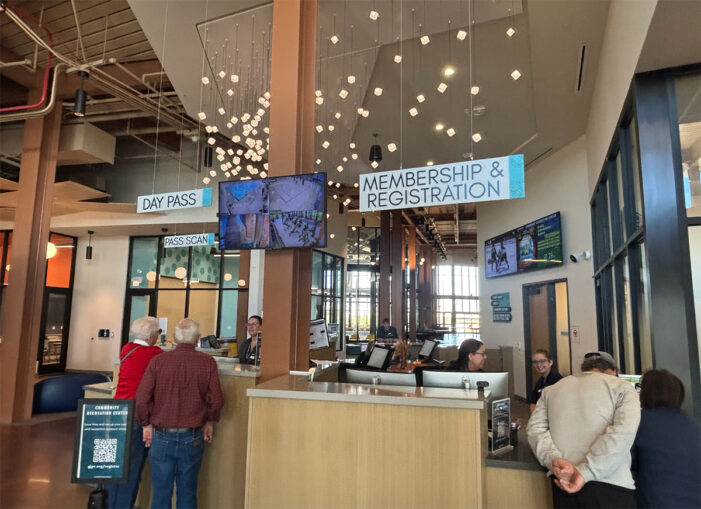
Grand Junction received a large and well-equipped recreation center when the facility opened Sept. 25, and membership sales are on pace to exceed projections, according to the city.
Its opening also has raised questions about costs beyond the voter-approved 0.14-percentage-point sales-tax increase. Local businesses have expressed concerns about potential lost revenue, although the full effect may take time to measure. And admission prices are among the highest of the regional community recreation centers reviewed by The Business Times.
The opening also comes amid changes to longstanding facilities. The Senior Center will remain open after the city reversed a proposal to move its activities into the new recreation center. Orchard Mesa Pool is set to close permanently after voters rejected repair funding. The city also planned to relocate recreation programming from the Red Barn at Lincoln Park to the new center while leasing the barn to Colorado Mesa University.
The project grew substantially during planning and construction under former City Manager Greg Caton.
In 2022, the city considered a roughly 65,000-square-foot, $55 million option before advancing an approximately 83,000-square-foot, $70 million concept ahead of the 2023 election. The completed center reached approximately 107,000 square feet and $82.1 million.
The ballot authorized up to $70 million in debt and said amenities “may include but not necessarily be limited to” those listed. It did not individually name every service the completed facility would offer, including the indoor climbing wall and primary care and therapy clinic.
Memberships approach the city’s goal
In written responses provided Nov. 5, Grand Junction Communications Manager Kelsey Coleman reported 4,396 total memberships covering 6,956 individuals, including 2,271 SilverSneakers and Renew Active participants. Those programs provide fitness benefits through participating health-insurance plans.
The individual count nearly matched the 6,978 members anticipated in the city’s financial model. The city said sales were “on pace to well exceed” its initial goal.
The city also reported 35,693 admissions, including 10,734 day-pass admissions. A broader count of 52,316 building visits included events, clinic visits, community-wing use and tours.
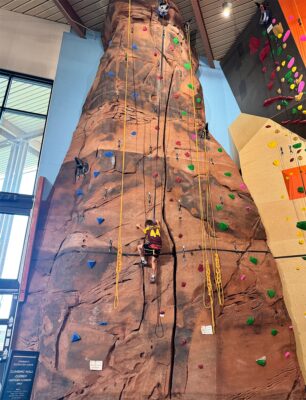
Coleman’s response said attendance was tracking with projections. Pools, the climbing wall and game hallway were popular attractions, while community and party rooms drew strong reservation demand.
Business concerns
In a July 6 Daily Sentinel article, prior to the rec center’s opening, Cole Christensen, owner of Mesa Fitness in Grand Junction and Gold’s Gym in Montrose, said the Montrose gym experienced a 32.8 percent membership decline after that community’s recreation center opened in 2017. He said it never fully regained those members.
Crossroads Fitness owners Dale and Paula Reece also described Grand Junction’s center as direct competition while recognizing community benefits.
Before becoming the Grand Junction Parks and Recreation director, Ken Sherbenou oversaw development of Montrose’s recreation center. He said recreation centers could expand fitness participation over time, although private gyms would likely experience near-term membership declines. He also said,as a compromise with private operators, Grand Junction did not plan to offer personal training.
According to the city’s website, the recreation center offers yoga, chair yoga, barre, Zumba, tai chi, line dancing, cardio kickboxing, strength training, indoor cycling, high-intensity interval training, balance and mobility, introductory weightlifting and SilverSneakers classes.
In an interview with The Business Times, Grand Valley Climbing owner Fabrizio Zangrilli said at least initially his business has seen fewer casual recreational visits.
The center’s overlap with existing businesses also extends to health care. Intermountain Health’s Matchett Park Clinic opened inside the building Sept. 28, offering physical therapy, aquatic therapy, rehabilitation and wellness-focused primary care. Intermountain Health says the partnership connects rehabilitation with continued exercise at the recreation center or another gym.
Kirby Richardson, who co-owns Tailwind Therapies with her husband, Sean, described their business as one of the region’s few remaining independent therapy clinics. She said the city’s partnership with St. Mary’s adds to competitive pressures from large hospital systems, and she expressed frustration that tax dollars are helping support a competitor to smaller local providers.
Several other local businesses contacted by The Business Times declined to comment, or said not enough time had passed to assess the extent of the new recreation center’s effect on their operations.
The price of access
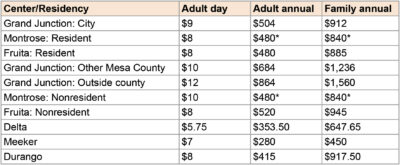
Grand Junction charges city residents $504 for a standard adult annual membership, compared with $480 at Montrose and Fruita rec centers, $415 at Durango, $353.50 at Delta and $280 at Meeker.
Census estimates put Grand Junction’s median household income at $70,080, nearly identical to Montrose’s $70,386 and below Durango’s $78,602 and Fruita’s $87,184. These are 2020–2024 estimates expressed in 2024 dollars.
The price difference is larger outside city limits. An adult elsewhere in Mesa County pays $684 annually for a standard adult annual membership; an outside-county customer pays $864.
For a family of four, Grand Junction charges $912 annually inside city limits, $1,236 elsewhere in Mesa County and $1,560 outside the county.
A family in nearby Clifton therefore pays $324 more annually than a city-resident household. One visit for two adults and two children ages 3 to 17 years costs $36 at the county rate, compared with $30 for city residents. Clifton’s median household income is $52,100, approximately 26 percent below Grand Junction.
Comparisons vary by category. Durango’s annual price for two adults and two children ages 4–17 is $917.50, slightly above Grand Junction’s city-resident family rate.
Scholarships promised in the plan
Asked whether the center was reaching lower-income households, Coleman said the city does not collect members’ income information and could not provide that breakdown.
The city’s recreation center plan, adopted Nov. 16, 2022, stated on page 44 that the facility “must be affordable and financially accessible to the Grand Junction community at large.”
The adopted plan also stated on page 47: “Scholarships will be available through the Parks & Recreation Department to ensure accessibility to the CRC for low-income families.”
The city advertises scholarships for youth camps, swim lessons and sports, with eligibility limited to children living within city limits.
The Business Times could not locate a publicly listed scholarship covering recreation-center memberships or general admission for low-income families. The city did not respond to a follow-up question about that assistance in time for this edition of The Business Times.
 Funding the expanded facility
The ballot’s $70 million figure limited borrowing rather than the total construction budget. It asked whether “City of Grand Junction debt” should “be increased $70,000,000.” It separately authorized sales-tax revenue for “debt service, construction, equipping, and furnishing, and if available, operating and maintaining” the center.
The city’s published construction-funding plan identifies $2.5 million in cannabis-tax revenue and $3.3 million in dedicated sales-tax revenue, totaling $5.8 million separate from bond proceeds. The cannabis tax was authorized separately.
The city also credits a $4.5 million Intermountain Health St. Mary’s Hospital contribution and a $1 million state grant with helping expand the facility. St. Mary’s pays an annual lease for its therapy and medical space.
The $82.1 million budget is approximately 17 percent above the $70 million concept, while the building grew about 29 percent, including the clinic. Three planned pools became five, and group fitness rooms and community rooms each increased from two to three.
Orchard Mesa Pool and the Red Barn
On Nov. 3, voters rejected Issue 2B, according to unofficial results released by the city. It would have raised the sales and use tax by 0.07 percentage points and authorized up to $12 million in debt for Orchard Mesa Pool repairs.
The city says the pool’s major systems have reached the end of their useful lives. Mesa County Valley School District 51 owns the facility, historically operated along with the city and Mesa County. After the county withdrew in 2024, the city and district continued under an agreement expiring in December 2026. Following the vote, the city said the pool would move toward closure.
As previously reported by The Business Times, city recreation programming at the Red Barn was expected to move to the new center. Under a 25-year agreement, CMU will use the barn for football strength and conditioning, and it will construct a separate building beside Stocker Stadium.
Neither the closure of Orchard Mesa Pool nor the relocation of recreation programming from the Red Barn to the new recreation center was stated in the 2023 ballot language.
Senior Center stays after residents object
Grand Junction City Manager Mike Bennett reversed the proposed Senior Recreation Center closure Oct. 21 after member and community feedback, announcing it would remain at 550 Ouray Ave. Residents emphasized the importance of familiar surroundings and a space dedicated to seniors.
The proposal was part of efforts to address the city’s General Fund structural deficit. The city will retain approximately $100,000 in its recommended 2027 budget for facility and utility costs and develop a new agreement with the nonprofit operator by January.

Breaking down real cost of GJ rec center added by The Business Times Staff on
View all posts by The Business Times Staff →
One Response to "Breaking down real cost of GJ rec center"