
Brandon Leuallen, The Business Times
Since 2022, Grand Junction has seen more than $62 million invested in subsidized housing and homelessness-related initiatives through a combination of city funding and partner investment.
During a May 4 workshop, city officials also said roughly $460,000 in taxpayer dollars had been spent cleaning up homeless encampments along the river corridor since 2022, removing approximately 119 tons of debris from campsites along the Colorado and Gunnison rivers.
Also during the workshop, City Council directed staff to move forward with a proposed amendment to the city’s camping ordinance that would remove language currently limiting enforcement when overnight shelter space is unavailable.
The discussion centered around two major developments: The 2024 U.S. Supreme Court decision in City of Grants Pass v. Johnson; and the recent consolidation of the HomewardBound North Avenue shelter into the Pathways shelter on 29 Road, which reduced the number of emergency-shelter beds available in the city.
Grand Junction Police Chief Matt Smith emphasized during the May 5 workshop that camping along the Colorado and Gunnison river corridors has involved longstanding environmental impacts and public-safety concerns that predated the consolidation of the North Avenue shelter into the Pathways shelter, and they have remained an ongoing issue
Interim City Attorney Jeremiah Boies told council the city’s current ordinance was originally written around the 2019 Ninth Circuit case Martin v. City of Boise, which found it unconstitutional to enforce camping bans when no overnight shelter was available.
“The important caveat and the reason for this discussion is there’s an exception to our ability to enforce the camping ordinance contained within there, and that was based on Ninth Circuit case law,” Boies said.
Boies said the Supreme Court’s 2024 Grants Pass ruling overturned that earlier precedent.
“In that case, they overturned the Ninth Circuit previous holding and found that there was no constitutional violation for enforcing a camping ban on public property when there was no overnight shelter available,” Boies said.
Under the city’s current ordinance, enforcement cannot occur if overnight-shelter space is unavailable. Boies said the closure of Homeward Bound has effectively made the ordinance difficult or impossible to enforce in many situations.
“We’re essentially in a position where our camping ordinance becomes effectively unenforceable, because most of the time there is no overnight shelter available,” he said.
Ordinance dates back to 2019
According to the city’s May 4 staff report discussing potential amendments to Ordinance No. 4833, the ordinance was originally adopted on April 17, 2019, and prohibited camping on public property while including several exceptions, including one tied to overnight-shelter availability.
The staff report states the shelter-availability language was specifically added to reflect the legal standards established in the Martin v. Boise ruling before it was overturned by the Supreme Court in 2024.
The ordinance was later reenacted in 2022 after council removed an original sunset clause.
According to the May 10, 2022, memorandum from then-Police Chief Doug Shoemaker that was included in the city’s ordinance materials, Grand Junction police made more than 1,000 contacts related to illegal camping over a two-year period while issuing citations in only a small number of cases.
The memo says enforcement generally occurred only after individuals ignored requests to leave or “refused other assistance in getting permanent housing.”
River encampments predate shelter closure
Smith gave council a historical overview of the city’s homeless-encampment-response efforts, which he said began in 2011 after outreach teams identified growing concerns involving public safety, public health, environmental contamination, wildlife impacts and wildfire risk.
“The homeless outreach team and that team were really bridging the gap between our homeless community, nonprofit-service providers that were out in the camps pretty frequently,” Smith said. “And they identified some issues.”
Smith said the city initially attempted smaller cleanup efforts internally before eventually hiring specialized contractors capable of handling hazardous waste, needles, propane tanks, mattresses and other debris commonly found in camps.
“As a result, in 2011, we started doing camp cleanups,” Smith said.
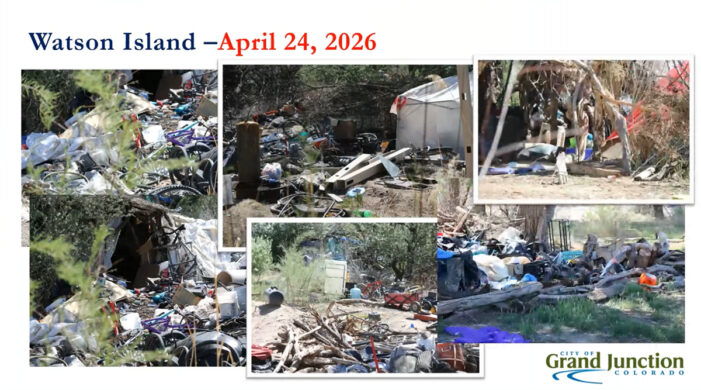
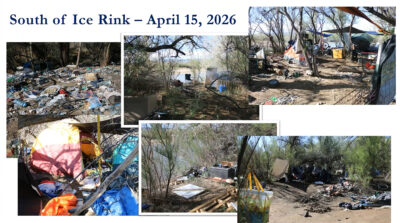
Smith presented photographs from multiple areas along the Colorado and Gunnison river corridors, including Watson Island, Railroad Island, the Point and areas south of the ice rink, showing tents, needles, debris, propane tanks, garbage and waste near waterways.
“Some of these camps, we’ve cleaned up five or six times in the same sites over the years,” Smith said.
He said the city removed approximately 119 tons of material from riverfront encampments between 2022 and 2025 at a cost of roughly $460,000.
Smith said the city’s cleanup strategy has largely focused on voluntary compliance rather than arrests or citations.
“Our primary goal is to gain compliance and to get the camp cleaned up, get them someplace where they can be, and then link them up with services if we can, and if they want services,” Smith said.
Some camps described as operating “like mini cities”
Council member Scott Beilfuss said some encampments along the river have developed internal leadership and communication structures over time as outreach workers and nonprofit organizations built relationships with homeless residents.
“Many of the camps are run like mini cities, and there’s leadership, and there’s coordination,” Beilfuss said.
Beilfuss said outreach groups and volunteers have spent years building trust with people living in the camps and helping coordinate cleanup efforts.
“We identified from some of our meetings that they need water, toilets and Dumpsters. Pretty simple,” Beilfuss said.
Council member Jason Nguyen questioned whether the city could reduce environmental damage and cleanup costs by providing sanitation infrastructure such as Dumpsters and toilets.
“We’re spending half a million on picking up 120 tons of trash,” Nguyen said. “Could we just provide Dumpster service and maybe not have to do that?”
City Manager Mike Bennett said the city has occasionally provided temporary Dumpsters and portable toilets during cleanup operations, but it has avoided permanent infrastructure, because camping is prohibited in those areas.
“And so we had not taken measures that would encourage camping where camping is not allowed,” Bennett said.
Bennett also said the city lacks the staffing and operational capacity to manage sanctioned camping areas along the river corridor.
“With our current resources and with the departments and services that we actually have, we are not capable of managing, overseeing and running camps,” Bennett said.
Council debates where homeless residents would go
Beilfuss raised concerns about where displaced campers would realistically go if enforcement increases while shelter capacity remains limited.
“We don’t have additional places in town right now, and we haven’t for a long time,” Beilfuss said.
Beilfuss pointed to the growing number of elderly and disabled individuals living in camps and said a number of homeless residents are not violent offenders or addicts.
“There are people that want to work, and some of them do have jobs, and that’s where they live,” Beilfuss said.
Council member Laurel Lutz, who since the May 4 workshop was voted in as Grand Junction’s mayor, said she supports moving forward with the ordinance amendment, but she also wants the city to continue broader discussions about homelessness strategy and interim housing solutions.
“What’s going to happen is they’re just going to migrate around, and you’re going to be cleaning up in a circle,” Lutz said.
Majority supports moving ordinance forward
Council member Ben Van Dyke said he did not view the proposed amendment as anti-homeless, but rather as restoring tools law enforcement has historically used while addressing environmental and public-safety concerns.
“I don’t think it’s very compassionate to encourage and allow for extended camping or camping that is unsanitary or dangerous or poses risks to others, especially when we’re talking about fire hazards down by the river and stuff,” Van Dyke said.
Van Dyke also pointed to the impacts encampments can have on nearby residents, businesses and public spaces.
“We’re talking about places that are adjacent to homes, to family businesses, restaurants and so on,” Van Dyke said. “And these people all are taxpayers as well and deserve to share these spaces without being adjacent to some of the other more hazardous conditions, sanitary or otherwise, that exist in homeless camps, especially if they’ve been there for a significant period of time.”
Council ultimately gave staff majority support to prepare a formal ordinance amendment for future readings and public hearings.
Council members Scott Beilfuss and Jason Nguyen did not support moving the amendment forward. Council member Anna Stout was not in attendance.
Support came from council members Lutz, Van Dyke, Cody Kennedy and Robert Ballard, who participated remotely.
Lack of clear verified data found in report
To gain a deeper understanding of the data surrounding homelessness in Grand Junction, particularly the homeless individuals living in camps along the river corridor, The Business Times reviewed the City of Grand Junction’s 2025 Unhoused Needs Survey Report.
According to the report, the city surveyed 90 individuals over a 2 1/2-week period during 2024 using a 44-question survey that was updated from a previous 2023 version. The report says the survey was designed to help the city better understand “gateways into and barriers to exiting houselessness in Grand Junction.”
While the report references individuals staying in encampments and unsheltered situations, it does not appear to provide a detailed breakdown showing how many surveyed individuals were specifically living along the Colorado and Gunnison river corridors in camps similar to those shown in Police Chief Matt Smith’s workshop presentation.
Many of the survey findings were based on self-reported responses from surveyed individuals, and the report does not indicate that individual responses were independently verified. The full list of survey questions also was not included in the report reviewed by The Business Times.
The Business Times will follow up in the coming weeks on issues and data related to river encampments and the broader homelessness discussion in Grand Junction.

City Council moves toward camping-ban amendment added by The Business Times Staff on
View all posts by The Business Times Staff →
5 Responses to "City Council moves toward camping-ban amendment"