
Brandon Leuallen, The Business Times
MORE TO THE STORY
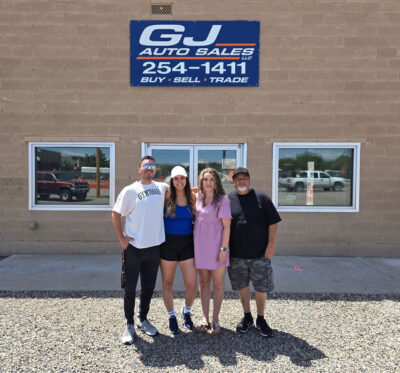
This article is a follow-up to “CDOT Sells Used Car Dealer a Lemon,” published June 4 in The Business Times. In that story, we reported about CDOT acquiring the GJ Auto Sales property through the threat of eminent domain for a planned mobility hub.
This expanded report traces the project’s timeline, revealing a process — jointly coordinated by CDOT, the City of Grand Junction and Mesa County’s Regional Transportation Planning Office — that began before the property owners ever found out and ended only after the property owners accepted a final offer just before condemnation proceedings could begin.
For 22 years, Mike and Amber Martinez had operated GJ Auto Sales from a downtown Grand Junction corner, building up their small family business and planning to add value to the property and keep it growing for years to come.
But in the spring of 2021, behind the scenes, the City of Grand Junction, the Colorado Department of Transportation and Mesa County’s Regional Transportation Planning Office (RTPO) already were making plans for a transit project that would ultimately result in the couple’s unwilling departure.
When the couple found out, they also discovered CDOT had used their business address in a federal grant application.
The couple says they were never told about that.
They first learned about the project while being interviewed for the July 11, 2021, edition of The Daily Sentinel, which included a map with their property circled and labeled “Proposed Mobility Hub.”
“We were blindsided,” Amber Martinez said.
At the time, Mike Martinez spoke to a reporter from the Sentinel, expressing disbelief and an unwillingness to walk away from the business they had built over two decades.
“It’s hard to say anything right now. We’ve got a successful business here,” Martinez said in the article. “So, we’re not planning on going anywhere.”
In one of their first meetings with CDOT representatives, the couple shared how their children had written their names in the concrete at the entrance of their business — a symbol of their deep personal and family investment.
“We don’t pay for sentimental value,” Amber recalled CDOT saying.
The Governor Came to Town
Amber said the situation became more surreal during a major political event. On Feb. 17, 2022, Colorado Gov. Jared Polis traveled to Grand Junction to deliver his State of the State address at Two Rivers Convention Center. At the same time, in the convention center lobby, their property appeared on a large whiteboard titled “Mobility Hub – Concept Plan” for all to see — while the Martinez family still owned and operated the site.
“They put up those signs while we were still running our business,” Amber said.
They Had Plans of Their Own
Before learning of the project’s intentions, the couple had been actively investing in the future of the property, renovating part of the site to expand operations.
“We were remodeling that building. We had plans for it,” Amber said. “If we had known, we never would have started those renovations.”
There were three rental units on the property: a commercial photo shop on the Second Street side; an upstairs unit the couple was remodeling into an Airbnb; and a third unit.
After discovering their property was targeted for the mobility hub, the Martinezes stopped renovations on the Airbnb, which remained unfinished and unrented for nearly three and a half years. The photo-shop tenant moved out in 2022, and the couple couldn’t find new renters, because the property had been publicly identified as the future site of a government project. Combined, these vacancies resulted in years of significant lost rental income that was of no consequence in the appraisal CDOT used to make its initial offer.
The couple came to believe the city had long sought to push them out after meeting with city planners to inquire about making improvements to the property.
The Martinezes said they asked about building a new office next to the building on Second Street. They said they were told if they did, they would not be able to have outdoor sales again as that would require a change of use, and they would lose their grandfathered status that allowed them to operate the car lot in the downtown area.
During that meeting with city planners, the Martinezes said they were also told the vision the city had for downtown didn’t include a car dealership.
A Tardy Response, But No Apology
Shocked by the newspaper revelation, the couple reached out to Grand Junction Public Works Director Trent Prall. In an email dated July 16, 2021, Prall apologized for his “tardy response,” but offered no apology for including their property in months of coordinated planning with CDOT without notifying them.
“He said, ‘Sorry for the delay in replying,’ not sorry for taking our land or not telling us they were planning to,” Amber said. “We told him, ‘You should have come to us a long time ago.’”
“It wasn’t just a lack of communication,” Mike added. “It was calculated silence.”
Other Options Were Available
The couple said they were told by CDOT that other properties, including the one the county offered and the property at 261 Ute Ave. — right next door — were also considered for the mobility hub. The City of Grand Junction already owns that parcel, which totals 1.15 acres, nearly twice the size of the GJ Auto Sales site (0.564 acres).
According to the city, only a narrow strip of the 261 Ute Ave. property is being used for regional and interstate bus operations right next to the alley. The couple was told the remaining land may be preserved for a future subsidized housing development.
The city also owns a 0.64-acre piece of property directly to the north of the site, where Mesa Pawn and Loan used to be.
When asked:
- What other properties owned by the city were considered?
- Why did the city not offer other city-owned locations?
- What is the city planning for the resource center site if not the mobility hub?
The city responded:
- The Mobility Hub is a CDOT-led project. CDOT purchased the property for the use and benefit of the project.
- The best contacts for your questions would be Rob Beck, program manager (rob.beck@state.co.us) or Charles Marsh, CDOT public information officer (charles.marsh@state.co.us).
- The city, county and CDOT contributed financially, and the owner sold the property after extensive negotiations. There was discussion of eminent domain with the Council, but no action was filed.
- The city-owned property at 261 Ute Ave. — only a long linear strip adjacent to the alley — will be used for a portion of the mobility hub, specifically for regional and interstate buses.
CDOT’s Right of Way Manual states in Chapter 4: Acquisition Policies, Procedures, and Information Colorado Department of Transportation November 2020: “Due to eminent domain’s intrusive nature, high costs, and the potential initiating eminent domain will harm CDOT’s relations within communities, CDOT strives to use eminent domain only as a last resort.”
Out of Options, They Listed It High
Uncertain about their options and hoping the bold pricing would persuade officials to choose another location, the couple listed their property for sale for $4.9 million in August 2022.
“We priced it high, hoping they’d just leave us alone,” Amber said.
The Martinezes never expected a buyer from the open market, knowing the property had already been publicly identified as the future site of the mobility hub. As reality set in and it became clear the project was moving forward regardless, they began gradually lowering the price, determined to fight until the end, but realizing there likely was no way to keep their property.
Eminent Domain and the Consent Agenda
In October 2023, Grand Junction City Council voted unanimously in favor of a resolution authorizing the use of eminent domain if negotiations for the property were unsuccessful. The resolution was placed on the consent agenda and passed without public discussion.
Then–Mayor Anna Stout signed the resolution. Current Mayor Cody Kennedy, who voted in favor at the time, now says he wants to improve the process:

Looking back, Kennedy said, “I wish this had not been passed in the consent agenda.”
He said he wished council had spoken directly with the family to get more context.
In the future, Kennedy said, he believes any matter involving eminent domain should appear on the regular agenda to allow for meaningful public and council engagement.
“That’s not what a consent agenda should be used for,” Kennedy said. “It’s for normal administrative processes that are just kind of day-to-day stuff, not anything that’s this heavy.
“When we’re talking about eminent domain, if we have to use it – which I hope we don’t – I think it should be a regular agenda item.”
On Jan. 24, 2024, CDOT issued a Notice of Intent to Acquire, a step that initiates a process forcing the property owner into negotiations to sell, regardless of their willingness to do so. If the negotiations fail, then property condemnation and court proceedings for eminent domain begin.
On Aug. 19, 2024, City Council held an executive session to seek legal counsel about CDOT’s request to possibly join a condemnation action by the State of Colorado
On Aug. 21, 2024, during its regular meeting, CIty Council voted in favor of a resolution to support CDOT’s request to condemn the property and move forward with eminent domain proceedings.
The city staff recommendation reads, in part, “Adopt and approve the resolution determining the necessity of and authorizing the acquisition of certain property and property interests by condemnation.”
The Next Steps in the city staff report, reads, “CDOT is seeking support from the City Council for the acquisition of the site by eminent domain. Design and acquisition of property for the mobility hub can then begin in earnest by CDOT. An intergovernmental agreement will be needed in the future to capture responsibilities for operations and maintenance of the mobility hub.”
Mayor Abe Herman noted: “The consent agenda includes items that are considered routine and will be approved by a single motion. Items on the consent agenda will not be discussed by City Council unless an item is removed for individual consideration.”
No items were pulled for discussion. The resolution passed 6-0. Council member Anna Stout was absent.
County Said No Eminent Domain
 Mesa County Commissioner Cody Davis said the county had offered 105 West Main St. in front of the Central Services building off the corner of First and Main as an option in the planning process.
The county made clear in an August 2024 letter to CDOT that its support for the purchase of the GJ auto sales property for the Downtown Grand Junction Mobility Hub was contingent on eminent domain not being used.
The formal letter, signed by County Administrator Peter Baier, reaffirmed the county’s commitment to the project, including a $100,000 contribution toward property acquisition, but emphasized that support was conditional.
“We didn’t believe that was the proper use of eminent domain,” Davis said. “It should only be used if there is no other option.”
Davis said the county also doubled its original financial commitment to help CDOT increase its offer and secure an agreement.
Priorities for the Location
According to background materials presented during the Grand Junction City Council’s Aug. 21, 2024, regular session, several potential locations were evaluated, but downtown Grand Junction ranked highest based on proximity to existing development and infrastructure.
Key reasons cited included:
- Proximity to destinations such as the Amtrak station, Main Street, the Mesa County Justice Center and the proposed pedestrian bridge to Dos Rios.
- Ability to expand the current transfer facility.
- Increased visibility compared to the current site.
- Strong multimodal and vehicle connectivity.
CDOT Clarifies Hub’s Purpose
While CDOT is the lead agency, it confirmed the mobility hub was always intended to be a joint initiative, funded and planned in partnership with the City of Grand Junction, Mesa County and Grand Valley Transit. Funding came through a 2022 RAISE grant.
“This isn’t about fixing a single malfunctioning element,” CDOT said. “It’s about unifying and coordinating the Grand Valley’s transportation system.”
The existing transfer facility on Fifth Street will remain in use for other county functions.
Negotiations and Emotional Costs
The Martinezes received a letter from a local contractor, highlighting the gap between the lowest appraised value used in CDOT’s initial offer and the current cost of rebuilding.
According to the contractor, constructing a new 4,300-square-foot commercial space – with two commercial rental units and an upstairs residential unit – would cost between $1.87 million and $2.69 million, depending on the design. A separate estimate for tenant finish was around $1.14 million. These estimates do not include the cost of land, which would be necessary for relocation.
The builder also warned them, “Based on your current location with the traffic count, it will be incredibly hard to find a new location that will provide the same amount of traffic and at a reasonable price. Development fees are also on the rise, and so are energy codes and costs of materials.”
In contrast, when someone loses a building through no fault of their own, such as in a natural disaster, insurance typically covers the current cost to rebuild, provided the policy includes replacement cost coverage and sufficient limits. This means owners are often made whole with coverage that reflects today’s construction prices.
But when a property is taken through eminent domain, compensation is based on appraised fair market value, not on the current cost to replace what was lost on a new site, leaving a significant gap for the Martinezes.
CDOT made an initial offer of $963,850 for the GJ Auto Sales property in May 2024, just above the lowest appraised value, based on its own appraisal. The couple commissioned their own appraisal, paid for by CDOT, submitted multiple counteroffers and ultimately accepted $1,417,000 in January 2025, just before condemnation proceedings were set to begin.
“They kept trying to get us to take their first offer,” Amber said. “This wasn’t a willing sale — we couldn’t afford a court battle.”
CDOT also attempted to block multiple access points to the property – the move would have choked their business out and drained them financially even more – until a court appeal was filed and CDOT kept them open.
A property close to American Furniture Warehouse was discussed as part of the compensation to the Martinezes, and the couple said it could have worked, but CDOT pulled that property from the discussion after it originally was brought up to them.
In addition to the used-car business, the Martinezes’ property included three rental units. It was more than just a small business; it was an investment. The family lost not only its primary source of income, but multiple other revenue streams and its one-of-a-kind location.
Colorado law requires “just compensation” in the form of fair market value for takings under eminent domain. But the fair market value does not cover lost rental income, business viability, emotional distress, or future earnings — all issues the Martinezes faced.
In the Martinez announcement on Facebook about GJ Auto Sales closing, they stated they had experienced eminent domain. In an interview, Amber pointed to paperwork from CDOT with the words “Eminent Domain” in many different places on the documents, including the closing documents, which read: “From: Real Property Transfer Declaration (TD-1000)COD1028.doe / Updated: 01.22.25 ‘Please include any additional information concerning the transaction and price paid that you feel is important: Eminent domain by State for a public purpose. Acquisition for a highway project. Settlement for total purchase price paid was in excess of fair market value of $917.000.00.”
According to the couple, the saga also brought legal fees, lost sales from road construction on Ute and Pitkin avenues, compounded by impacts from the Homeward Bound of the Grand Valley Resource Center next door, and outstanding mortgage debt, which had to be paid off from the proceeds before funds could be released.
Mike and Amber Martinez said they were trusting in their faith in God to make it through.
Relocation Still Unresolved
CDOT closed on the sale of the property on April 3, 2025, and GJ Auto Sales vacated by May 23. While eligible for relocation assistance, the couple says the search for a new location has been difficult.
“They took the only income we had,” Amber said. “We’re still looking, but we’ve hit roadblocks — zoning, cost, location. It’s not easy to just start over after 22 years.”
Speaking Out for Others
They describe themselves as private people, and the Martinezes never went public with complaints during the process. It wasn’t until May 2025, as they were leaving the property, that they decided to share their experience.
Amber said also that other businesses on Pitkin and Ute are probably going to face access issues.
“If we had known earlier, we could’ve done things differently,” Amber said.
Now, they say they’re speaking out to alert other small local businesses and property owners — especially those who have no idea their existence isn’t part of the city’s vision and may already be listed in government grant submissions or on proposed plans without ever knowing it.
What Is a Notice of Intent to Acquire?
In Colorado, a Notice of Intent to Acquire is the formal first step when a government agency plans to purchase private property for a public project. Under C.R.S. 38‑1‑121, “authorities must notify property owners in writing and begin good-faith negotiations. This notice must inform owners that if the estimated value exceeds $5,000, they have the right to obtain their own appraisal – paid for by the agency.”
Mike and Amber Martinez received their notice on Jan. 25, 2024 when the couple entered negotiations to sell a property they didn’t want to sell and planned on owning far into the future. CDOT’s initial offer followed shortly after.
Owners may make unlimited counter-offers during negotiations. Colorado law places no cap on how many counter-offers a landowner can submit. However, the government is not obligated to negotiate indefinitely.
Once an agency believes negotiations are at an impasse, it may proceed to file a condemnation petition in court, initiating eminent domain. In that legal process, a judge or jury decides what constitutes just compensation, usually defined as fair market value. Compensation does not include sentimental value, business loss or emotional attachment.
If the final compensation awarded at trial is at least 130 percent of the government’s final offer, the property owner may recover attorney fees and costs, per C.R.S. 38-1-122(1.5).
Timeline: GJ Auto Sales and the Mobility Hub
Spring 2021 – CDOT, the City of Grand Junction and the Mesa County Regional Transportation Office begin planning for a mobility hub and evaluating sites while preparing a federal RAISE grant application.
July 11, 2021 – The Daily Sentinel publishes an article about the proposed mobility hub. The property owned by Mike and Amber Martinez at 317 S. Second St., where they operated GJ Auto Sales, is pictured and labeled as the proposed site. The couple first learns of the plan.
Martinezes stopped renovations on upstairs rental, causing loss of renovation investment and losing about 3 1/2 years of potential rent on the unit by the end of the process.
July 13, 2021 – The Martinezes email Grand Junction Public Works Director Trent Prall. He replies on July, 16 with an apology for the delay but does not acknowledge the property was targeted without notice.
Feb. 17, 2022 – Gov. Jared Polis visits Grand Junction for his State of the State address. At the venue, a large “Mobility Hub – Concept Plan” board displays the Martinez property as the site for the hub.
Aug. 17, 2022 – The couple lists their property for sale with a $4.9 million price tag, hoping the price deters the state and city from proceeding.
Sept. 16, 2022 – The couple received a letter from CDOT, notifying them it is closing access to the property from Ute and Pitkin avenues.
Nov. 14, 2022 – Court appeal was filed to stop closure of access to the property by CDOT. During a subsequent meeting, CDOT said it will not close access to the property.
End of 2022 – Martinezes lose photography-shop tenant for other unit, resulting in about two years of lost rent on the unit by the end of the process.
Oct. 18, 2023 – City Council passes a resolution authorizing the use of eminent domain if negotiations fail. The resolution is approved on the consent agenda without public discussion.
August 2023 – Road construction starts on Ute and Pitkin avenues, further affecting car sales.
Jan. 25, 2024 – CDOT sends a formal Notice of Intent to Acquire for the property.
Jan 30, 2024 – Homeless resource center opens up next door, drastically affecting car sales.
April 15, 2024 – A local contractor estimated it would cost $1.87 to $2.69 million to rebuild the couple’s property, plus $1.14 million for tenant finish not including the land purchase—far exceeding CDOT’s initial appraisal. The builder also warned about rising fees, and increasing construction costs saying it would also be difficult to find a comparable location matching the high traffic of the current one.
May 16, 2024 – CDOT sends an initial offer based on its appraisal. The initial offer was for $963,850, which included a $46,850, 45-day incentive over the fair-market-value amount of $917,000. The appraisal provided on the owners behalf was $1,012,00. CDOT reimbursed the owners for their appraisal.
Aug. 21, 2024 – Two days after an executive session to receive legal advice about possibly joining a condemnation action by the State of Colorado, City Council voted 6-0 during its regular meeting on a resolution supporting CDOT’s official request to move to eminent domain. It was included on the consent agenda, which bundles items typically considered routine.
August 2024 – Mesa County sends a letter to CDOT, stating its support is contingent on not using eminent domain. The county also had offered alternative land, and after sending the letter, the county increased its financial contribution.
Jan. 2, 2025 – While losing most of their rental income over three and a half years and seeing car sales decline significantly, the couple faced mounting financial hardship. During this time, they also paid more than $30,000 in legal fees. After multiple counter offers, the couple accepts CDOT’s final offer of $1,417,000 just before formal condemnation proceedings were set to begin on Jan. 6. The funds required the current mortgage to be paid off before any remaining amount could be released to them.
April 3, 2025 – CDOT closes on the sale of the property.
May 23, 2025 – GJ Auto Sales vacates its location after 22 years in business. Mike and Amber Martinez are still searching for a new property while facing zoning, cost and location challenges.

GJ Auto Sales learned CDOT and City targeted their property without telling them added by The Business Times Staff on
View all posts by The Business Times Staff →
6 Responses to "GJ Auto Sales learned CDOT and City targeted their property without telling them"