

Brandon Leuallen,The Business Times
The Grand Junction Police Department is reporting an increase in the illegal use of electric bikes and similar motorized devices, particularly among younger riders, raising safety concerns as warmer weather brings more activity outdoors.
Officers say electric dirt bikes and other off-highway vehicles are increasingly being operated on city streets, sidewalks and in parks, areas where they are not permitted.
“We are seeing an increase of e-bikes, or what would more accurately be classified as off-highway vehicles, being operated on our roadways and in our parks,” Motor Officer Vaughn Soderquist of the Grand Junction Police Department said in an interview with The Business Times. “A lot of youth in the community are operating those, and it’s incredibly dangerous.”
Soderquist added, “These are fun vehicles to have, as long as they’re operated appropriately. We have a great recreational area surrounding our community and recommend using those areas.”
Increase tied to warmer weather
Police say the trend became more noticeable in recent weeks when temperatures rose and more residents, particularly juveniles, took to the streets on electric-powered devices.
“They’re really fast, they’re quiet, and they’re being operated by individuals who often don’t have any formal driving training,” Soderquist said. “That creates a dangerous situation for riders, motorists and pedestrians.”
Unlike standard e-bikes, these electric motorcycles are designed for off-road use in areas such as desert trails or private property. Police say using them within city limits increases the risk of crashes and injuries.
Understanding the classifications
Electric-powered devices fall into several categories under state law, which determine where they can be used.
Electric bicycles are divided into three classes. Class 1 and Class 2 e-bikes are limited to motor-assisted speeds of up to 20 miles per hour and are generally allowed wherever traditional bicycles are permitted, including streets, bike lanes and most sidewalks and shared-use paths unless posted otherwise.
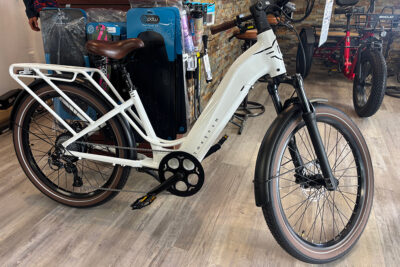
Class 3 e-bikes can reach speeds of up to 28 miles per hour with motor assistance. They are restricted to roadways and on-street bike lanes and are not allowed on sidewalks or multi-use paths such as the Riverfront Trail. Riders must be at least 16 years old.
All three classes must have motors rated at 750 watts or less.
Soderquist said devices that exceed that threshold fall into a different category.
“If it’s over that 750-watt category, it would be considered a low-powered scooter,” Soderquist said.
Low-powered scooters are allowed on public roadways and require a valid driver’s license, insurance and registration through the state. They are not permitted on sidewalks or trails.
Electric dirt bikes and other off-highway vehicles are not allowed on public streets, sidewalks, bike paths or in city parks. Schreiner emphasized these vehicles are intended for off-road areas such as desert riding zones or private property.
Soderquist said officers are also seeing illegal and unsafe use of other motorized devices, including mini bikes, pit bikes, gas-powered scooters and motorized skateboards, many of which are classified as toy vehicles, including those with wheels smaller than 14 inches.
Soderquist also noted that motorized off-highway vehicles, including electric motorcycles, are not permitted in any city parks, including Matchett Park.
Responsibility and potential penalties
Officers say violations can lead to a range of consequences, depending on the situation.
Citations may include traffic infractions with fines or a summons requiring a court appearance before a municipal judge. Additional charges can apply depending on how the vehicle is being operated.
“If their parent or guardian knowingly allows them to ride that on the public roadway or sidewalk or in the parks, the parents could face charging as well,” Soderquist said.
Education and enforcement efforts
The department said it is addressing the issue through enforcement and public education. Officers are partnering with the Colorado Department of Transportation and the Colorado State Patrol on safety campaigns throughout the summer.
Grand Junction Police are also working with School District 51 to distribute information to parents about the rules and risks associated with electric-powered devices.
Soderquist said the goal is to prevent injuries and fatalities by helping residents better understand how and where these devices can be used safely.
Is the county different?
In an interview with The Business Times, Deputy Larry Nelson with the Mesa County Sheriff’s Office said e-bike rules are generally the same on county roads, with the devices treated similarly to traditional bicycles, while higher-powered electric motorcycles and similar vehicles fall under different classifications.
Street legal electric motorcycles may be operated on public roads in Colorado if they are properly registered, insured and operated by a licensed driver, but many models are sold as off-highway vehicles and are not street legal.
Mesa County provides an interactive map showing which roads are open to street-legal vehicles and which allow registered off-highway vehicles at: emap.mesacounty.us/countyroads/countyroads.html
Under Colorado law, off-highway vehicles must be registered through Colorado Parks and Wildlife, which requires an annual registration or permit to operate on public lands and designated routes. More information is available at: cpw.state.co.us/register-off-highway-vehicle.
Operators must have a valid driver’s license to ride off-highway vehicles on county roads open to OHVs, but youth may operate them on designated trails and public lands with proper registration and helmet requirements if under 18.

GJPD warns of rising illegal use of e-bikes, e-motorcycles among youth added by The Business Times Staff on
View all posts by The Business Times Staff →