
One man’s fight for a gazebo in his front yard sparks questions about city code
Brandon Leuallen, The Business Times
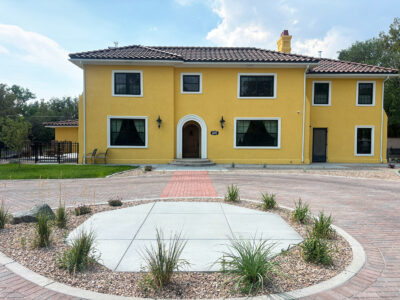
When Kevin Cole purchased the historic Spanish Colonial Revival home at 1259 Gunnison Avenue in disrepair, he didn’t just plan to fix it up. He set out to restore it to its former glory and make it an asset to the community.
The remodel is now complete, with matching landscaping that gives the property a true Spanish Colonial feel and plenty of curb appeal. But one element is still missing. In the center of the circular driveway, a decorative concrete pad sits empty, awaiting what Cole envisioned as its finishing touch: a gazebo matching the style of the home and landscaping where he and guests could relax in the shade in view of Lincoln Park across the street.
Cole said the house needed extensive work, and while some neighbors were initially skeptical about the remodel and bold new color, many told him they changed their minds after seeing the finished landscaping and full exterior.
Built in 1925 by lumber magnate W.C. Kurtz, the home was added to the Historic Building Inventory in 1995.
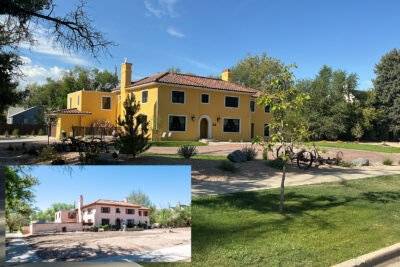
Cole spent roughly two years remodeling the property, transforming it from a deteriorating structure into a fully restored Spanish Colonial Revival home. Improvements included installing matching landscaping to complement the architecture, restoring original features, fixing the original guest quarters above the garage, installing additional parking that wasn’t required, and painting the exterior in a bold yellow stucco inspired by the home’s historic design.
City Says No to Gazebo in the Front Yard
Cole said he approached city planning staff about his design, only to be told, “No accessory structure in front of a house in the city limits.” At first, he said they suggested a trellis roof might be acceptable, but later retracted that option.
Cole said he met with a city planner and zoning supervisor, but he left feeling the tone was indifferent and dismissive. Staff told him a variance wasn’t possible because his lot wasn’t unique. When he noted the property is nearly half an acre, they said it didn’t matter.
Cole pointed to the existing hexagonal pad as the proposed base, explaining, “The roof would match … the pop-outs around the windows … and I think it would look really good. Actually, I know it would look really good.”
City staff replied, “That’s in your opinion.”
Code Inconsistencies and a Reversal
After being told the structure wouldn’t qualify as a “landscaping accessory,” Cole combed through the city code.
He found sections allowing accessory dwelling units (ADUs) in certain front or side yards and asked officials for clarification.
Unable to get approval for the gazebo and wanting to test the system’s consistency, Cole submitted an application for an ADU intentionally designed to clash with the property’s style and color. The city ultimately approved the ADU for the side yard, despite its obvious mismatch with the rest of the home and landscaping.
Cole said he asked staff whether any front-yard accessory structure in the city would require a variance, an administrative adjustment or be out of compliance, and he was told yes. He said he also was told the reason for the rule was that approving one would mean approving them for everyone.
“So what?” he said. “Why no gazebo?”
Calls for Clarity and Fairness
Cole said he hasn’t met a single neighbor or local resident who objects to the idea.
“I have not talked to anybody that says this (the rejection of the gazebo) kind of makes sense,” he said.
He wishes the city would focus less on automatic denials and more on problem-solving.
“Couldn’t you just be a little bit helpful?… Let’s figure out how we can make this work,” Cole said.
Instead, he said, staff offered for him to file complaints against other homeowners with structures in their front yard that may qualify for code violations, which he did not desire and declined to do.
History of the Home
The Mesa County Assessor’s property report lists 1259 Gunnison Ave. as a two-story Spanish Colonial Revival, a style that saw a resurgence in the 1920s. Built in 1925 by William Clarence Kurtz, it was landscaped by renowned Denver landscape architect Sacco R. deBoer.
Historical research on the property shows Kurtz was born in 1889 in Stewartstown, Pennsylvania, and moved west in the early 1900s, eventually settling in Colorado. According to those records, he rose through the ranks of the Independent Lumber Company, later becoming president, and partnered with Clyde Biggs to form the Biggs-Kurtz Hardware Company and Biggs-Kurtz Investment Company. Their ventures included lumber yards, a railroad company, a peach orchard in Palisade and cattle ranching.
Kurtz also founded the First National Bank of Grand Junction in 1933 and served in leadership roles with the Grand Junction Chamber of Commerce, Rotary Club and Benevolent and Protective Order of Elks, according to the same historical documents.
Ownership records indicate the Kurtz family left Grand Junction in the 1950s. The home later passed through several owners, including the Younge, Burke and Schwan families, before being sold to Kevin Cole in 2022.

Grand restoration meets bureaucratic wall added by The Business Times Staff on
View all posts by The Business Times Staff →
6 Responses to "Grand restoration meets bureaucratic wall"