
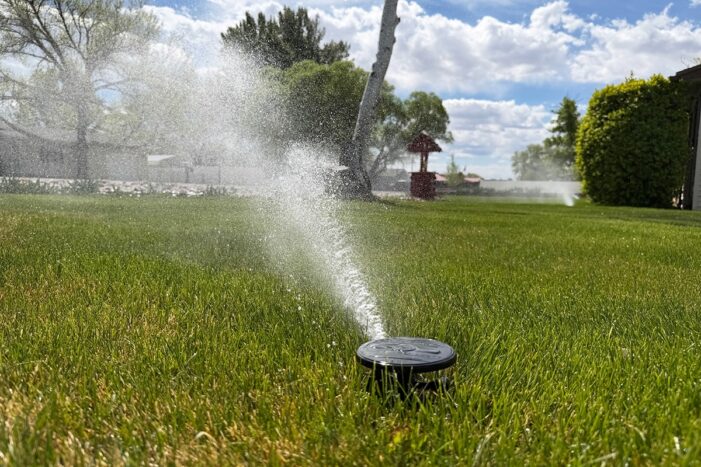
Local landscaper says overwatering is unnecessary and can weaken lawns.
Brandon Leuallen, The Business Times
While drought conditions often bring increased attention to water use, a local irrigation professional says many homeowners overwater their lawns even in normal years, creating long-term problems for turf health and water conservation.
In an interview with The Business Times, Matt Morgan, owner of 2 Brothers Landscaping in Grand Junction, drew on his 18 years in business in the Grand Valley and said overwatering is not only unnecessary but can weaken lawns.
“Roots need air as much as they do water,” Morgan said. “When we overwater like that, we suffocate the root system by not letting the air get down in between waterings.”
Morgan said frequent, shallow watering keeps the top layer of soil saturated, preventing oxygen from reaching the roots and leading to shallow root systems.
“So where it can’t breathe, there won’t be roots,” he said. “It really creates a very shallow root system.”
That becomes especially problematic during drought conditions. Lawns that have been overwatered are less able to survive when water becomes limited.
“If it’s used to that much water and all of a sudden the water goes away, it’s going to be done,” Morgan said. “If you get it used to less water, it’s going to survive less water and it’s going to survive the drought much, much better.”
Deep watering, less often
Morgan recommends watering deeply, but less frequently instead of watering daily.
“Longer run times, less often is a lot healthier than watering every day anyway,” he said.
In normal conditions, he recommends watering no more than three times per week. During drought conditions, many water providers are asking residents to cut back further.
“Right now, I say no more than three times a week, but in drought conditions like this, all of the water purveyors are asking us to do two,” Morgan said. “Make it survive. It doesn’t have to thrive this year.”
He added that lawns can make it through a drought year even if they are not lush.
“Just keep it alive, even if it’s a little bit on the verge of dormancy,” he said.
Soil and conditions vary
Morgan said watering schedules should be adjusted based on soil type and conditions across the Grand Valley, which can vary significantly.
Areas with sandy soil, such as the Redlands, drain quickly, while clay-heavy areas in the valley retain moisture longer. Because of that, he avoids recommending exact watering times.
Instead, he suggests a simple test.
“If you can still stick a screwdriver down in there readily, then it’s moist enough,” he said. “If you pull it out and it’s got stuff stuck to it, then it’s too wet. If you can’t get it shoved in, then it’s too dry.”
Watering when it rains
One of the most visible examples of water waste is irrigation systems running during or immediately after rainfall, something Morgan said often comes down to homeowners simply not shutting their systems off.
“Maybe it rained on the weekend, but we were gone for the weekend, so it just ran because we weren’t home,” he said.
When significant rain does occur, however, he said it’s important for homeowners to adjust their systems accordingly.
One option is to install a rain sensor designed to automatically shut off irrigation systems during significant rainfall. Morgan said rain sensors can shut off irrigation during rainfall, but are used less locally because most storms aren’t large enough to trigger them.
“It’s great when we actually get a good rain, because then you don’t have to remember to go shut it off yourself,” Morgan said.
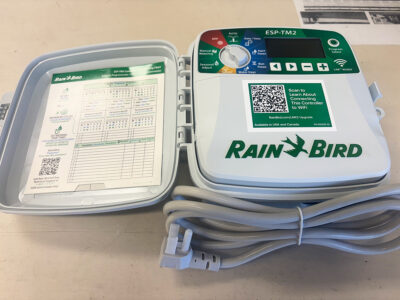
He said what he has seen that is effective is for homeowners to utilize Wi-Fi-enabled irrigation controllers, which allow them to turn systems off remotely if the lawn has enough water and even if weather changes while they are away.
“We’re more prone to get on our phone and say, ‘Oh yeah, I need to turn my clock off,’ than we are to actually walk out there,” he said.
Mowing height and fertilizer?
In addition to watering practices, Morgan said mowing height plays a key role in maintaining healthy lawns, especially during hot or dry conditions.
“During this time of year you really should be mowing at about 2.5 to 3 inches, and about 3.5 or more in the summer when it’s hot,” he said.
Longer grass helps shade the soil and retain moisture.
“You don’t want to be cutting short because it will heat the ground up and you’ll lose your moisture faster,” he said.
He also recommends limiting fertilizer use during drought conditions to avoid stressing grass.
“Be conservative with your fertilizer this year, so you’re not pushing growth that you can’t water,” Morgan said.
Leaks and misaligned sprinklers
Beyond watering schedules, Morgan said system issues such as leaks or poorly adjusted sprinkler heads can also contribute to unnecessary water use.
He said it’s common to see sprinklers spraying sidewalks, driveways or streets, often due to heads being out of alignment or systems not being properly maintained.
“Keep them covering well, keep them well adjusted, so that they run efficiently,” Morgan said.
He said the goal is to achieve uniform coverage across the lawn, so homeowners aren’t compensating for dry spots by running systems longer than necessary.
“Get it uniformly covering well, and then that way you can get good coverage and efficient water use,” he said.
Guidelines for summer watering and mowing
Matt Morgan, owner of 2 Brothers Landscaping, offers the following tips for a healthy lawn:
Watering frequency
- Normal conditions: No more than 3 times per week
- Drought conditions: 2 times per week
- Water deeply and less often, not daily
- Aim to keep soil moist, not saturated
Mowing height
- Maintain grass at 2.5 to 3 inches
- Increase to around 3.5 inches or more in hot summer months
- Avoid cutting too short to help retain moisture and reduce heat stress
Fertilizer
- Use fertilizer conservatively during hot or dry conditions
- Avoid pushing growth that can’t be supported with limited water
- Reduce applications during drought to prevent stress or burn

How much watering do lawns actually need? added by The Business Times Staff on
View all posts by The Business Times Staff →