
Brandon Leuallen, The Business Times
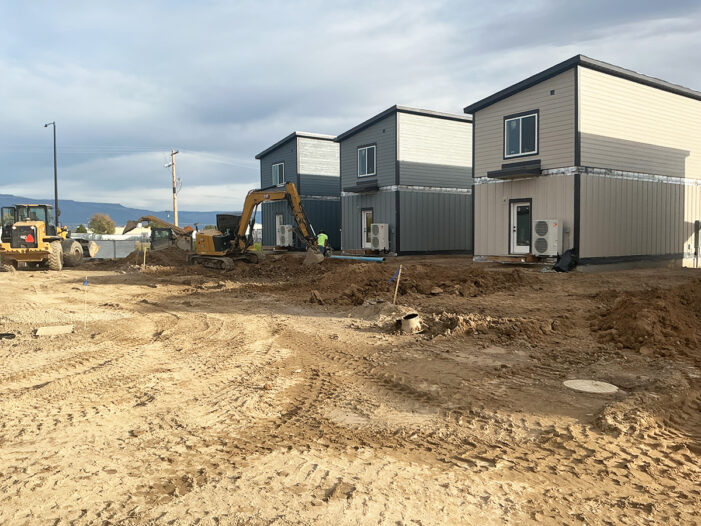
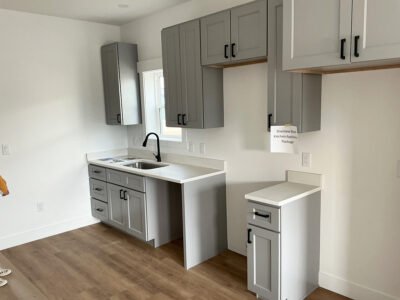
Inside Juniper Grove’s model homes, quartz countertops, modern cabinets and vinyl flooring offer visitors a look at what homeownership could mean at Grand Junction’s Salt Flats development. Outside, crews are finishing grading, utility connections and other work before the first buyers move in.
For many people touring homes in Grand Junction, the larger question is whether they can afford one.
Juniper Grove advertises prices starting at $279,000 and mortgage rates below 4 percent for qualified buyers. The national average for a 30-year fixed mortgage was 7.24 percent on Oct. 29, according to Freddie Mac.
Samantha Stevens, Juniper Grove’s community ambassador, said during a recent walk-through that approximately 80 percent of prospective buyers were purchasing their first home. Others had relocated, sold a previous property or remained renters.
The opportunity comes with conditions. Buyers must meet income and financing requirements, occupy the homes and accept limits on resale prices. Significant tax-payer investment helps make the purchases possible, while deed restrictions are intended to preserve affordability for future buyers.
Neighborhood taking shape
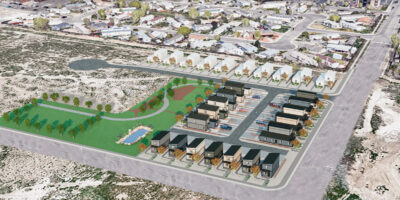
Rural Homes is developing Juniper Grove’s 48 homes in two phases. Stevens said the first includes 27 homes.
According to the city, the completed neighborhood will include eight detached houses and 40 duplex units. Sales materials describe three models: the Mesa, a single-story, two-bedroom, two-bathroom home of approximately 950 square feet; and the Monument and Ridge, each offering three bedrooms, two bathrooms and approximately 1,200 square feet.
Stevens said Fading West manufactures the homes in Buena Vista before transporting them in modules and installing them on permanent concrete foundations.
She described two-by-six framing and enhanced insulation. The project’s features sheet lists mini-split heating and cooling, all-electric systems, stainless-steel kitchen appliances, washers and dryers. Stevens also discussed plans for solar panels.
There is no homeowners association, although attached homes have party-wall agreements.
Each home receives two designated parking spaces, Stevens said. Landscaping includes rock, climate-appropriate plants and drip irrigation.
Garages originally considered for some homes were removed to meet affordability calculations. Stevens said owners could add them behind their homes, accessed from the alley, at their own expense and with necessary approvals.
Getting qualified
The income ceiling is only one part of qualifying.
According to buyer materials, households must earn at or below 100 percent of Mesa County’s area median income, adjusted for household size. The chart distributed during the tour lists annual limits of $70,500 for one person, $80,500 for two people, $90,600 for three, $100,600 for four and $108,700 for five.
Applicants can earn less, Stevens said, but must demonstrate they can support the purchase.
A lender evaluates credit, income, debt and borrowing capacity. Impact Development Services separately reviews eligibility for the housing program.
According to the buyer guide, monthly housing costs generally cannot exceed 35 percent of household income at purchase. The calculation includes mortgage payments, taxes, insurance and applicable association or metropolitan district fees.
Stevens said debt, credit history and other financing obstacles have affected some interested households. During the tour, she estimated roughly a dozen had lender prequalification, and about 10 had completed both reviews and qualified for the lottery, which establishes the order for selecting home sites. The remaining homes in the 27-home first phase will be available to qualified applicants on a first-come, first-served basis. Those figures represented applicants, not completed sales.
Once qualified buyers become owners, however, an increase in income does not require them to sell.
Building equity within limits
The homes are intended to remain affordable beyond their first owners.
According to the buyer guide, restrictions last 40 years from recording, regardless of ownership changes. Owners must use the property as their sole primary residence, with published buying instructions requiring occupancy at least eight months annually.
Whole-home rentals and short-term rentals are prohibited. Owners may rent one bedroom under a written lease while continuing to live there, with no income restriction on the tenant.
Someone moving elsewhere for work therefore cannot assume the home can become a rental.
The Grand Junction Housing Authority administers the program after purchase. Owners must annually recertify primary residency, and the authority may investigate violations and request inspections with at least 24 hours’ notice.
Owners can sell, but the next household must qualify, and the price is restricted.
According to the guide, the maximum resale price is the lower of two calculations: the original price increased by 3 percent annually, compounded, plus approved improvement credits; or a price keeping the next buyer’s housing costs within the program’s 35 percent income limit.
Borrowing is restricted, too. Total debt secured by the home cannot exceed 97 percent of its original purchase price. Refinancing and additional mortgages require written consent.
According to the published schedule, home selection begins Nov. 19 and contract signing Nov. 30.
Initial closings are planned for December, although Stevens said delays could push some into January. Remaining homes become available on a rolling basis.
Beyond Juniper Grove
Juniper Grove is the first ownership neighborhood within a much larger development.
According to the city’s preliminary master-plan announcement, Salt Flats is planned for 465 homes across 21.78 acres, combining ownership housing, apartments and accessory dwelling units with green space, walking connections and transportation improvements.
Vertikal proposes 46 for-sale homes serving households earning up to 140 percent of area median income. That project is separate from Juniper Grove’s second phase.
Volunteers of America and MGL Partners plan the Haven, with 62 apartments for adults ages 55 and older and veterans, including 13 veteran-supportive units. According to the city, it would serve households earning up to 60 percent of area median income under a 99-year, no-cost land lease.
Brikwell’s Ascent proposes 144 apartments serving households between 30 percent and 70 percent of area median income. Later phases could add more apartments.
Land and taxpayer investment
The land transaction began years before Juniper Grove’s homes arrived.
According to Mesa County Assessor records, En-Sim QOF LLC, managed by Enstrom Candies co-owner Doug Simons, purchased the original Salt Flats property for $1.65 million on Oct. 23, 2020. Homes.com lists its size at 35.85 acres, putting the average purchase price at approximately $1.06 per square foot.
The city pursued the acquisition during Greg Caton’s tenure as Grand Junction’s city manager, approving an initial letter of intent on April 3, 2024. Caton left the position April 5, 2024. On Sept. 23, 2024, the Grand Junction City Council adopted Resolution 67-24, reducing En-Sim’s infrastructure commitment from $2 million to $1 million.
The city completed its purchase of 21.78 of the 35.85 acres on Jan. 9, 2025, for $3.2 million, according to city records. At approximately $3.37 per square foot, the city paid about 3.2 times the original property’s average price per square foot a little more than four years earlier. The comparison involves different-sized parcels and does not account for En-Sim’s infrastructure obligation.
The city says an independent appraisal supported the negotiated price. Records reviewed do not establish whether En-Sim received competing purchase offers.
According to city project information, the purchase used a $2.2 million Proposition 123 grant and a $1 million city contribution. A separate infrastructure package combined a $2 million state grant with an $800,000 city match. Together, those packages total $6 million in public funding for the broader development.
On Sept. 16, 2026, the city council approved approximately 3.3 acres at no cost and $749,670 in conditional assistance for Grand Junction Homes LLC, a Rural Homes affiliate. According to the city’s agreement, that includes $156,330 for infrastructure and $593,340 for water and sewer fees.
The land is already included in the $6 million acquisition and initial infrastructure total. The city separately budgeted $1.25 million in 2026 for a second phase of roads and utilities serving the broader Salt Flats development.
Juniper Grove and other qualifying Salt Flats projects are eligible for transportation, parks, police and fire impact-fee waivers under city policy. The total value of waivers applied to the development was not identified in the records reviewed.

Juniper Grove opens path to homeownership at Salt Flats, with public support and lasting restrictions added by The Business Times Staff on
View all posts by The Business Times Staff →