
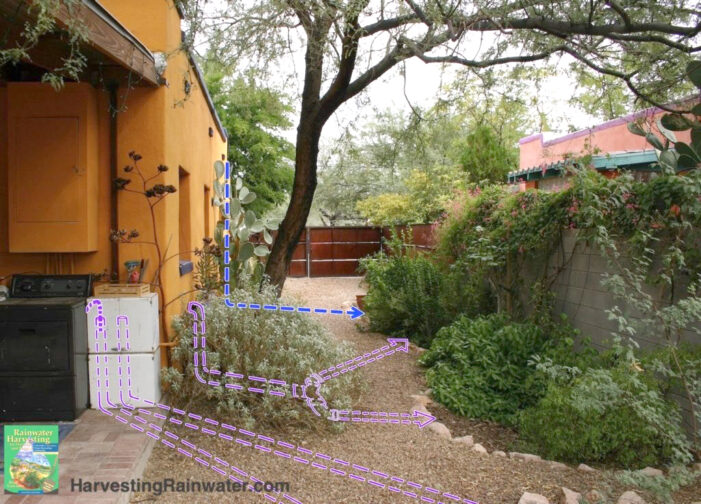
Can graywater and rainwater be part of GJ’s solution to water issues?
Brandon Leuallen, The Business Times
Limited water supplies, rising irrigation costs and the urban heat island effect are creating overlapping challenges for Grand Junction and the surrounding region as the population continues to grow from in-migration.
For some residents, drought pricing and limited irrigation supplies this year have meant paying considerably more to keep lawns, trees and shrubs watered. Others have allowed landscaping to decline or paid to convert traditional landscapes to lower-water alternatives, including xeriscaping and zero-scaping.
Conserving water and/or avoiding higher water bills, however, does not necessarily have to mean eliminating vegetation altogether.
While there is no silver bullet, conservation practices gaining popularity in other dry climates south of Colorado could, where appropriate, help address all three challenges in the region’s high-desert climate.
Over the past two decades, some Southwestern cities, including Tucson, Ariz., have increasingly used water capture and reuse to hydrate soils as they face many of the same, and often more severe, challenges as Grand Junction. Grand Junction has more recently legalized and incentivized some of these practices, but awareness and widespread adoption have yet to follow.
Many of those practices were pioneered more than two decades ago in Tucson by Brad Lancaster, his brother and other private citizens who were determined to improve their community for future generations. Brad Lancaster later wrote a book called Rainwater Harvesting for Drylands and Beyond. His early neighborhood projects helped demonstrate the benefits.
The Business Times reached out to Lancaster to discuss his experience in Tucson and other cities as well as what lessons those efforts could offer Grand Junction and other communities in the arid West.
Capturing rain instead of letting it run away
Rainwater and stormwater harvesting capture precipitation and runoff before it leaves a property or neighborhood.
Grand Junction now encourages rainwater capture through its water-efficiency rebate program. The city offers a $50 rebate for qualifying rain barrels, with rebates available for up to two barrels per residential property through a fourplex. Most qualifying Colorado residences can collect precipitation in two rain barrels with a combined storage capacity of 110 gallons for outdoor use.
Lancaster said rain barrels can introduce people to the concept, but communities in dry climates should look beyond small storage containers as they can do far more for less by simply using a shovel.
Rain gardens and basins placed an adequate distance from structures temporarily hold runoff and allow it to infiltrate, essentially using the soil for storage while restoring capacity for the next storm. Multiple basins throughout the property can capture water from different portions of a roof, driveway or other drainage areas, collectively soaking hundreds or even thousands of gallons into the soil during a storm.
The vegetation planted around those basins is also important. Drought-tolerant trees, shrubs and other plants known to perform well locally can make better use of the captured water while requiring less supplemental irrigation once established. Some of these can even be edible.
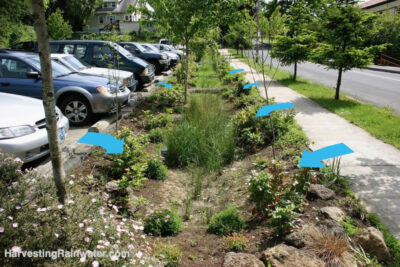
Lancaster said rain gardens can also receive more than one water source where regulations allow.
“What I would push further, if they’re not already doing this, is they should also allow the collection of both waters in the same rain garden,” Lancaster said, “so you get a bigger bang for the buck.”
Rain could supply the basin during storms, while appropriately distributed graywater could help support vegetation during dry periods. Lancaster also pointed to air-conditioning condensate as another water source that can potentially be directed toward landscaping, especially between rain events.
Grand Junction does not receive large amounts of precipitation, which can make rainwater harvesting seem insignificant. But even infrequent storms can produce substantial volumes of water over a large surface. One inch of rain falling on a 2,000-square-foot roof represents about 1,250 gallons of water before collection losses. Even a half-inch storm would produce more than 600 gallons.
Lancaster also collects rain off of sheds and any other building on a property as well as what falls directly on the ground to direct it where it is most useful.
Lancaster said recent changes to Colorado law created additional rainwater-collection opportunities for certain qualifying properties served by qualifying exempt wells and others not on municipal water. Those properties can collect substantially more rainwater in tanks, potentially storing thousands of gallons for use.
What about water running down the street?
Lancaster said communities can go further by capturing stormwater already flowing across streets and other paved surfaces.
In Tucson, that includes openings in street curbs and parking lots that direct runoff into vegetated basins rather than allowing it to flow directly into storm gutters. Lancaster helped construct an early Tucson curb-cut project in 2003, when the idea faced resistance because it was not yet legal as locals and officials were unfamiliar with it.
Tucson eventually changed its rules to accommodate the practice.
More than two decades later, Lancaster said areas where runoff was redirected into roadside basins developed substantially more vegetation.
“The before and after is very dramatic,” he said.
A basin can infiltrate water into the surrounding soil and regain capacity for another storm.
“That helps recharge our aquifers at the same time, and the flows of our creeks, springs and rivers,” Lancaster said.
Lancaster also said properly designed rain gardens and basins allow water to infiltrate quickly enough that it does not remain stagnant or provide breeding habitat for mosquitoes.
In 2019 Tucson began funding its Storm to Shade program, which supports green infrastructure in public spaces, including rain gardens and other stormwater-capture projects.
Using water more than once
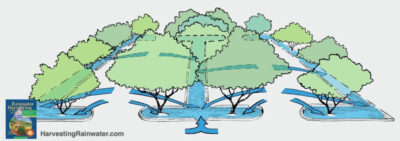
Graywater is different from blackwater, or sewage. It is wastewater from sources such as showers, bathtubs, bathroom sinks and washing machines that has not come into contact with toilet waste. It can still contain soaps, detergents, microorganisms and other contaminants.
Colorado previously required local governments to affirmatively authorize graywater use. A state law that took effect Jan. 1, 2026, instead authorized graywater statewide unless a local government prohibits all or certain categories of its use.
Grand Junction adopted its graywater program in 2022, while graywater became legal in unincorporated Mesa County under the statewide change Jan. 1, 2026. The city and county allow approved systems for subsurface landscape irrigation, while more advanced systems can treat graywater for flushing toilets and urinals.
The City of Grand Junction estimates a household of four could save about 20,000 gallons annually through graywater reuse.
Under normal Grand Junction water rates, reducing potable consumption by 20,000 gallons annually could represent roughly $90 to $140 in reduced water charges, depending on which consumption tiers those gallons would otherwise fall into. Savings could be greater when drought pricing applies.
But adoption has been limited.
Cost is one potential reason. Grand Junction estimates subsurface landscape-irrigation systems can cost approximately $200 to $2,000, while more complicated indoor systems can range from $2,500 to $20,000 depending on the system and whether it is incorporated into new construction or retrofitted into an existing building.
Lancaster also said complexity itself can become an obstacle. He cautioned against unnecessarily complicated systems that store untreated graywater in tanks before pumping it elsewhere. Instead, he advocates directing appropriate graywater into the soil relatively quickly.
“You dramatically reduce the cost, you reduce the complexity, it works better,” Lancaster said.
The Business Times has reached out to the City of Grand Junction and will examine the city’s program and local adoption further in a follow-up article.
Regulations can make a difference
Lancaster said other dry communities have faced similar challenges with awareness and adoption, and Tucson’s experience showed that simply making graywater legal did not initially lead residents to use permitted systems.
He said Arizona previously allowed graywater reuse, but permitting requirements were expensive and cumbersome enough that legal participation remained extremely low.
Meanwhile, Lancaster said University of Arizona researchers found that more than 200,000 people across the state were already harvesting graywater without permits and found no significant health risk when common-sense guidelines were followed.
Arizona subsequently simplified its regulatory approach for smaller residential systems. Lancaster said qualifying systems can now operate without individual inspections or fees as long as residents follow the state’s 13 common-sense guidelines.
Lancaster said problems that have happened have generally occurred when people failed to follow the established guidelines for properly designing and operating the systems.
Turning water into shade
The potential benefits extend beyond water conservation.
Grand Junction is also confronting an urban heat island effect created when pavement, buildings and other hard surfaces absorb solar energy and become substantially hotter than vegetated and shaded areas.
Previous measurements with Grand Junction City Forester Rob Davis found shaded grass at about 76 degrees, compared with 97 degrees in direct sun. Asphalt measured about 148 degrees in the sun and 90 degrees beneath trees.
The city’s heat map also shows some of the strongest heat-island effects around commercial areas with large buildings, expansive parking lots and relatively few trees.
Lancaster said water harvesting combined with proper vegetation combats heat in several ways. Trees shade pavement and buildings, while moisture in soil and vegetation provides evaporative cooling. Vegetated rain gardens can also interrupt expanses of pavement and other surfaces Lancaster described as a “heat battery.”
“You’re reducing that heat island effect multiple ways,” Lancaster said.
Those systems can provide another benefit during heavy storms by slowing runoff and potentially reducing localized flooding.
New projects, however, are not immediately self-sustaining.
Lancaster said newly planted rain gardens and water-harvesting basins generally require supplemental irrigation while trees, shrubs and other drought-tolerant plants become established. As root systems develop, supplemental watering can be reduced and plants can rely more heavily on rainwater and stormwater captured by the basin. He said he has many demonstrations on his YouTube channel, www.youtube.com/c/HarvestingRainwater.
Building a water-harvesting culture and industry
Lancaster said one of Tucson’s successes has been moving beyond simply making water harvesting legal. The city is actively encouraging and teaching the practices while creating opportunities for local businesses specializing in the work.
Lancaster said participants receiving certain rebates are required to complete training. That education helps residents understand what a properly designed system should look like while creating demand for contractors who know how to install and maintain them.
More than two decades after Lancaster’s first Tucson curb-cut project, water harvesting there has moved from an unusual neighborhood experiment into municipal programs, private businesses and public infrastructure.
Lancaster said Tucson also contracts with local businesses to construct and maintain some of that infrastructure, helping create a water-harvesting industry that largely did not exist when he began his work.
He said local plumbing and landscaping companies have also developed expertise in graywater reuse and water-harvesting infrastructure as demand for the practices has grown.
“When I started this work … there was not a single water harvesting company in Tucson,” Lancaster said. “Now there’s many.”

Making every drop of water count added by The Business Times Staff on
View all posts by The Business Times Staff →
One Response to "Making every drop of water count"