
Sometimes, for various reasons, The Business Times isn’t able to print everything it wanted to present in a story. When that happens and we feel the need to provide what the original story was missing, we’ll bring you “More to the Story.”
In the May 6 edition’s story about Intermountain Health’s plans to build a primary-care clinic in Fruita, Intermountain Health’s executive with in-depth knowledge about the project was not available for an interview.
However, Intermountain Health Medical Group’s Western Colorado executive director, Joya Boyd, did an interview with The Business Times on May 13, and provided Intermountain Health’s perspective on the project. So, here it is now:
Boyd said the property at 502/524 Kokopelli Blvd. in Fruita, which Intermountain Health forerunner SCL Health purchased in February 2023, was done with the understanding it eventually wanted to offer health care in Fruita.
“Part of what we do is have very thoughtful and targeted strategic-growth plans,” Boyd said. “We know that primary care is such an important aspect to everyone, and it’s an entry point into health care. And so anytime we can expand primary care in Mesa County and surrounding areas, we want to do so.
“We’re fortunate enough that we’ve been able to now proceed forward with the next phase of this project, which has actually been designing the clinic and being able to see it kind of come to fruition.”
Boyd said the Fruita primary-care clinic has been in the design phase for several months, and Intermountain Health anticipates being able to begin construction by the end of this year. She said the goal is to open the clinic by the end of 2027.
The timing of the project, Boyd said, reflects the population growth Intermountain is seeing in Fruita and “being thoughtful of providing services that might not have been readily available for the community members and for us.”
Boyd said the information about the building and the clinic’s services remains the same as what was in the General Project Report submitted to the City of Fruita in 2025.
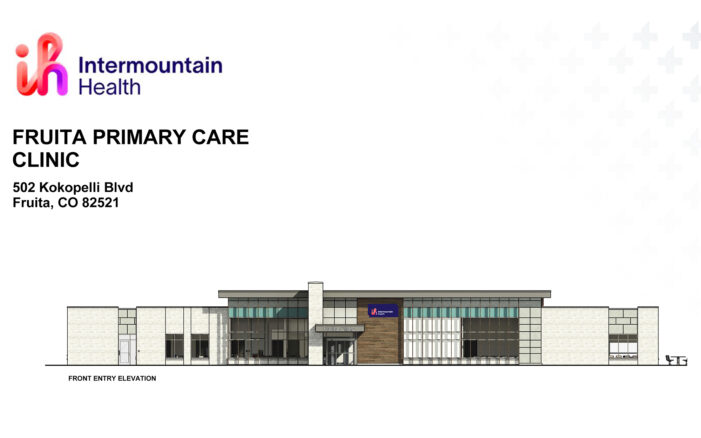
The clinic being constructed during Phase 1 will be 15,500 square feet, and the nearly three-acre property will have 68 parking spaces.
The Fruita Clinic will house eight providers, including four primary-care providers, two dedicated walk-in providers and two rotating specialists. Its rotating specialty services will include obstetrics, general cardiology and orthopedics. The facility will have on-site imaging, including X-ray and ultrasound, and dedicated treatment rooms.
The General Project Report mentioned Intermountain Health’s current plans accommodating a future Phase 2 expansion, and Boyd said when and how the clinic expands depends on the needs of the community.
For the time being, Intermountain Health wants to address primary care, and Boyd said it’s important to reiterate Intermountain regards primary care in high regard.
“Our quality of care that we provide within our primary care is important,” she said, “because we know that if we’re getting people into services within primary care, and we could focus on preventative health screenings, your annual wellness visits, ensuring that you’re getting the colonoscopies and the mammograms and those diagnostic screenings, that we’re going to be preventing and lowering cost of care overall for everyone.
“I think that’s always an important point to make. We’re really proud of the quality of care we provide in our primary-care space and feel that the Fruita community will benefit from those services.”
Starting with that will help Intermountain Health determine which other services the community can benefit from having, and Intermountain can take that into account for its design work for Phase 2.
Boyd said Intermountain’s entrance into the Fruita market is really about “meeting the growth trajectory in the community and complementing with services that aren’t always readily available.
“For example, we know cardiology is an important service for the community members that we’re attracting. That 65-plus population needs those services, and they’re sometimes really hard to get into, and so trying to complement those other specialists coming in is important for us to do.”

MORE TO THE STORY: Intermountain Health targets end of 2027 to open Fruita clinic added by The Business Times Staff on
View all posts by The Business Times Staff →