
Brandon Leuallen, The Business Times
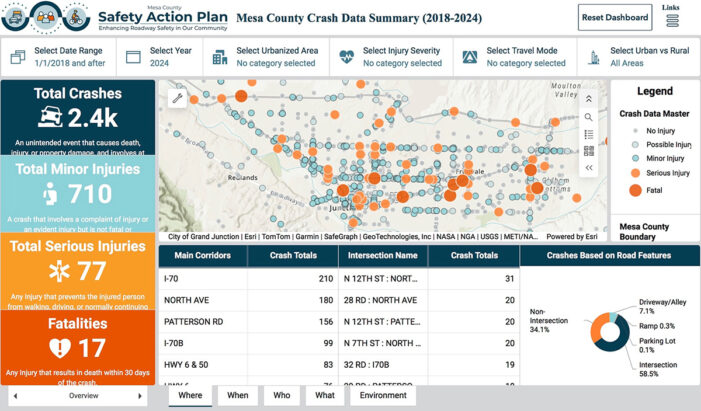
Mesa County has launched a new public crash data dashboard designed to help residents, planners and law enforcement better understand where crashes are occurring, what factors are contributing to them and how future safety improvements may be prioritized.
The interactive dashboard, developed by Mesa County’s Regional Transportation Planning Office using Colorado Department of Transportation crash datasets, allows users to filter crashes by year, severity, location, age group, roadway type, weather conditions and other factors. Users can also zoom into specific corridors, intersections or neighborhoods and analyze trends across the county.
Rachel Peterson, senior transportation planner with Mesa County’s Regional Transportation Planning Office, said the tool grew out of Mesa County’s Safety Action Plan, which was formally adopted in November 2024 after the county received federal-grant funding to study crashes more holistically.
“We wanted to be transparent with our community first and foremost,” Peterson said. “But we also wanted to kind of humanize the data. Sometimes you’ll see just numbers pushed out into the community, and I think this dashboard helps serve as a visual acknowledgement for victims and their families.”
Peterson said the county also hopes the dashboard becomes a practical planning and public-awareness tool.
“It helps inform decisions, and it’s just a really powerful tool for all sorts of things from grant applications to enforcement areas,” she said.
How data is collected, updated
The dashboard compiles crash reports submitted by local law-enforcement agencies through the Colorado Department of Revenue and CDOT. Mesa County then refines and standardizes the data, verifies crashes occurred within county boundaries and organizes the information into a more visual and interactive format than the state dashboard.
“It’s more refined, and visually you can kind of see where those coordinates are and where those crashes actually occurred,” Peterson said.
Peterson said if you get stuck, use the reset button, and you can go back to the beginning.
The dashboard currently contains crash data through 2024 and will soon be updated with the 2025 data. Peterson said there is generally about a six-month lag before yearly crash data is fully processed and released publicly by CDOT.
According to the dashboard, roughly 2,400 crashes occurred within the mapped portion of Mesa County in 2024, including 710 minor injuries, 77 serious injuries and 17 fatalities.
Major corridors and intersections stand out
The data showed that about 30 percent of crashes in 2024 occurred along five major corridors:
- Interstate 70 — 210 crashes.
- North Avenue — 180 crashes.
- Patterson Road — 156 crashes.
- Interstate 70 Business Loop — 99 crashes.
- U.S. Highway 6 and 50 — 83 crashes.
The dashboard also shows intersections account for a majority of crashes. The intersection of 12th Street and North Avenue recorded the highest number of crashes in 2024 with 31, followed by several intersections with about 20 crashes each.
Peterson said the county has identified several high-priority locations through what it calls a “high injury network,” which focuses on roadway segments and intersections with elevated crash rates.
“We narrowed it down to nine locations that were on the high injury network that we could do capital-improvement projects on,” Peterson said.
Most of those locations are within Grand Junction’s urbanized area, she said.
The county plans to use the data to support future grant applications, evaluate capital improvement priorities and guide education and enforcement efforts.
Peterson said Mesa County recently received a Safe Streets and Roads for All federal grant that will help fund new speed feedback signs, public outreach efforts and additional roadway safety analysis.
Impairment, vulnerable road users emerge as major concerns
One of the most significant trends identified through the dashboard involves impaired driving.
Peterson said impairment was a factor in nearly 67 percent of fatal crashes in 2024, compared with about 43 percent the year before.
While impairment-related crashes make up a much smaller share of total crashes overall, Peterson said the concentration within fatal crashes stood out sharply.
The dashboard also highlighted the impact on what transportation planners call “vulnerable road users,” including pedestrians, bicyclists and motorcyclists.
According to Peterson, nearly half of traffic fatalities between 2022 and 2025 involved vulnerable road users, a rate higher than the statewide average. Dashboard data with years 2022, 2023 and 2024 selected shows 13 of those fatalities involved motorcycles, with about 23.1 percent involving impairment and 61.5 percent involving speeding.
Fourteen fatalities involved pedestrians, with roughly 58 percent involving impairment and 25 percent categorized as driver error. Three fatalities involved bicycles or pedal bikes.
Rear-end and broadside crashes were among the most common crash types identified in the dashboard, particularly in urban areas where intersections and congestion create more vehicle-conflict points.
Dashboard includes limitations
Peterson emphasized that while the dashboard offers extensive filtering and mapping capabilities, it does have limitations: Crash locations are approximate; some data may be incomplete; and the “Why” section relies on officer-reported contributing factors rather than definitive legal determinations of fault.
The county also notes the dashboard is intended as a planning and analysis tool rather than a legal record of responsibility.
County hopes dashboard influences driver behavior
Peterson said the county hopes the dashboard will ultimately encourage residents to think more carefully about how their own driving behavior affects roadway safety.
“The big goal of this crash-data dashboard is not just being a tool to check your neighborhood,” Peterson said. “We hope it will foster a shared responsibility mindset where folks start thinking about how their decisions while commuting might impact others.”
She added many crashes reflected in the dashboard were preventable.
“Specific choices while you’re commuting, like speeding or distraction, can have consequences,” Peterson said.

New dashboard details crashes in Mesa County added by The Business Times Staff on
View all posts by The Business Times Staff →