
Brandon Leuallen, The Business Times
Organizational leaders from across Western Colorado gathered at Colorado Mesa University on Sept. 23 for a conference designed to provide the type of high-level training that often requires companies to send employees to larger cities.
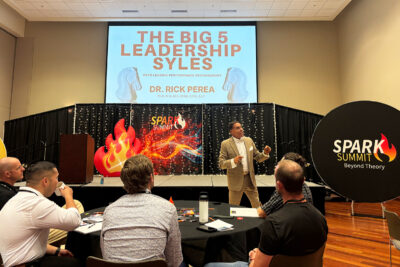
The second annual SPARK Summit brought speakers from across the country to CMU’s Meyer Ballroom for keynote presentations and master classes focused on leadership, executive finance, artificial intelligence, communication, employee development and business growth.
The one-day conference was organized by the C-Suite Initiative, founded by business coaches Kristin Donahue and Bob Bever.
“We created SPARK Summit so that Western Colorado business leaders can come together, ignite the fire of curiosity, fan the flames of innovation, spark new ideas and drive meaningful growth in the business community,” Donahue said.
Donahue and Bever designed the event to give attendees access to experienced practitioners with proven track records working with professional sports teams, hospitals, Fortune 100 and Fortune 500 companies, technology companies and other major organizations.
“We want you guys to have a personal experience with these speakers,” Donahue told attendees. “We want you to get to interact rather than being one of 10,000 in an auditorium.”
Speakers sat with participants, answered questions and spent scheduled periods in an area called the “Playground,” where attendees could approach them for individual conversations. Longer breaks allowed participants to meet speakers and other business leaders. After presentations, attendees identified “SPARK moments,” including ideas they found valuable and changes they planned to make in their organizations.
Lessons from Broncos, Nuggets championships
Performance and organizational psychologist Dr. Rick Perea opened the summit with a high-energy presentation focused on improving performance by concentrating on factors people can control.
Perea has worked with the Denver Broncos, Denver Nuggets, Colorado Rockies and other NFL, NBA and Major League Baseball teams.
Perea distinguished an organization’s immediate climate from the culture it develops over time.
“The climate is right now. It’s today when you walk in that front door,” Perea said. “The culture is over time.”
Using an energy stick and a chain of participants holding hands, Perea demonstrated how one person disconnecting could disrupt the group. He used the exercise to illustrate the importance of cooperation, trust and shared commitment.
Perea also encouraged attendees to distinguish between outcome goals, such as revenue or sales targets, and the daily processes that contribute to those outcomes. He said leaders should focus on preparation, communication, customer contact and other actions they can control.
Perea returned later for a breakout session on five leadership styles: transformational; transactional; referent; charismatic; and autocratic.
He described transformational leaders as people who change an organization’s direction or culture, while transactional leaders turn broader goals into daily operations. Referent leaders influence others through consistent example, and charismatic leaders inspire through communication, passion and vulnerability. Autocratic leadership provides structure and accountability during emergencies, safety concerns and other high-stakes situations.
Perea said effective leaders move among the styles based on the needs of their organizations.
“You can be one of any of these five at any moment,” Perea said.
He also emphasized the relationship between leadership and followership, arguing that strong leaders recognize when others are prepared to lead.
“You must share power,” Perea said. “You must be open and vulnerable with your followers, because you want them to understand they are developing leaders as well.”
Connecting finance with operations
Kelly Johnston, president and CEO of JFS LLC, led an executive-finance breakout titled “Revenue Is Vanity. Cash Is Reality.”
JFS provides accounting, tax planning and financial consulting services, with a particular focus on helping financially distressed hospitals. Johnston said the company works with 23 rural hospitals across the country.
“Accounting and data can be misleading if you don’t use it correctly,” Johnston said.
She used the turnaround of St. Vincent General Hospital District in Leadville to demonstrate how operational decisions and financial information must work together.
Johnston said the hospital had overdrawn its bank account and was approaching payroll without enough money when she became involved. After reconstructing its records, she found the hospital had a $5 million loss and owed vendors $4.2 million, far more than the $300,000 its board believed it owed.
Johnston said the hospital has since reached a $7 million positive bottom line and 152 days of cash on hand. It also rehired employees and is preparing to relaunch surgical services.
“It is doable, but it takes work,” Johnston said.
The same principles apply to smaller companies, she said. Owners must understand the differences among revenue, margins, profit and cash, because a positive income statement does not necessarily mean money is available in the bank.

Equipment purchases, debt payments and owner distributions can reduce cash without appearing on a profit-and-loss statement. Businesses must also account for employee downtime, future hiring, taxes and the cost of replacing an owner who wants to step away from delivering services.
Johnston said finance and operations are often treated as separate functions even though decisions in one directly affect the other.
“Finance can’t operate without operations, and vice versa,” she said. “We tend to try to make them work in silos, which is very ineffective.”
She encouraged owners to classify expenses as unnecessary, profit-producing or replaceable. Unnecessary expenses can be eliminated, replaceable expenses can be reduced or renegotiated, and resources can be directed toward products or services producing the strongest returns.
Johnston also recommended monitoring unpaid invoices and unbilled work. She said JFS once had $390,000 sitting in accounts receivable during a period of rapid growth and identified about $8,000 a month in work that employees performed but did not bill to clients.
Businesses should also evaluate which services they perform best, Johnston said. JFS eliminated or outsourced weaker service lines and concentrated more heavily on health care consulting. She said St. Vincent eliminated eight of its 12 service lines and became more profitable by focusing on work it could perform effectively.
“Money follows culture, quality and really knowing your numbers,” Johnston said.
Multiple tracks offer practical choices
The summit included three keynote presentations and three rounds of master classes.
It offered an artificial-intelligence session during each breakout period, allowing participants interested in AI to follow that track while others selected leadership, finance, communication, marketing or employee-development sessions.
Dr. Elisa Janson Jones demonstrated how businesses can use AI and non-AI tools to turn spoken explanations into documented operating procedures, preserving knowledge that might otherwise be lost when an experienced employee leaves.
Travis Hurst and Cameron Searle of Native GTM discussed building an AI “employee” and reducing time spent on repetitive administrative work.
Other master classes included Denise “DT” Thomas on high-stakes communication, Carl Lubbe on employee development and Ross McDaniel of Fencepost on local-business marketing.
Craig Weber, author of “Conversational Capacity,” delivered the lunch keynote on how leaders and teams can engage in productive conversations when pressure is high or participants disagree.
Thomas closed the summit with a presentation about turning leadership insights into measurable action through intentional leadership, communication and accountability.
A reception following the final keynote provided another opportunity for attendees to connect with speakers and other Western Colorado business leaders.

SPARK Summit brings back high-level training added by The Business Times Staff on
View all posts by The Business Times Staff →